
Complete Pool Water Chemistry Guide - Chlorine, pH & Balance
Quick Answer
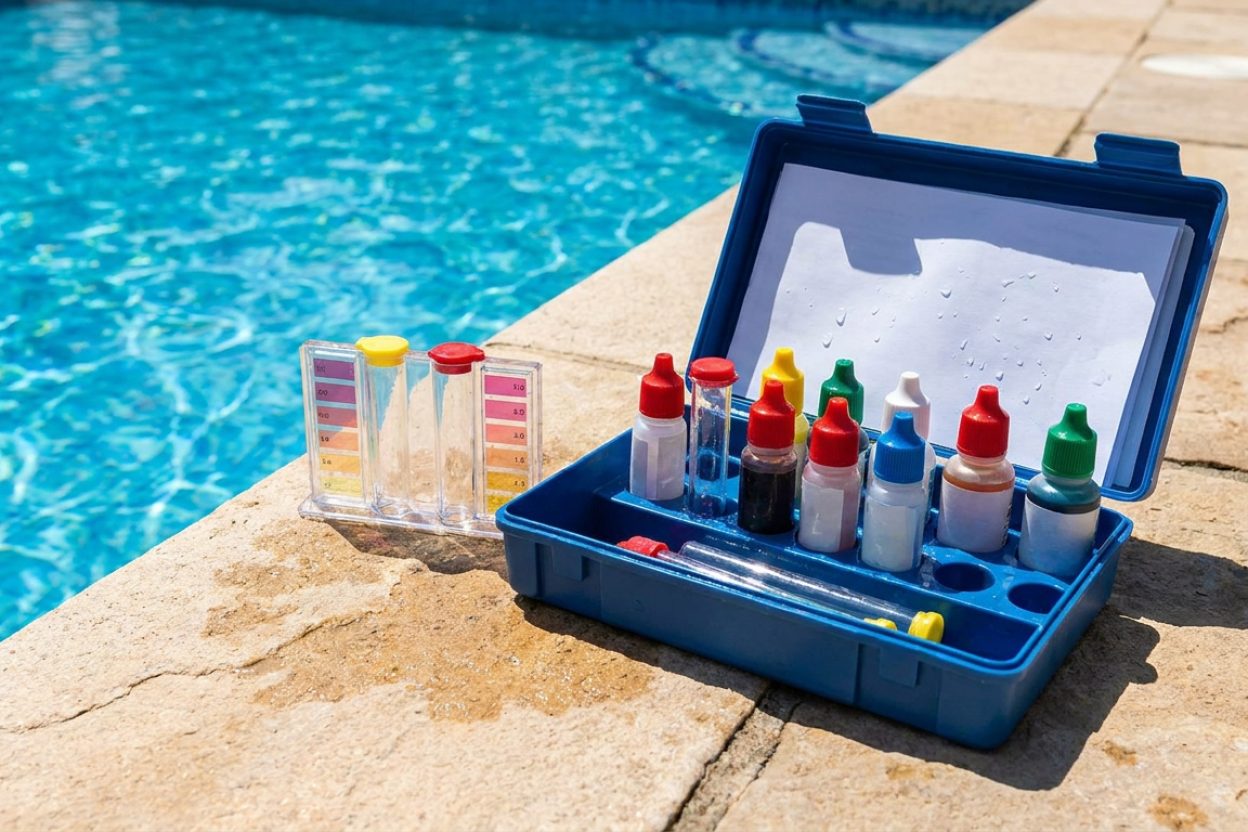
Pool water chemistry means keeping free chlorine scaled to your stabilizer (CYA) level — typically 4-8 ppm for a stabilized outdoor pool — along with pH 7.4-7.6, total alkalinity 60-120 ppm, and calcium hardness 250-350 ppm for plaster. Test 2-3 times a week with a quality FAS-DPD kit like the Taylor K-2006 or TF-100 and dose to your pool volume for safe, clear water.
Quick Overview - Pool Water Chemistry Essentials
That burning sensation in your eyes and the smell of "chlorine" hitting you before you even reach the pool deck is your water chemistry telling you exactly what's wrong. Proper chemical balance protects swimmers from harmful bacteria, prevents equipment damage, and maintains crystal-clear water. The key parameters are:
- Free Chlorine (FCFree Chlorine — The chlorine actively sanitizing your water right now. This is the number you keep an eye on. how much you need →): For a stabilized outdoor pool, scale FC to your CYACyanuric Acid (stabilizer) — Sunscreen for your chlorine — it keeps sunlight from burning it off. The catch: the more you have, the more chlorine you need to keep. learn more → using the chart below — typically 4-8 ppm
- pH: 7.4-7.6 for a balance of comfort, equipment care, and chlorine effectiveness
- Total Alkalinity (TATotal Alkalinity — The buffer that keeps your pH from bouncing around. Get this in range and pH gets a lot easier to manage. learn more →): 60-80ppm for salt water, 80-120ppm for regular pools
- Cyanuric Acid (CYA): 30-50ppm regular outdoor pools, 70-80ppm for outdoor salt water generators
- Calcium Hardness (CH): 250-350ppm for plaster, 175-225ppm for vinyl/fiberglass
Understanding Pool Water Chemistry Fundamentals
The Role of Free Chlorine
Free chlorine is your pool's primary sanitizer, killing bacteria, viruses, and algae. However, the amount of chlorine needed depends heavily on your Cyanuric Acid (CYA) level. This relationship is critical - too little chlorine allows algae growth, while too much wastes money and can irritate swimmers.
Two Standards for Free Chlorine: CDC Baseline vs. the FC/CYA Chart
There are two common reference points for free chlorine, and they do not fully agree.
Federal/CDC guidance sets a flat public-health minimum: at least 1 ppm free chlorine in pools (at least 2 ppm when cyanuric acid stabilizer is used), and at least 3 ppm in hot tubs and spas, with pH around 7.2-7.8. This is the regulatory floor most public pools are held to.
The Trouble Free Pool (TFP) FC/CYAFC/CYA chart — The chart that sets your chlorine target from your stabilizer (CYA) level — the two go together. see the chart → chart goes further, because cyanuric acid binds chlorine and lowers how much is actively sanitizing. The more CYA in your water, the more total free chlorine you need to keep enough active chlorine working — so these run higher than the flat CDC numbers:
- CYA 30 ppm — minimum 2 ppm, target 4-6 ppm (SLAM/shock 12)
- CYA 40 ppm — minimum 3 ppm, target 5-7 ppm (SLAM/shock 16)
- CYA 50 ppm — minimum 4 ppm, target 6-8 ppm (SLAM/shock 20)
- CYA 60 ppm — minimum 5 ppm, target 7-9 ppm (SLAM/shock 24)
- CYA 70 ppm — minimum 5 ppm, target 8-10 ppm (SLAM/shock 28)
- CYA 80 ppm — minimum 6 ppm, target 9-11 ppm (SLAM/shock 31)
The target column is the range to actually hold day to day; the minimum is the point below which you risk losing the pool to algae. The two standards diverge most on a stabilized outdoor pool: once CYA reaches 50 ppm or more, the CDC’s flat 1-2 ppm can be too low to prevent algae, which is why the TFP chart is the more reliable guide for routine maintenance — it is the more protective, real-world standard. That said, the CDC/MAHC figures are the official public-health baseline and what many local health departments enforce for public pools, so treat the TFP targets as the more accurate guide rather than a contradiction. When in doubt, test and keep free chlorine in the TFP target band for your CYA.
Saltwater pools absolutely need cyanuric acid to protect the chlorine generated by the salt cell. Without proper CYA levels, you'll burn through chlorine rapidly and struggle with algae issues.
pH and Its Critical Impact
pH measures how acidic or basic your water is on a scale of 0-14. For pools, the ideal range is 7.4-7.6 because:
- Chlorine is still effective in this range
- Swimmer comfort is optimized
- Equipment corrosion is minimized
- Scaling is prevented
Most pool owners need both pH Up and pH Down chemicals to maintain proper balance. Higher pH shifts chlorine toward its less-active form, but in a CYA-stabilized pool the active chlorine is buffered, so the practical drop is far smaller than the raw HOCl percentages suggest.
When pH is too low (below 7.2), you can experience:
- Equipment corrosion
- Liner damage
- Eye and skin irritation
- Corrosion of metal, plaster, and liner (low pH is aggressive)
To raise pool pH safely, use sodium carbonate (soda ash) for quick increases or sodium bicarbonate for gradual increases that also raise alkalinity.
Total Alkalinity - Your pH Buffer
Alkalinity is absolutely essential because it acts as a pH buffer, preventing rapid pH swings. Target ranges are:
- Regular pools: 80-120ppm
- Salt water pools: 60-80ppm (lower due to pH rise from chlorine generation)
Use sodium bicarbonate (baking soda) to increase alkalinity. Use our all-in-one pool calculator for dosing estimates based on your pool volume.
When adding alkalinity, wait 4-6 hours before shocking to allow proper distribution and avoid temporary pH spikes.
Cyanuric Acid - Chlorine Stabilizer
CYA protects chlorine from UV degradation, but too much over-stabilizes the water, where chlorine becomes much less effective. Without CYA, chlorine dissipates within hours in direct sunlight.
Target levels:
- Regular pools: 30-50ppm
- Salt water generators: 70-80ppm (higher due to increased UV exposure from longer run times)
Testing Your Pool Water Accurately
Choosing the Right Test Kit
Accurate testing is crucial for proper chemical management. The gold standards are:
- Taylor K-2006: Professional-grade kit with FAS-DPDFAS-DPD test — A drop-based test that reads chlorine accurately even at high "shock" levels, where test strips give up. see test kits → chlorine testing
- TF-100: Similar accuracy to K-2006 with more tests included
- Test strips: Convenient but notoriously inaccurate, especially for chlorine
Testing Frequency and Timing
Test your water:
- 2-3 times per week during swimming season
- After heavy rain or high bather loads
- Before and after adding chemicals
- When water appears cloudy or algae is present
Best testing practices:
- Test in shade, not direct sunlight
- Use pool water from elbow depth
- Rinse test cells between tests
- Replace reagents annually
Step-by-Step Water Balancing Procedures
Initial Pool Startup Chemistry
- Fill and circulate: Run pump continuously during startup
- Test baseline levels: FC, pH, TA, CYA, CH
- Add CYA first: Target 50ppm for regular pools, 80ppm for SWGSalt Water Generator — The "salt cell" that makes chlorine from the salt in a saltwater pool. Same chlorine — it just makes its own. pool terms →
- Balance alkalinity: Adjust to proper range for your pool type
- Adjust pH: Aim for 7.4-7.6
- Add calcium hardness: If needed for plaster pools
- Establish chlorine level: Based on your CYA level
Weekly Maintenance Routine
- Test water chemistry (Monday/Wednesday/Friday recommended)
- Adjust chlorine as needed to maintain minimum FC/CYA ratio
- Check pH and adjust if outside 7.4-7.6 range
- Monitor alkalinity weekly, adjust monthly as needed
- Test CYA monthly during season
- Shock weekly or as needed based on combined chlorine levels
You don't necessarily need to shock weekly - it depends on usage, weather conditions, and your current chlorine levels.
Shocking Your Pool (SLAM Process)
SLAMShock Level And Maintain — raise free chlorine to a target based on your CYA and hold it there until the algae is gone. It's a process, not a one-time dose. the SLAM walkthrough → (Shock Level And Maintain) is the most effective method for clearing algae and bacteria:
- Test current levels: FC, pH, CYA, TA
- Lower pH to about 7.2 first: mainly so the pH test stays honest at shock-level chlorine, not because high pH ruins the shock
- Calculate shock level: Use FC/CYA chart to determine target FC
- Add liquid chlorine: Use sodium hypochlorite, not dichlor/trichlor
- Maintain shock level 24/7: Test and add chlorine as needed
- Continue until clear: Pass overnight chlorine loss test
You can shock your pool multiple days in a row if chlorine levels haven't reached proper shock levels.
Chemical Types and Applications
Chlorine Options
- Liquid Chlorine (Sodium Hypochlorite): Best for shocking and routine sanitizing, doesn't add CYA
- Trichlor tablets: Slow-dissolving pucks, add CYA - good for feeders but watch CYA buildup
- Dichlor: Fast-dissolving granular, adds CYA - good for spas, limited pool use
- Cal-Hypo: Granular shock that adds calcium — good when calcium hardness is low; avoid when it is already high (causes scaling). Not surface-type-dependent.
pH Adjusters
- Sodium Carbonate (Soda Ash): Raises pH quickly without affecting alkalinity much
- Sodium Bicarbonate (Baking Soda): Raises both pH and alkalinity gradually
- Muriatic Acid: Lowers both pH and alkalinity
- Dry Acid (Sodium Bisulfate): Safer alternative to muriatic acid
Pool pH increaser can be used in spas since both use the same sodium carbonate chemistry.
Specialty Chemicals
Most pools don't need algaecide if you maintain proper chlorine levels. Algaecide should be considered a backup, not a primary sanitizer.
Phosphate removers are usually unnecessary if you maintain proper chlorine levels. Only consider them if you have persistent algae issues despite good chemistry.
Salt Water Pool Chemistry
Salt water pools still require chemical management, including pH adjusters, alkalinity control, and stabilizer. The salt cell generates chlorine but doesn't maintain balance.
Salt cells use electrolysis to convert dissolved salt into chlorine and hydrogen gas; salt pools drift up in pH over time mainly from aeration (CO2 off-gassing), as the cell itself is roughly pH-neutral.
Key differences for salt water pools:
- Lower alkalinity targets (60-80ppm) due to pH rise
- Higher CYA levels (70-80ppm) needed for longer run times
- Regular pH monitoring due to electrolysis pH rise
- Salt level maintenance (2700-3400ppm typically)
Troubleshooting Common Water Chemistry Issues
Cloudy Water
To clear cloudy water, first test and balance your chemistry, then shock with liquid chlorine to proper FC/CYA ratio. Run the pump continuously until clear.
Common causes:
- Low free chlorine levels
- High pH reducing chlorine effectiveness
- Poor filtration or circulation
- High bather load or contamination
For faster clearing, use a clarifier after balancing chemistry, but never as a substitute for proper sanitizer levels.
Green Water (Algae)
Green pool water can make you sick — mainly because the chlorine has crashed and the water is no longer sanitized:
- Test and adjust pH to 7.4-7.6
- Shock to proper FC/CYA level (usually 10-20ppm FC for green pools)
- Maintain shock level 24/7 until clear
- Brush walls and floor daily
- Clean filter frequently
Pool algae can cause skin irritation, so avoid swimming until water is clear and chemically balanced.
High Combined Chlorine
Combined chlorine (chloramines) causes strong chlorine smell and eye irritation. When combined chlorine exceeds 0.5ppm:
- Shock the pool to break chloramine bonds
- Maintain higher FC levels temporarily
- Ensure proper filtration and circulation
- Check for organic contamination sources
Chemical Interaction Timing
When adding calcium hardness, wait 2-4 hours before shocking to prevent precipitation.
You can vacuum after adding most chemicals, but wait 15-30 minutes for liquid chemicals to distribute.
Seasonal Chemistry Management
Opening Your Pool
- Remove winter cover and clean
- Reconnect equipment and start circulation
- Test all parameters - expect imbalances after winter
- Shock heavily if water is green or cloudy
- Balance alkalinity and pH first
- Establish proper chlorine levels
- Monitor daily until stable
Closing Your Pool
Whether you need to winterize depends on your climate - areas with freezing temperatures require full winterization.
A properly winterized pool can stay closed for 6-8 months safely with proper chemical treatment.
- Balance all chemistry parameters
- Shock and super-chlorinate
- Add winter algaecide if desired
- Lower water level (varies by cover type)
- Add winterizing chemicals
- Cover securely
Equipment Impact on Chemistry
Filtration Systems
Different filter types affect chemistry management:
- Sand filters: Require regular backwashing, sand type matters for effectiveness
- Cartridge filters: Cannot be backwashed, require physical cleaning
- DE filters: Need regular backwashing every 4-6 weeks
Filter replacement timing varies: cartridge elements last 2-5 years, sand filter media 5-7 years, and DE grids 5-10 years with proper cleaning.
Pump Operation
Most pools need 8-12 hours of daily pump operation for proper chemical distribution and filtration.
Running your filter continuously is beneficial for water clarity and chemical effectiveness, especially during treatment periods.
When to Call a Professional
Contact a pool professional when:
- Chemistry consistently won't balance despite proper procedures
- Equipment malfunctions affect chemical distribution
- Water testing shows unusual or extreme readings
- Persistent algae or clarity issues after proper treatment
- You're uncomfortable handling strong chemicals safely
- Major equipment repairs or replacements are needed
Signs you need a new pump include loud grinding or humming, bearing failure, shaft-seal leaks, or repeated breaker trips — not age alone, since well-maintained pumps often run 15+ years and are often rebuildable.
Professional services typically include:
- Comprehensive water testing and analysis
- Equipment inspection and maintenance
- Chemical adjustment and balancing
- Troubleshooting persistent problems
- Seasonal opening and closing services
Safety Considerations
Essential safety practices:
- Wear protective equipment when handling chemicals
- Read and follow all manufacturer instructions
- Store chemicals separately to prevent reactions
- Keep chemicals away from heat sources
- Have fresh water available for emergency rinsing
- Never smoke around pool chemicals
If you must shock without running the filter, ensure proper circulation through manual mixing and wait for complete distribution before swimming.
Frequently Asked Questions
How often should I test my pool water?
Test 2-3 times per week during swimming season, and after heavy use, rain, or when adding chemicals. During off-season or low-use periods, weekly testing is usually sufficient.
Can I swim immediately after adding chemicals?
It depends on the chemical. Most liquid chemicals allow swimming after 15-30 minutes of circulation. Granular chemicals may require 1-2 hours. Always test to ensure levels are in safe ranges before swimming.
Why does my pool keep turning green despite adding chlorine?
This usually indicates insufficient free chlorine for your CYA level, or pH that's too high reducing chlorine effectiveness. Test both FC and CYA levels, and ensure pH is below 7.6.
How much does proper pool chemistry cost monthly?
Typical monthly chemical costs range from $30-80 depending on pool size, usage, and local chemical prices. Proper maintenance actually saves money by preventing costly problems.
How do I lower chlorine that's too high?
Stop adding chlorine and let it naturally dissipate over 24-48 hours, or add sodium thiosulfate for immediate reduction.
Related Pool Maintenance Guides
For comprehensive pool care, also reference these essential guides:
- Complete pool cleaning equipment guide - choosing the right vacuum system
- DIY pool liner installation - replacing liners affects chemistry startup
- Variable speed pump operation - optimizing circulation for chemical effectiveness
- Fiberglass pool leak detection - leaks affect chemical balance
- Above ground pool installation - proper setup ensures good chemistry management
Mastering pool water chemistry takes time and practice, but following these guidelines will ensure safe, clear, and enjoyable swimming water year-round. Remember that consistent testing and gradual adjustments are more effective than dramatic chemical swings.
Still need help? Ask a Pool & Spa Expert AD
Get a personalized answer from PoolGuy810 — 30 years owning a pool and spa repair company. Describe your issue and get step-by-step help.
Related Pool Guides
Need More Help?
Try our free pool calculators and tools to help diagnose and fix your pool problems.
Browse Pool ToolsSLAM calculator, pH calculator, salt dosing & more