
How to Lower Pool Chlorine Levels: 5 Proven Methods

Safe ways to bring down high chlorine before kids can swim again?
Read full question
Between my overzealous shock treatment last weekend and this week's hot weather, my pool's chlorine levels have skyrocketed beyond what's safe for the kids. They keep asking when they can get back in the pool, but I can smell the strong chemical odor and I know that's not good.
What are the safest and most effective ways to lower chlorine levels quickly? I've heard about just waiting it out, but I'm wondering if there are faster methods that won't harm the water quality. I want to make sure the pool is completely safe before I let them back in.
Quick Answer
You rarely need to drain a pool to lower chlorine — stop adding it, uncover the pool, and let the sun burn it off (it's safe to swim up to about 10 ppm). To drop it faster, use a reducing agent: hydrogen peroxide, ascorbic acid (vitamin C), or sodium thiosulfate.
First, is it actually too high?
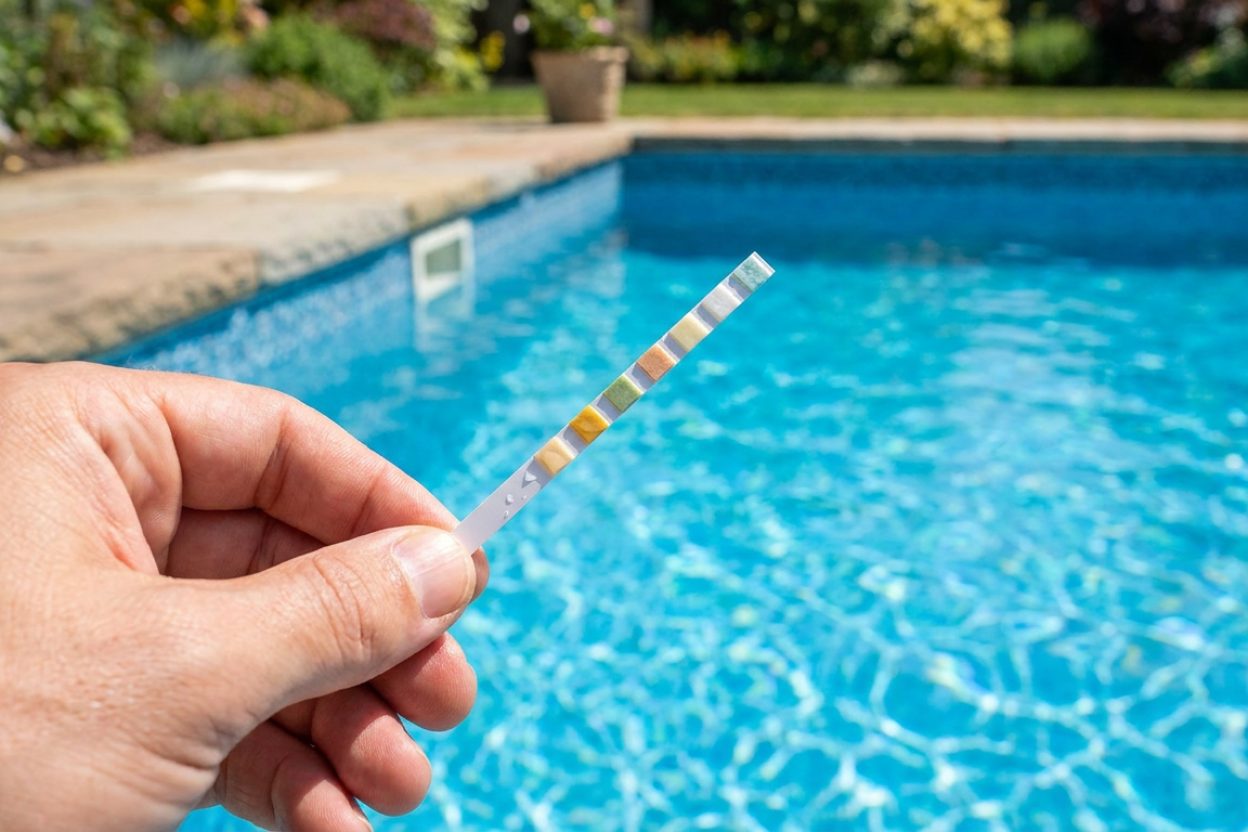
"Too high" depends on your cyanuric acid (CYACyanuric Acid (stabilizer) — Sunscreen for your chlorine — it keeps sunlight from burning it off. The catch: the more you have, the more chlorine you need to keep. learn more →). For everyday swimming, free chlorine should sit at roughly 7–15% of your CYA (so CYA 40 → about 4-6 ppm), and it's still safe to swim up to about 10 ppm regardless. If your kit reads 6–8 ppm, you may not need to do anything at all. Confirm with a good test (Taylor K-2006 or a quality FAS-DPDFAS-DPD test — A drop-based test that reads chlorine accurately even at high "shock" levels, where test strips give up. see test kits → kit) before treating — strips read high and erratic at elevated chlorine.
Method 1: Let the sun do it (best for most people)
The level usually spiked from a heavy dose or shock, and it falls on its own:
- Stop all chlorine — turn off the salt generator, pull tablets and floaters, skip the next dose.
- Uncover the pool and run the pump — UV burns off free chlorine; a sunny day can drop several ppm.
- Retest in a few hours. Most "too-high" readings are back in range by the next day. Lower-CYA water clears even faster in sun.
Method 2: Hydrogen peroxide (fast, cheap, swim-friendly)
Hydrogen peroxide reacts with chlorine and neutralizes it almost immediately — it's a legitimate, widely used method, not a hazard.
- Use pool- or food-grade peroxide (27–35%), not the 3% drugstore bottle (you'd need gallons of the weak stuff).
- Add a small amount with the pump running, wait 20–30 minutes, and retest. Start low — it's easy to take chlorine to zero.
- Handle concentrated peroxide carefully (gloves and eye protection), and recheck pH afterward.
One caveat: peroxide keeps consuming chlorine until it's used up, so don't add it right before you want the pool sanitizing again.
Method 3: Ascorbic acid (vitamin C)
Ascorbic acid is a mild reducing agent — the same inexpensive powder used to lift metal stains — and it pulls free chlorine down quickly.
- Sprinkle a modest amount over the water with the pump running.
- Retest after 15–20 minutes and repeat in small steps if needed.
- It can nudge pH down a little, so recheck pH when you're done.
Method 4: Sodium thiosulfate (chlorine neutralizer)
The classic "chlorine reducer" sold at pool stores (also known as photographer's hypo). It works in minutes.
- Roughly 2 oz per 10,000 gallons lowers free chlorine about 1 ppm, but products vary — follow the label.
- Dissolve in a bucket of pool water, then add it around the perimeter with the pump running.
- Wait about 30 minutes and retest. It overshoots easily — add conservatively or you'll land at zero, and it can pull down pH and alkalinity.
What about draining the pool?
Skip it. Replacing water does dilute chlorine, but it wastes hundreds of gallons, throws off your CYA, pH, and hardness, and is wildly overkill for something the sun fixes for free. Partial drainage only makes sense if your CYA is also far too high — and even then it's about the stabilizer, not the chlorine.
A couple of things not to do
- Don't shock it. Shocking adds chlorine — the opposite of what you want.
- Don't panic about swimming. Up to ~10 ppm is fine; aim to stay at or above your CYA-based minimum rather than chasing a low number.
- Go slow with any reducer. Hydrogen peroxide, vitamin C, and thiosulfate can all take you straight to zero — add a little, then retest.
After it's down, rebalance
- pH 7.4–7.6 (reducers can pull it down).
- Free chlorine back up to your CYA-based target so the pool stays sanitized.
- Total alkalinity 60–120 ppm.
For safe chlorine targets by CYA level, see our all-in-one pool calculator.
 Taylor K-2006C Complete FAS-DPD Pool & Spa Test Kit
The FAS-DPD kit pool pros trust — reads chlorine accurately even at shock/SLAM levels, plus pH, alkalinity, calcium hardness and CYA. View on Amazon →
Taylor K-2006C Complete FAS-DPD Pool & Spa Test Kit
The FAS-DPD kit pool pros trust — reads chlorine accurately even at shock/SLAM levels, plus pH, alkalinity, calcium hardness and CYA. View on Amazon →
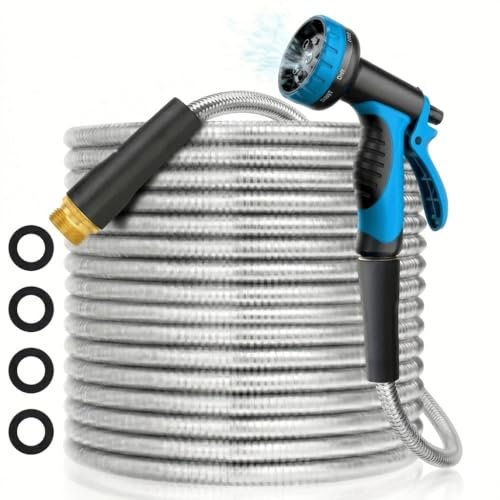 50 ft Flexible Metal Garden Hose (Kink-Free)
Durable hose for filling, priming, and rinsing equipment. View on Amazon →
50 ft Flexible Metal Garden Hose (Kink-Free)
Durable hose for filling, priming, and rinsing equipment. View on Amazon →
Still need help? Ask a Pool & Spa Expert AD
Get a personalized answer from PoolGuy810 — 30 years owning a pool and spa repair company. Describe your issue and get step-by-step help.
Related Pool Guides
Need More Help?
Try our free pool calculators and tools to help diagnose and fix your pool problems.
Browse Pool ToolsSLAM calculator, pH calculator, salt dosing & more