
Does Pool Stabilizer Evaporate? CYA Levels Explained

Does cyanuric acid evaporate from pool water or stay in solution?
Read full question
Woke up determined to finally understand pool chemistry, but now I'm standing in the pool store aisle staring at bottles of cyanuric acid and chlorine stabilizer with no clue which one I actually need. I know chlorine evaporates and needs constant replenishment, but I'm unclear about what happens to stabilizer over time.
Specifically, does CYA evaporate from the pool like chlorine does, or does it remain in solution indefinitely? If it doesn't evaporate, what are the actual mechanisms for removing excess stabilizer when levels get too high? I need to understand this for proper water balance management.
Quick Answer
Pool stabilizer (cyanuric acid/CYA) does not evaporate. Unlike chlorine, it leaves the water only very slowly — bacteria break it down a few percent a month — so in practice it stays until you dilute it out with a partial drain-and-refill or reverse osmosis. Add it about once a season: ~13 oz of granular CYA per 10,000 gallons raises it 10 ppm. Dissolve fully in a bucket of hot water or use the sock method first; avoid pouring undissolved CYA through the skimmer.
Diagnosing Your Stabilizer Situation
First, let's diagnose what's happening with your pool stabilizer levels. Many pool owners assume their stabilizer disappears like chlorine does, but the reality is quite different. If you've been adding stabilizer regularly thinking it evaporates, you likely have dangerously high CYACyanuric Acid (stabilizer) — Sunscreen for your chlorine — it keeps sunlight from burning it off. The catch: the more you have, the more chlorine you need to keep. learn more → levels that are making your chlorine ineffective.
Test Your Current CYA Level
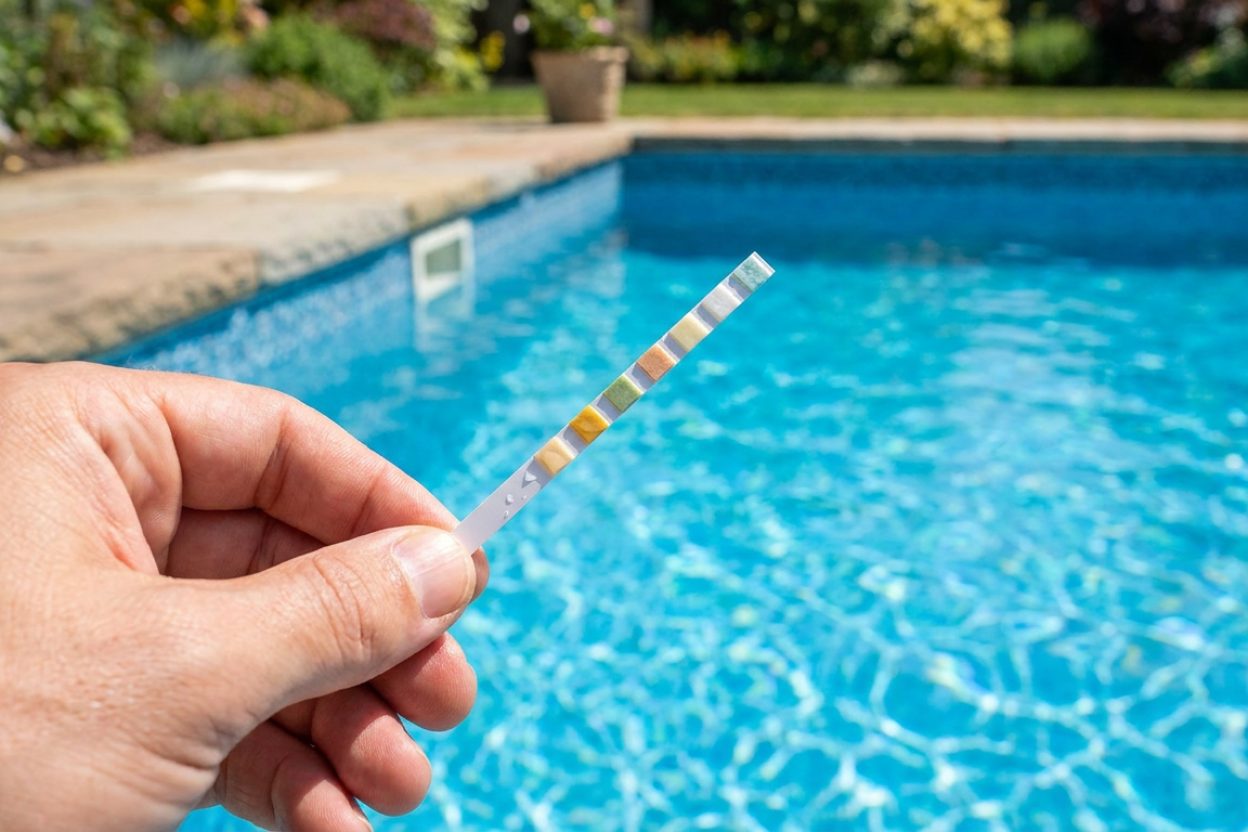
Before making any adjustments, you need to know your exact cyanuric acid level. Use a reliable test method like the Taylor K-2006C test kit turbidity test or CYA test strips. The ideal range is 30-50 ppm for traditional chlorine pools and 70-80 ppm for salt water generator pools.
Why Stabilizer Doesn't Evaporate
Understanding the chemistry helps explain why stabilizer behaves so differently from chlorine. Cyanuric acid forms a protective bond with free chlorine molecules, creating chlorinated cyanurates (stabilized chlorine compounds) that resist UV degradation. This bond is fairly stable, and CYA itself breaks down only very slowly - a few percent per month - so it effectively accumulates faster than it leaves.
What Actually Happens to Stabilizer
Since stabilizer doesn't evaporate, it accumulates in your pool water over time. Every time you add stabilized chlorine products (dichlor, trichlor, or stabilizer directly), you're increasing your CYA level permanently. This is why many pools end up with CYA levels above 100 ppm, rendering chlorine nearly useless.
How Stabilizer Levels Actually Change
The Main Ways CYA Decreases
- Dilution through water replacement: When you drain and refill portions of your pool
- Backwashing: Sand and DE filters remove small amounts during backwashing
- Splash-out and overflow: Water lost through swimming and rain overflow
- Winter closing: If you drain water below the skimmer level
- Very slow natural breakdown: Bacteria break CYA down gradually \xe2\x80\x94 only about 3% per month on average, so it can't be relied on to lower high levels
Calculating Your Dilution Needs
If your CYA is above 50 ppm (or 80 ppm for SWGSalt Water Generator — The "salt cell" that makes chlorine from the salt in a saltwater pool. Same chlorine — it just makes its own. pool terms →), you'll need to dilute. a handy way to calculate the amount of water to replace is by using our all-in-one pool calculator. Alternatively, you can do it by hand using the formula: (Current CYA - Target CYA) ÷ Current CYA = Percentage of water to replace. For example, if your CYA is 100 ppm and you want 50 ppm: (100-50) ÷ 100 = 50% water replacement needed.
Proper Stabilizer Management
Add Stabilizer Only When Needed
Most pools need stabilizer added only once per season. Dissolve as much as you can in a bucket of hot water first (CYA is only sparingly soluble, so it won't fully dissolve - pour the slurry and granules in too), or use the SOCK method (put the CYA in a sock/nylon in the skimmer basket, or hang it in front of a return, squeezing occasionally). Avoid adding through the skimmer as undissolved CYA can damage equipment. Retest after 24-48 hours of circulation.
Choose Your Chlorine Products Wisely
To prevent over-stabilization, use liquid chlorine (sodium hypochlorite) for regular sanitizing and shock treatments. Save stabilized chlorine products for specific situations or use them sparingly. Cal-hypo shock is another good option that doesn't add CYA.
Troubleshooting High Stabilizer Problems
If you discover your CYA is too high, you'll notice these symptoms:
- Chlorine requires much higher levels to work effectively
- You're adding more and more chlorine with little effect
- Pool stays cloudy or develops algae despite high chlorine readings
- Your free chlorine to CYA ratio is below proper levels
The FC/CYA Relationship
High stabilizer levels require proportionally higher chlorine levels. With CYA at 80 ppm, you need at least 6 ppm free chlorine for basic sanitation. This becomes expensive and impractical, which is why maintaining proper CYA levels is crucial.
Prevention and Long-term Strategy
The best approach is preventing over-stabilization from the start. Test CYA monthly during pool season and annually before opening. Keep detailed records of what products you add, as many contain hidden stabilizer.
Safety warning: Never add cyanuric acid directly to pool water in large quantities. It dissolves slowly, so it can sit on surfaces or in the skimmer if not handled carefully; cyanuric acid is only a weak acid, though, so it doesn't cause dangerous pH swings.
When to Seek Professional Help
If your CYA is extremely high (over 150 ppm) or you're struggling with persistent algae problems, consider professional water testing and treatment. Sometimes a complete drain and refill is the most cost-effective solution.
For the full breakdown of safe chlorine levels by CYA level, see our pool water chemistry guide.

Still need help? Ask a Pool & Spa Expert AD
Get a personalized answer from PoolGuy810 — 30 years owning a pool and spa repair company. Describe your issue and get step-by-step help.
Related Pool Guides
Need More Help?
Try our free pool calculators and tools to help diagnose and fix your pool problems.
Browse Pool ToolsSLAM calculator, pH calculator, salt dosing & more