
How Long After Adding Chlorine Can You Swim? Safe Wait Times

New pool owner - how long to wait after adding chlorine?
Read full question
About an hour after that crazy thunderstorm hit, I finally got around to shocking my pool but now I'm completely lost on how long before the kids can jump back in. The pool store told me I need to add chlorine regularly, but they didn't really explain how long I need to wait before it's safe to swim again.
I'm using liquid chlorine for regular maintenance, but I also bought some shock treatment for when the water gets cloudy. Do I need to wait different amounts of time depending on which one I use? I don't want to mess this up and make anyone sick, so any guidance would be really helpful!
Quick Answer
Wait times depend on chlorine type and amount added. For liquid chlorine at normal doses, wait 15-30 minutes. For shock treatments, wait until free chlorine drops back under about 10 ppm (often several hours to a day, depending on the dose).
First, Let's Diagnose What Type of Chlorine Addition You Made
Before determining your safe swim time, we need to identify exactly what chlorine product you added and how much. This directly impacts how long you'll wait:
Regular Maintenance Chlorinating
If you added liquid chlorine (sodium hypochlorite) for daily maintenance to maintain proper free chlorine for your CYACyanuric Acid (stabilizer) — Sunscreen for your chlorine — it keeps sunlight from burning it off. The catch: the more you have, the more chlorine you need to keep. learn more → level (your target scales with CYA — see the FC/CYAFC/CYA chart — The chart that sets your chlorine target from your stabilizer (CYA) level — the two go together. see the chart → chart; 5-7.5% of CYA is the bare minimum, not the everyday target), the wait time is minimal. Most pool professionals recommend waiting just 15-30 minutes for proper circulation, then testing to confirm levels are appropriate for your stabilizer level.
Shock Treatment (SLAM Process)
If you're shocking your pool or performing a SLAMShock Level And Maintain — raise free chlorine to a target based on your CYA and hold it there until the algae is gone. It's a process, not a one-time dose. the SLAM walkthrough → (Shock Level And Maintain) process for algae or contamination, you've likely added much higher amounts. Your free chlorine might be 10-20+ ppm, requiring much longer wait times.
Cal-Hypo or Dichlor Shock
Calcium hypochlorite or dichlor shock products from pool stores typically require longer wait times due to their concentrated nature and additional chemicals.
Step-by-Step Solutions for Each Scenario
Scenario 1: Regular Liquid Chlorine Maintenance
- Run your pump for at least 15-30 minutes after adding liquid chlorine to ensure complete circulation and mixing
- Test free chlorine levels using a reliable test kit like the Taylor K-2006 or comparable digital tester
- Verify levels are appropriate for your CYA - within the FC/CYA target range for your stabilizer (e.g., CYA 40 = about 5-7 ppm FCFree Chlorine — The chlorine actively sanitizing your water right now. This is the number you keep an eye on. how much you need →, CYA 70 = about 8-10 ppm FC); the 7.5%-of-CYA figure is your minimum FC, not your everyday target
- Check pH levels - ensure pH is between 7.2-7.8 for swimmer comfort and chlorine effectiveness
- Enter the pool safely once levels are confirmed in range
Scenario 2: Shock Treatment Recovery
- Wait minimum 8 hours after shocking, preferably overnight, before testing chlorine levels
- Test free chlorine every 2-4 hours until you can clearly see the bottom and main drain
- Continue monitoring - chlorine levels should naturally decline through UV breakdown and normal consumption
- Don't swim until water is clear - you need to be able to see a swimmer in distress at the bottom
- Consider your CYA levels - if cyanuric acid is 30-50 ppm, chlorine will last longer and take more time to dissipate
Scenario 3: Cal-Hypo or Store-Bought Shock
- Wait 24 hours minimum and test before swimming - these granular products spike FC well above maintenance levels, so wait until free chlorine drops below about 10 ppm (often 8-24 hours)
- Brush pool surfaces if you notice any undissolved granules, which can cause bleaching or irritation
- Test multiple parameters - check FC, pH, and calcium hardness as cal-hypo raises calcium levels
- Ensure complete dissolution - any visible particles must be fully dissolved before swimming
Critical Testing and Safety Protocols
Never guess about chlorine levels - always test before allowing swimming. Here's your testing protocol:
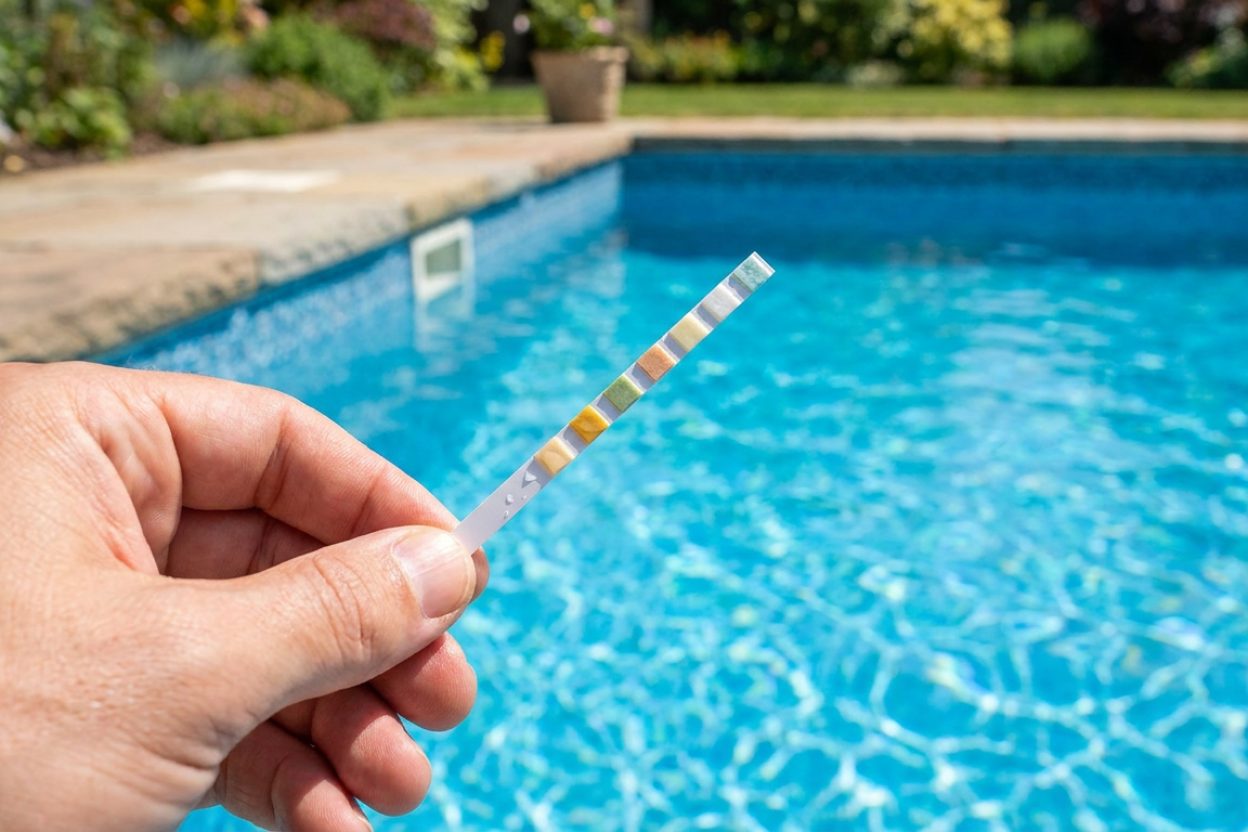
- Use a reliable test method: Taylor K-2006 test kit, digital colorimeter, or quality test strips
- Test at the opposite end from where you added chemicals to ensure even distribution
- Take samples 18 inches below surface away from return jets for accurate readings
- Record your results to track patterns and improve future dosing accuracy
Factors That Affect Wait Times
Pool Size and Circulation
Larger pools take longer to achieve even chemical distribution. A 20,000-gallon pool needs more circulation time than a 10,000-gallon pool. Ensure your pump runs long enough to turn over the entire volume.
Cyanuric Acid (CYA) Levels
Higher CYA levels (above 50 ppm) protect chlorine from UV degradation, meaning chlorine levels will remain elevated longer. Pools with low or no CYA will see chlorine dissipate more quickly in sunlight.
Water Temperature and Sun Exposure
Hot, sunny conditions accelerate chlorine breakdown, while cool, overcast conditions or nighttime additions result in slower chlorine dissipation.
Bather Load and Contamination
If you're shocking due to heavy bather loads, algae, or contamination events, maintain higher chlorine levels longer as part of the SLAM process until water clears completely.
Common Mistakes to Avoid
- Swimming too soon after shocking: High chlorine levels cause skin and eye irritation
- Not running circulation: Poor mixing creates chlorine hot spots that can bleach swimsuits
- Adding chlorine with swimmers present: Never add chemicals while people are in the pool
- Ignoring pH levels: High pH reduces chlorine effectiveness and increases required wait times
- Using pool store "shock" products unnecessarily: Liquid chlorine is more predictable and cost-effective
Prevention Tips for Faster Future Swims
Maintain consistent daily chlorination to avoid large shock treatments. Add liquid chlorine in the evening to allow overnight circulation and natural UV breakdown by morning. Keep CYA levels in the 30-50 ppm range for optimal chlorine efficiency without extended wait times.
Safety Warning: Never enter a pool immediately after adding any chemicals. Always test first, and when in doubt, wait longer. Skin and eye irritation from high chlorine exposure can be serious and take days to resolve.
For the full breakdown of safe chlorine levels by CYA level, see our pool water chemistry guide.

Still need help? Ask a Pool & Spa Expert AD
Get a personalized answer from PoolGuy810 — 30 years owning a pool and spa repair company. Describe your issue and get step-by-step help.
Related Pool Guides
Need More Help?
Try our free pool calculators and tools to help diagnose and fix your pool problems.
Browse Pool ToolsSLAM calculator, pH calculator, salt dosing & more