
How to Fix Pool Stabilizer Level: Complete CYA Guide

What's the correct procedure for adjusting pool CYA levels?
Read full question
Nobody warned me I'd walk out this morning to find my pool showing a 28 ppm CYA reading that has me completely baffled about what to do next.
For low stabilizer situations, what's the exact amount of cyanuric acid needed per gallon of pool water to achieve specific ppm increases? Additionally, I've read that high CYA levels present different challenges - what are the recommended approaches when levels exceed acceptable thresholds? I need reliable technical guidance for both scenarios to maintain proper water chemistry balance.
Quick Answer
To fix low stabilizer, add cyanuric acid at 1 pound per 10,000 gallons to raise CYA by 13ppm. For high levels over 80ppm, partially drain and refill your pool, as there's no chemical way to lower stabilizer. Pre-dissolve CYA in a bucket of hot water or use the sock method, and avoid broadcasting dry granules onto the pool floor.
Quick Solution
Low Stabilizer (under 30ppm): Add cyanuric acid granules at 1 pound per 10,000 gallons to raise levels by 13ppm. High Stabilizer (over 80ppm): Drain 1/3 to 1/2 of your pool water and refill with fresh water - there's no chemical way to lower CYACyanuric Acid (stabilizer) — Sunscreen for your chlorine — it keeps sunlight from burning it off. The catch: the more you have, the more chlorine you need to keep. learn more → levels.
Understanding Your Stabilizer Problem
Pool stabilizer, also called cyanuric acid (CYA), protects your chlorine from being destroyed by UV rays. The ideal range is 30-50ppm for traditional chlorine pools and 70-80ppm for salt water generators. Problems arise when levels drift outside these ranges, making your chlorine either ineffective or requiring dangerously high amounts.
Fixing Low Stabilizer Levels
How Much to Add
For a quick estimate, use our all-in-one pool calculator to estimate how much to add based on your pool size and current vs. target CYA levels.
As a rule of thumb, about 1 pound of cyanuric acid per 10,000 gallons raises CYA by roughly 13 ppm. The exact amount varies with your pool size and the product, so treat it as a starting point, add gradually, and re-test as you go.
Application Method
- Test current CYA levels using a Taylor K-2006 test kit or the CYA test portion of comprehensive test kits for accuracy
- Use the calculator above to size the dose for your pool volume
- Pre-dissolve the cyanuric acid in a bucket of hot water and pour it in slowly - it's only sparingly soluble, so pour the granules in too - OR use the sock method - put the granules in a sock or nylon in the skimmer basket (or hang it in front of a return) and squeeze it now and then. Never broadcast dry granules onto the pool floor - they are slow to dissolve and mildly acidic, so sitting granules can mar plaster
- Run your filtration system continuously; granular CYA dissolves slowly and can take several days (up to a week) to fully dissolve and register
- Retest CYA levels after several days (up to a week) - cyanuric acid dissolves very slowly
- Adjust your free chlorine target based on new CYA levels using the FC/CYAFC/CYA chart — The chart that sets your chlorine target from your stabilizer (CYA) level — the two go together. see the chart → relationship — our all-in-one pool calculator estimates the free chlorine target for your CYA.
Important: Cyanuric acid is very slow to dissolve and can take up to a week to fully register on tests. Be patient and avoid adding more until you're certain of the current level.
Fixing High Stabilizer Levels
Unfortunately, there's no chemical way to lower cyanuric acid levels. Your only options are dilution through water replacement.
Partial Drain Method
- Test and record current CYA levels
- Lower CYA by replacing some water; our all-in-one pool calculator works out how much to drain based on your pool size and current vs. target CYA levels.
- Drain the calculated percentage of water from your pool
- Refill with fresh water
- Run circulation system for 24 hours to mix thoroughly
- Retest all chemical parameters and rebalance
When to Consider Full Drain
If your CYA exceeds 100ppm, a complete drain and refill may be more practical than multiple partial drains. This is especially true if you have other water balance issues like high total dissolved solids (TDS).
Adjusting Chlorine After Stabilizer Changes
Once you've corrected your stabilizer levels, you must adjust your free chlorine targets accordingly. Use these standardized FCFree Chlorine — The chlorine actively sanitizing your water right now. This is the number you keep an eye on. how much you need → target ranges based on CYA:
- CYA 30-50ppm: FC 4-6 ppm
- CYA 60-80ppm: FC 6-8 ppm
- Salt/SWG pool, CYA 70-80ppm: FC 6-8 ppm (fine to run near 6; never below ~5)
Prevention and Maintenance
Test CYA levels monthly during swimming season and after adding any stabilized chlorine products. Trichlor tablets and dichlor shock both contain cyanuric acid and will gradually raise your levels. Consider switching to liquid chlorine (sodium hypochlorite) for regular sanitizing to avoid CYA buildup.
Common Mistakes to Avoid
- Never broadcast dry cyanuric acid onto the pool floor - pre-dissolve it in a bucket or use the sock method
- Don't retest CYA for at least 48 hours after adding - it needs time to dissolve completely
- Avoid using stabilized chlorine products when CYA is already above 50ppm
- Don't ignore high CYA thinking more chlorine will solve algae problems - it won't work effectively
Safety Warning: When handling cyanuric acid, wear protective equipment including gloves and eye protection. The granules can be irritating to skin and eyes.
For the full breakdown of safe chlorine levels by CYA level, see our pool water chemistry guide.
 Taylor K-2006C Complete FAS-DPD Pool & Spa Test Kit
The FAS-DPD kit pool pros trust — reads chlorine accurately even at shock/SLAM levels, plus pH, alkalinity, calcium hardness and CYA. View on Amazon →
Taylor K-2006C Complete FAS-DPD Pool & Spa Test Kit
The FAS-DPD kit pool pros trust — reads chlorine accurately even at shock/SLAM levels, plus pH, alkalinity, calcium hardness and CYA. View on Amazon →
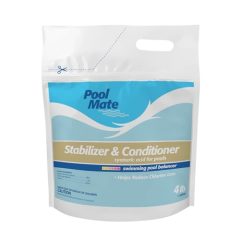 Pool Mate 4-Pounds Premium Pool Stabilizer and Conditioner, Concentrated Cyanuric Acid for Pools, Helps Chlorine Last Longer
View on Amazon →
Pool Mate 4-Pounds Premium Pool Stabilizer and Conditioner, Concentrated Cyanuric Acid for Pools, Helps Chlorine Last Longer
View on Amazon →
 50 ft Flexible Metal Garden Hose (Kink-Free)
Durable hose for filling, priming, and rinsing equipment. View on Amazon →
50 ft Flexible Metal Garden Hose (Kink-Free)
Durable hose for filling, priming, and rinsing equipment. View on Amazon →
Still need help? Ask a Pool & Spa Expert AD
Get a personalized answer from PoolGuy810 — 30 years owning a pool and spa repair company. Describe your issue and get step-by-step help.
Related Pool Guides
Need More Help?
Try our free pool calculators and tools to help diagnose and fix your pool problems.
Browse Pool ToolsSLAM calculator, pH calculator, salt dosing & more