

Can I Shock Pool After Adding Calcium? Safe Timing Guide

Safe to shock pool right after adding calcium hardness increaser?
Read full question
This is 11 PM and I just dumped calcium into my pool but now realize I need to shock it — can I do both tonight or will I completely wreck my water chemistry?
I just added calcium hardness increaser to bring my levels up, and now I need to shock the pool too. The pool store guy said I need to wait but couldn't give me a straight answer on how long. Can I add the shock right away or do I need to wait between adding these chemicals? I'm trying to get this done in one trip instead of paying them to come back again.
Quick Answer
Yes, you can shock your pool after adding calcium hardness increaser. Wait 15-30 minutes for the calcium to fully circulate and dissolve before adding shock to ensure even distribution. Calcium and chlorine do not chemically interact, so there is no need to wait 2-4 hours.
Safe Timing Protocol for Adding Shock After Calcium
The key to successfully combining these chemicals lies in proper sequencing and patience. Calcium hardness increaser (calcium chloride) needs time to fully dissolve and distribute evenly before introducing shock, which is typically calcium hypochlorite or sodium hypochlorite.
Step-by-Step Timing Guide
- Add calcium hardness increaser first - Dissolve in a bucket of pool water if using granular form, then pour around the pool perimeter with pump running
- Run circulation system continuously - Keep your pump and filter running for at least 15-30 minutes to ensure distribution
- Test calcium hardness levels - Use a reliable test kit like the Taylor K-2006 to verify your calcium hardness is within the target range of 250-350 ppm for plaster pools
- Wait for complete dissolution - Look for any remaining granules or cloudiness to clear completely
- Add shock treatment - Once calcium has circulated, add your shock according to your pool's chlorine demand
Why Even Distribution Matters
While calcium and chlorine do not chemically interact, adding any pool chemical requires proper circulation for even distribution. This is a general best practice, not specific to calcium and chlorine.
What Actually Causes Calcium Precipitation
Calcium precipitation occurs when water becomes oversaturated due to:
- pH too high (above 7.8) - High pH reduces calcium solubility
- Calcium hardness too high (above 400-500 ppm) - Exceeding solubility limits
- Total alkalinity too high - Contributes to water saturation
- CSI (Calcium Saturation Index) above 0.5 - Water is supersaturated
Important: Calcium and chlorine do not react with each other, so the timing between the two additions is not the issue. What matters is pH: a high-pH shock like cal-hypo can briefly tip already-saturated water into cloudiness, so keep pH in range and favor liquid chlorine when calcium is on the high side.
Proper Calcium Hardness Management
Before shocking, ensure your calcium hardness levels are appropriate for your pool type. Vinyl and fiberglass pools should maintain 150-250 ppm, while plaster and concrete pools need 250-350 ppm for surface protection.
Testing and Adjusting Calcium Levels
Use a quality test kit to measure calcium hardness accurately. The Taylor K-2006 or a comparable FAS-DPDFAS-DPD test — A drop-based test that reads chlorine accurately even at high "shock" levels, where test strips give up. see test kits → reagent (drop-titration) test kit provides reliable readings. If you need to raise calcium hardness, use our all-in-one pool calculator, but always re-test your water after dosing and follow the product label or verify dosing with the manufacturer's instructions.
Shock Treatment Best Practices After Calcium Addition
Once your calcium has properly circulated, follow these guidelines for effective shock treatment:
Choosing the Right Shock
- Liquid chlorine (sodium hypochlorite) - Best choice as it doesn't add calcium or cyanuric acid to your water
- Cal-hypo shock - Acceptable but adds more calcium, so monitor levels closely
- Avoid dichlor/trichlor shock - These add cyanuric acid which can accumulate over time
Shock Dosing Guidelines
For routine shocking, add enough liquid chlorine to raise free chlorine to 10-12 ppm. If you're performing a SLAMShock Level And Maintain — raise free chlorine to a target based on your CYA and hold it there until the algae is gone. It's a process, not a one-time dose. the SLAM walkthrough → (Shock Level And Maintain) process for algae treatment, raise free chlorine to shock level based on your CYACyanuric Acid (stabilizer) — Sunscreen for your chlorine — it keeps sunlight from burning it off. The catch: the more you have, the more chlorine you need to keep. learn more → reading using the FC/CYA chart.
Monitoring Water Chemistry Post-Treatment
After adding both calcium and shock, test your water chemistry within 24 hours to ensure all parameters remain balanced:
- Free chlorine - Should return to normal range (6-8 ppm for CYA 70-80)
- pH levels - May rise after shocking, adjust to 7.4-7.6 if necessary
- Total alkalinity - Should remain stable at 80-120 ppm
- Calcium hardness - Verify levels are in target range and stable
Safety Considerations
Never mix chemicals directly together. Always add chemicals separately with circulation running, and never add different chemicals to the same area of the pool simultaneously. Store all pool chemicals in a cool, dry place away from each other to prevent dangerous reactions.
If you notice any unusual cloudiness, precipitation, or chemical odors after treatment, stop adding chemicals immediately and run your filtration system continuously until water clears. Consider consulting a pool professional if problems persist.
For the full breakdown of safe chlorine levels by CYA level, see our pool water chemistry guide.
 Taylor K-2006C Complete FAS-DPD Pool & Spa Test Kit
The FAS-DPD kit pool pros trust — reads chlorine accurately even at shock/SLAM levels, plus pH, alkalinity, calcium hardness and CYA. View on Amazon →
Taylor K-2006C Complete FAS-DPD Pool & Spa Test Kit
The FAS-DPD kit pool pros trust — reads chlorine accurately even at shock/SLAM levels, plus pH, alkalinity, calcium hardness and CYA. View on Amazon →
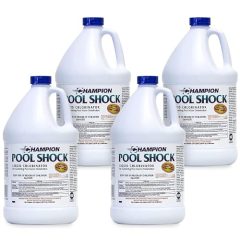 Liquid Chlorine / Sodium Hypochlorite (12.5%)
Everyday sanitizer — the B in BBB View on Amazon →
Liquid Chlorine / Sodium Hypochlorite (12.5%)
Everyday sanitizer — the B in BBB View on Amazon →
Still need help? Ask a Pool & Spa Expert AD
Get a personalized answer from PoolGuy810 — 30 years owning a pool and spa repair company. Describe your issue and get step-by-step help.
Related Pool Guides
Need More Help?
Try our free pool calculators and tools to help diagnose and fix your pool problems.
Browse Pool ToolsSLAM calculator, pH calculator, salt dosing & more