
What Are Chloramines in a Pool? Causes & Fixes

My Pool Smells Like Chlorine, Burns Eyes, AND Water Looks Off
Read full question
My backyard pool has developed a really strong chemical smell, my kids come out with red burning eyes every single time they swim, AND a neighbor mentioned my chlorine levels might actually be too low despite the overpowering odor — all at the same time. I test my water regularly and I keep adding chlorine, so I'm confused why it smells so strong and still seems to be underperforming as a sanitizer.
Someone at the pool store told me what I'm smelling isn't really chlorine at all — it's something called chloramines or 'combined chlorine' — and that this actually means my free chlorine is being used up and isn't working properly. That really surprised me because I always assumed the strong smell meant there was too much chlorine in the water.
Can someone explain exactly what chloramines are, where they come from, and what I need to do to get rid of them? I want to understand the chemistry so I'm actually solving the problem and not just dumping in more product that won't help.
Quick Answer
That harsh chemical smell and eye irritation are actually caused by chloramines — compounds formed when free chlorine reacts with swimmer waste — not excess chlorine. Chloramines are far weaker sanitizers than free chlorine and signal your pool's chlorine is being consumed and neutralized. The fix is breakpoint chlorination (shock treatment), better swimmer hygiene habits, and addressing your overall water chemistry.
The Big Misconception: More Smell Does NOT Mean More Chlorine
Here's the myth worth busting right away: that sharp, eye-watering chemical odor that most people associate with a heavily chlorinated pool? It's not actually free chlorine you're smelling. A well-maintained pool with the right amount of working chlorine has almost no detectable smell at all. What you're experiencing — the stinging eyes, the skin irritation, the pungent chemical bite in the air — is caused by chloramines, also called combined chlorine. And paradoxically, a strong chloramine smell is often a sign that your free chlorine is being depleted, not that you have too much.
So What Exactly Are Chloramines?
Chloramines form when free chlorine in your pool water reacts with nitrogen-containing contaminants introduced by swimmers. Every person who enters your pool brings with them sweat, urine, skin oils, sunscreen, cosmetics, and other organic waste — all of which contain ammonia and nitrogen compounds. When your free chlorine encounters these substances, instead of simply oxidizing and eliminating them cleanly, it chemically bonds with them to create a family of byproduct compounds collectively called chloramines.
There are three main types produced in this reaction:
- Monochloramine — the least irritating of the three
- Dichloramine — more irritating and more volatile
- Trichloramine (nitrogen trichloride) — the most irritating form, and the one most responsible for that distinctive harsh smell; it readily off-gasses from the water surface into the air above it, which is why indoor pools often have the worst chloramine odor problems
Together, these compounds are measured as your pool's combined chlorine (CCCombined Chlorine — "Used-up" chlorine left over from doing its job. Above about 0.5 ppm is the classic sign water needs a shock. learn more →) level. Common pool chemistry guidelines recommend keeping combined chlorine below 0.5 ppm; some public health standards for commercial pools are stricter. Keeping CC as low as possible is the practical goal for any pool. If your CC reading is climbing above that, your pool is telling you it needs attention.
Why Chloramines Are a Real Problem
Beyond the unpleasant smell and irritation, chloramines represent a genuine water safety concern. Research indicates chloramines are significantly less effective as sanitizers than free chlorine — some estimates suggest by an order of magnitude or more. If a significant portion of your total chlorine reading is combined chlorine rather than free chlorine, your pool's sanitizing power is reduced. This is primarily a water quality concern, though in severely neglected cases with very low free chlorine, pathogen control can be compromised.
Prolonged exposure to high chloramine concentrations — particularly trichloramine — has been associated with respiratory irritation and eye and skin problems, especially for competitive swimmers and lifeguards who spend significant time in or around indoor pool environments.
Where Do They Come From? (And How to Reduce the Source)
The single biggest source of chloramine precursors is swimmer contamination. This is worth saying plainly: urine in a pool is one of the primary drivers of chloramine formation, along with sweat and personal care products. Encouraging swimmers to shower before entering, avoid urinating in the pool, and limit heavy application of lotions and oils before swimming will meaningfully reduce the nitrogen load your chlorine has to fight. It sounds basic, but it genuinely makes a chemical difference.
How to Eliminate Chloramines: Breakpoint Chlorination
The most common and accessible way to destroy chloramines is breakpoint chlorination, which is essentially a heavy shock treatment. The chemistry requires pushing free chlorine well above the combined chlorine level — the exact ratio depends on your water chemistry, but it must exceed the breakpoint threshold for the chloramine bonds to break apart and convert to harmless nitrogen gas that escapes the water. Use our chlorine dosing calculator for a closer estimate based on your pool's specific readings.
In practical terms for most pool owners, this means performing a SLAMShock Level And Maintain — raise free chlorine to a target based on your CYA and hold it there until the algae is gone. It's a process, not a one-time dose. the SLAM walkthrough → (Shock, Level, And Maintain) procedure — raising free chlorine to a high target level and holding it there until all three SLAM completion criteria are met: CC is below 0.5 ppm, the water is visibly clear, and an overnight chlorine loss test (OCLT) shows no more than 1 ppm of FCFree Chlorine — The chlorine actively sanitizing your water right now. This is the number you keep an eye on. how much you need → loss overnight with the pump running. All three criteria must be satisfied — the OCLT is the most critical gate. The exact free chlorine level you need to reach depends critically on your pool's CYACyanuric Acid (stabilizer) — Sunscreen for your chlorine — it keeps sunlight from burning it off. The catch: the more you have, the more chlorine you need to keep. learn more → (cyanuric acid / stabilizer) level — this is not a one-size-fits-all number. See our pool water chemistry guide for how free chlorine targets scale with CYA, and check out our SLAM method guide for the full step-by-step process.
For the shock itself, unstabilized chlorine — liquid chlorine (sodium hypochlorite) or cal-hypo — is generally preferred so you don't inadvertently raise your CYA further during the process. When handling large quantities of chlorine for a shock treatment, always add product to water rather than water to product, never mix different chlorine types or add chlorine near acid, and avoid breathing fumes directly. Add liquid chlorine slowly around the perimeter of the pool with the pump running.
Advanced Options: UV and Ozone Systems
For pools that deal with chronic chloramine problems — often commercial or heavily-used residential pools — dedicated UV-C disinfection systems offer a highly effective long-term solution. UV-C light at the right wavelength breaks the chemical bonds in chloramine molecules directly, without requiring you to raise chlorine levels. Ozone systems and advanced oxidation systems that generate hydroxyl radicals work similarly, oxidizing chloramines at the molecular level. These systems are a meaningful investment and can significantly reduce combined chlorine levels and overall chlorine demand, though actual results vary by system, pool size, and bather load.
Testing: Know Your Numbers
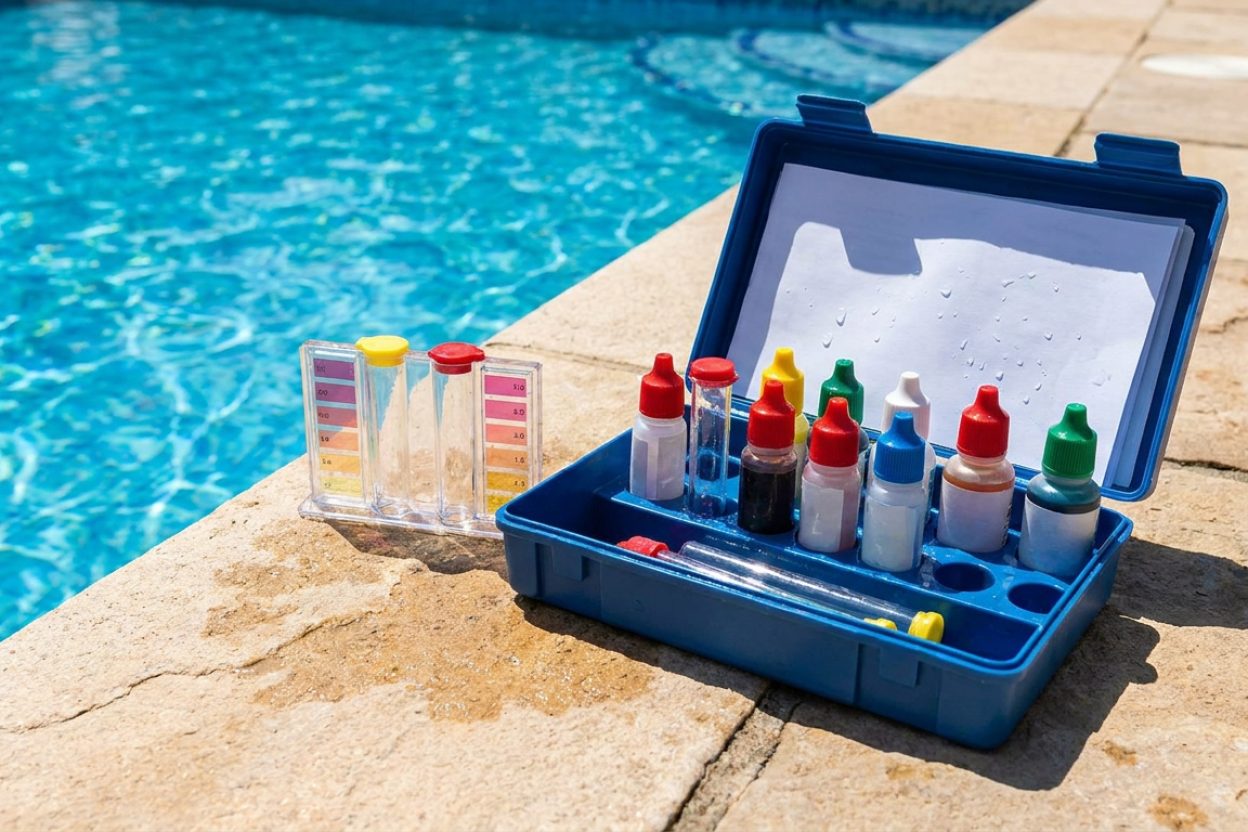
To properly track the chloramine situation in your pool, you need a test kit that measures both total chlorine and free chlorine separately — a basic test strip that only gives you one "chlorine" number won't cut it. Combined chlorine is simply the difference between the two: Total Chlorine − Free Chlorine = Combined Chlorine. A good DPD drop test kit or a quality photometer will give you both readings. Aim to keep combined chlorine below 0.5 ppm and keep your free chlorine at the appropriate level for your CYA as outlined in the water chemistry guide.
Quick Action Checklist
- Test your water for free chlorine, total chlorine, CYA, and pH
- Calculate your combined chlorine (total minus free)
- If CC is above 0.5 ppm, plan a SLAM / breakpoint shock treatment
- Use unstabilized chlorine for the shock and maintain the elevated FC level until all three SLAM completion criteria are met; handle all chlorine products safely
- Enforce pre-swim shower habits to reduce the nitrogen load going forward
- Consider your filtration run time — longer daily filtration helps dilute and process contaminants
The good news is that chloramines are a very solvable problem once you understand what's actually causing them. That overpowering "chlorine" smell will go away when your free chlorine is doing its job properly — and your swimmers will thank you for it.
 Taylor K-2006C Complete FAS-DPD Pool & Spa Test Kit
The FAS-DPD kit pool pros trust — reads chlorine accurately even at shock/SLAM levels, plus pH, alkalinity, calcium hardness and CYA. View on Amazon →
Taylor K-2006C Complete FAS-DPD Pool & Spa Test Kit
The FAS-DPD kit pool pros trust — reads chlorine accurately even at shock/SLAM levels, plus pH, alkalinity, calcium hardness and CYA. View on Amazon →
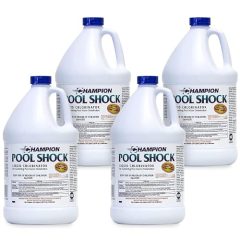 Liquid Chlorine / Sodium Hypochlorite (12.5%)
Everyday sanitizer — the B in BBB View on Amazon →
Liquid Chlorine / Sodium Hypochlorite (12.5%)
Everyday sanitizer — the B in BBB View on Amazon →
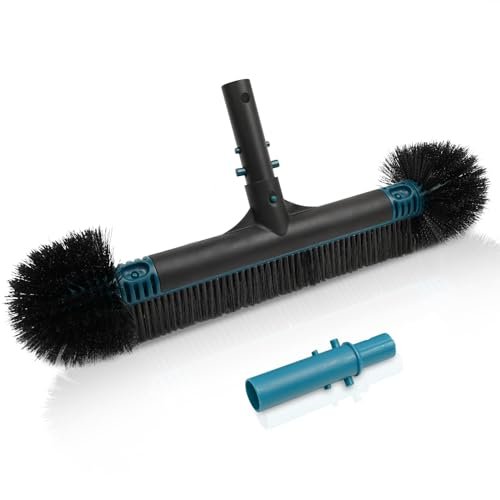 Poolvio 20" 2-in-1 Pool Brush Head (Walls & Floor)
Sturdy 20-inch brush head that clips onto any standard telescopic pole. View on Amazon →
Poolvio 20" 2-in-1 Pool Brush Head (Walls & Floor)
Sturdy 20-inch brush head that clips onto any standard telescopic pole. View on Amazon →
Still need help? Ask a Pool & Spa Expert AD
Get a personalized answer from PoolGuy810 — 30 years owning a pool and spa repair company. Describe your issue and get step-by-step help.
Related Pool Guides
Need More Help?
Try our free pool calculators and tools to help diagnose and fix your pool problems.
Browse Pool ToolsSLAM calculator, pH calculator, salt dosing & more