
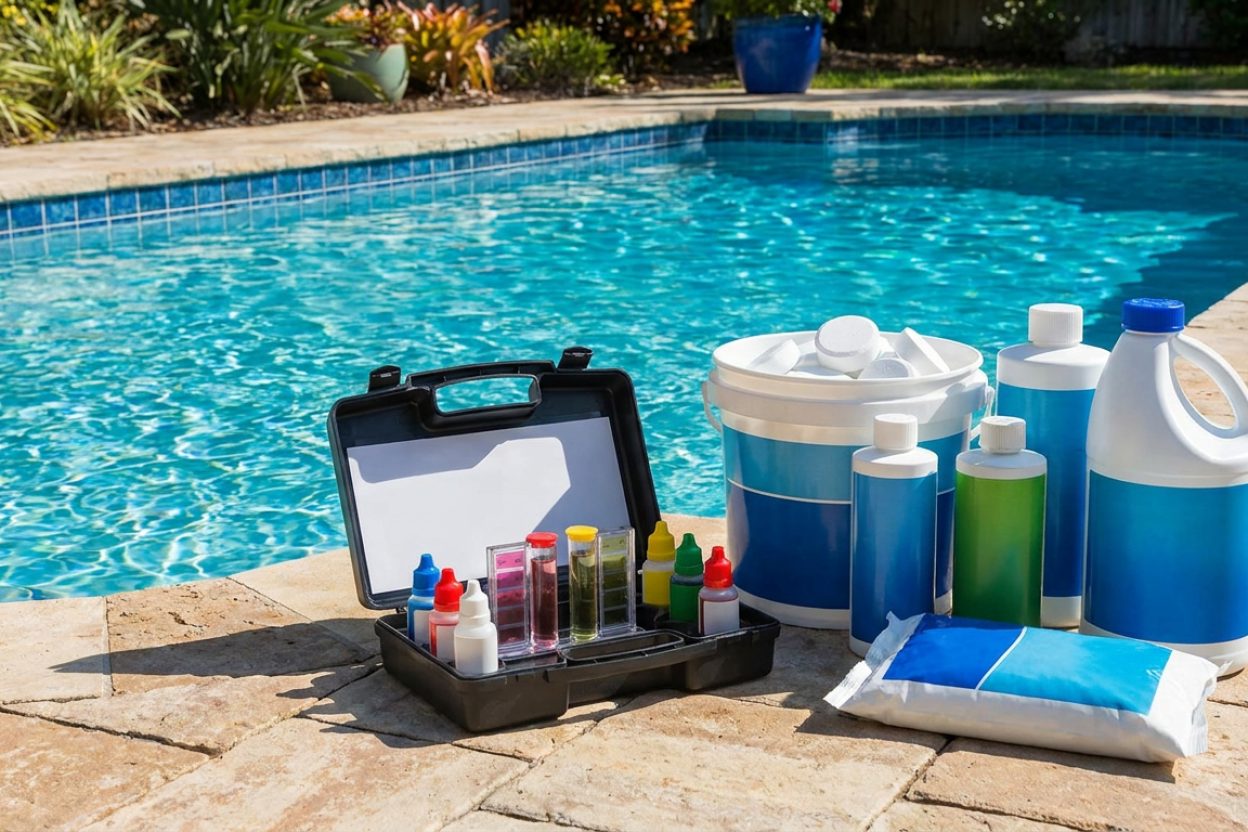
Salt Hot Tub + Chlorine Pool: Can They Coexist?

Salt hot tub and chlorine pool eating through my sanity — can they coexist?
Read full question
Looked at my chemical budget this month and my dual-system setup is eating through my patience faster than it should. I've got a saltwater hot tub running alongside a traditional chlorine pool, and I keep second-guessing whether the two systems are creating problems for each other. Sharing test kits, the occasional accidental splash of equipment — I'm not sure if cross-contamination is a real concern or if I'm overthinking it.
On top of that, I'm also wondering if switching it over to bromine might actually be cheaper and easier to maintain. I've heard bromine handles heat better, which makes sense for a spa. But I genuinely don't know if you can just dump bromine into a system that's been running chlorine, or whether there's a full drain-and-clean process involved.
Quick Answer
Yes, a saltwater hot tub and a chlorine pool can run side by side without any issues — they're separate closed systems and don't interfere with each other. However, you cannot run bromine through a salt-chlorine generator; switching to bromine requires draining the tub, cleaning it thoroughly, and rebuilding a bromide bank before operating without the salt cell.
The Good News: Two Different Systems Can Absolutely Coexist
Running a saltwater hot tub next to a chlorine-treated pool is a perfectly normal setup, and there's no technical conflict between the two. Each system operates in its own closed loop — your salt cell generates chlorine electrochemically inside the hot tub, and your pool uses traditionally dosed chlorine. Chemically speaking, both are producing the same active sanitizer (hypochlorous acid), just via different delivery methods. They don't interfere with each other at all.
The only real concern is cross-contamination from shared equipment. If you're dipping the same test kit reagents, brush, or vacuum head into both bodies of water, you can introduce residual chemistry from one into the other — not dangerous, but it can skew your test results and complicate water balancing. Keep your test vials rinsed between uses, designate separate brushes or nets where possible, and you'll be fine. Your pool water chemistry guide is a good reference for maintaining accurate readings across both systems.
Is It Dangerous to Mix the Two Waters — or Swim Between Them?
Short answer: no — not in the way the scary "never mix chlorine and bromine" headlines suggest. Walking from your bromine spa straight into the chlorine pool (or the other way around), or a little spa water splashing into the pool, is harmless. The amount of sanitizer riding along on your skin or swimsuit is a trace, and it's instantly diluted into thousands of gallons. There's no reaction to worry about.
Here's the part most warnings leave out: in the water, chlorine and bromine actually get along — chlorine is how you recharge bromine. When chlorine meets bromide ions, it converts them into hypobromous acid, the active bromine sanitizer. That's literally how a bromine system is maintained. So a few ounces of bromide-laden spa water landing in your chlorinated pool simply gets oxidized and fades into the background; it won't hurt anyone or "cancel out" your pool.
The danger those headlines are really describing is mixing the concentrated solid products, and that one is genuinely serious. Never combine chlorine tablets or granules with bromine tablets, never drop chlorine tablets into a floater or feeder that's been holding bromine (or vice versa), and never mix the two in a bucket or storage container. Concentrated chlorine and bromine reacting directly can generate enough heat to start a fire or release toxic gas — the same reason you never mix two different types of chlorine, like trichlor tablets and cal-hypo shock. Keep each product in its own clearly labeled feeder and storage spot and that risk is off the table.
So the rule of thumb: people and splashes moving between the two pools is no problem; the concentrated chemicals touching each other in a feeder, floater, or bucket, never. Showering between the spa and pool is still a good habit — but for hygiene and reducing sanitizer demand, not because of any danger.
Why You Can't Just Add Bromine to a Salt Hot Tub
This is where things get important, so pay attention here. A salt-chlorine generator works by passing a low-voltage current through saltwater to produce chlorine. A salt-chlorine generator continuously produces chlorine, which will compete with and break down your bromine bank — effectively undermining the bromine system before it can establish itself. The salt cell also can't generate bromine, so you'd be running two partially effective systems rather than one good one. It's a functional conflict, not a chemical danger, but it means the two approaches simply don't work together as co-sanitizers.
The salt cell and bromine are not compatible as co-sanitizers. If you want to switch to bromine, the salt system needs to come out of the picture entirely — and the tub needs a proper reset before you start the bromine system.
How to Switch Your Hot Tub from Salt to Bromine — The Right Way
This isn't a quick pour-and-go job. Done properly, it involves a few careful steps, and skipping any of them can mean your bromine system underperforms from day one.
- Drain the tub completely. Don't just dilute — get all the salt-laden water out. The main reason to drain fully is to remove residual chlorine compounds and reset the water chemistry baseline — not because salt ions themselves are incompatible with bromine. Starting fresh gives your bromide bank a clean foundation and prevents old chemistry from skewing your initial readings.
- Clean the shell and plumbing thoroughly. Bromine can leave a residue on surfaces, and conversely, a salt-treated tub will have mineral deposits and residual chlorine compounds in the plumbing. Run a line flush product through the jets, wipe down the shell, and rinse everything well before refilling.
- Refill with fresh water and balance chemistry first. Get your pH, total alkalinity, and calcium hardness dialed in before introducing any sanitizer. Bromine works best in the pH 7.2–7.6 range — like chlorine, its effectiveness drops noticeably at higher pH, so getting this dialed in before you start sanitizing matters.
- Establish your bromide bank. Bromine sanitation works differently from chlorine — it relies on a reservoir of bromide ions in the water (the "bank") that gets activated by a shock or oxidizer. Many owners start with a bromide booster or pre-measured bromide salt, then use an oxidizer (non-chlorine shock or small chlorine shock) to activate it. Bromine tablets in a floater or inline feeder will then maintain the bank over time.
- Maintain the bank consistently. This is the most common mistake people make after switching — they let the bromide bank drop and wonder why their bromine levels keep crashing. Regular oxidation through shock treatments is what reactivates the bromide ions already in the water. Think of the bank as your long-term investment; protecting it prevents you from constantly overdosing sanitizer.
Preventing the Problems That Make People Regret Switching
Whether you stick with salt or go to bromine, the biggest drain on your chemical budget is usually poor water balance — not the sanitizer itself. High pH makes any sanitizer less effective, forcing you to use more product to achieve the same result. Alkalinity swings cause pH instability. And in a hot tub, evaporation and bather load concentrate everything faster than in a pool.
A few habits that protect whichever system you run:
- Test frequently — hot tubs generally need testing at least 2–3 times per week given the small water volume and high temperature — more often if the tub sees heavy use. Small imbalances compound quickly.
- Shower before soaking — body oils, lotions, and sweat are the primary demand on your sanitizer. This single habit meaningfully extends chemical life.
- Drain and refill on schedule — total dissolved solids build up in hot tubs faster than pools. Most manufacturers recommend a full drain every 3–4 months for average use, but check your specific manual — heavy bather load or a smaller tub volume can shorten that interval considerably. Following this schedule prevents the kind of chemistry creep that makes water management increasingly difficult and expensive.
- Don't skip the shock — whether you're on bromine or chlorine, regular oxidation breaks down organic waste and, in a bromine system, reactivates the bromide bank. Skipping it is a common reason a bromine system feels like it's eating through product — without regular oxidation, the bromide bank depletes rather than recycling, so you end up constantly re-dosing instead of reactivating what's already there.
On Your Chlorine Pool: Keep It Simple and Separate
Your pool side doesn't need to change at all. Just maintain proper free chlorine levels scaled to your CYACyanuric Acid (stabilizer) — Sunscreen for your chlorine — it keeps sunlight from burning it off. The catch: the more you have, the more chlorine you need to keep. learn more → (stabilizer) — see the pool water chemistry guide for the correct FCFree Chlorine — The chlorine actively sanitizing your water right now. This is the number you keep an eye on. how much you need →-to-CYA relationship, because a flat ppm target without knowing your stabilizer level is meaningless. Use our salt calculator if you're ever adjusting salt on the pool side separately, and keep your testing kits labeled and rinsed between the two bodies of water.
The bottom line: your two-system setup isn't the problem. With clean habits and proper water balance, both a salt spa and a chlorine pool can run efficiently without cross-interference — and switching the spa to bromine is a solid choice for hot water if you're willing to do the conversion correctly rather than cutting corners on the drain-and-clean step.
 Taylor K-2006C Complete FAS-DPD Pool & Spa Test Kit
The FAS-DPD kit pool pros trust — reads chlorine accurately even at shock/SLAM levels, plus pH, alkalinity, calcium hardness and CYA. View on Amazon →
Taylor K-2006C Complete FAS-DPD Pool & Spa Test Kit
The FAS-DPD kit pool pros trust — reads chlorine accurately even at shock/SLAM levels, plus pH, alkalinity, calcium hardness and CYA. View on Amazon →
 Liquid Chlorine / Sodium Hypochlorite (12.5%)
Everyday sanitizer — the B in BBB View on Amazon →
Liquid Chlorine / Sodium Hypochlorite (12.5%)
Everyday sanitizer — the B in BBB View on Amazon →
 Arm & Hammer Pure Baking Soda (Alkalinity Up)
Raises Total Alkalinity cheaply View on Amazon →
Arm & Hammer Pure Baking Soda (Alkalinity Up)
Raises Total Alkalinity cheaply View on Amazon →
 50 ft Flexible Metal Garden Hose (Kink-Free)
Durable hose for filling, priming, and rinsing equipment. View on Amazon →
50 ft Flexible Metal Garden Hose (Kink-Free)
Durable hose for filling, priming, and rinsing equipment. View on Amazon →
Still need help? Ask a Pool & Spa Expert AD
Get a personalized answer from PoolGuy810 — 30 years owning a pool and spa repair company. Describe your issue and get step-by-step help.
Related Pool Guides
Need More Help?
Try our free pool calculators and tools to help diagnose and fix your pool problems.
Browse Pool ToolsSLAM calculator, pH calculator, salt dosing & more