
Why Is the Lincoln Reflecting Pool Green—and Why Not Shock It?

The Lincoln Memorial Reflecting Pool keeps turning green. Why not just shock it?
Read full question
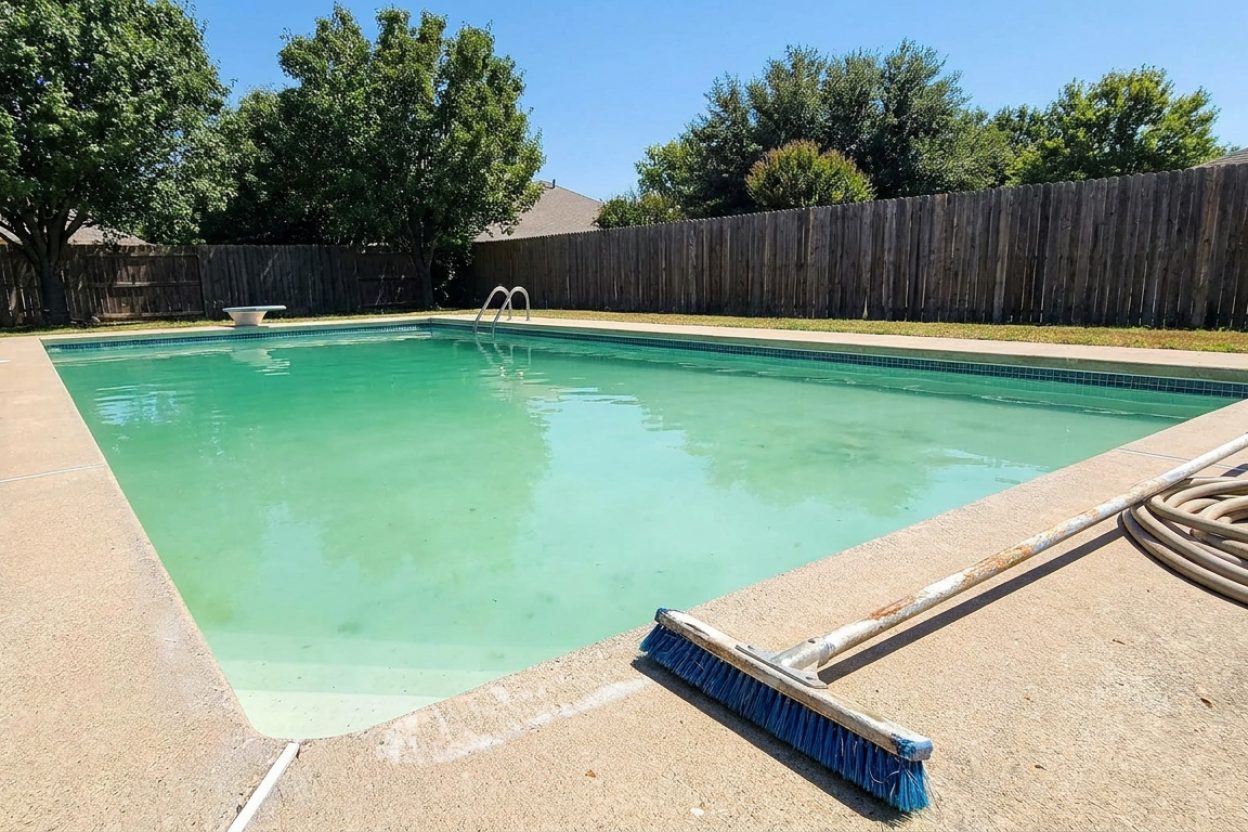
I saw the photos of the Lincoln Memorial Reflecting Pool gone bright green again, days after they finished a big renovation. I run my own backyard pool, and when mine goes green I shock the daylights out of it and it clears up in a couple of days. So why is the government out there pouring hydrogen peroxide and scraping algae by hand off a national monument? Why don't they just shock the thing like the rest of us do? What am I missing?
Quick Answer
For a backyard pool your instinct is right: green water is algae, and shock-level chlorine (SLAM) clears it. The Reflecting Pool can't do that—it's a huge, shallow, sun-baked open basin with no stabilizer, fed with municipal water through filtration that's been a chronic problem, and constantly re-fed nutrients by birds and runoff. Peroxide and ozone kill the bloom but don't remove the phosphorus that feeds it. The real fix is a working loop that strips nutrients—not more oxidizer.
First, why your backyard pool turns green — and how shock fixes it
Green water is almost always an algae bloom. Algae are living organisms, so clearing the pool means killing them faster than they can reproduce, then removing what's left.
You're right — shocking the pool works to clear algae, and what does the killing is chlorine. The method that works is SLAMShock Level And Maintain — raise free chlorine to a target based on your CYA and hold it there until the algae is gone. It's a process, not a one-time dose. the SLAM walkthrough → — Shock Level And Maintain: you raise free chlorine (FCFree Chlorine — The chlorine actively sanitizing your water right now. This is the number you keep an eye on. how much you need →) to the shock level for your pool and hold it there, testing and re-dosing several times a day, until the bloom is dead.
The reason this works in your yard is that a backyard pool is a small, sanitized, closed loop with stabilizer in the water. Hold on to those four things — small, sanitized, stabilized, closed — because the Reflecting Pool has none of them.
Why the Reflecting Pool is a completely different animal
It looks like a giant swimming pool, but functionally it isn't one. It's an ornamental basin, and the differences are exactly the things that decide whether shocking can work:
- It's enormous and shallow. The pool runs about 2,028 feet — more than a third of a mile — and is only about 18 inches deep at the sides and 30 inches in the center, holding roughly 6.5 million gallons across a vast, sun-exposed surface. Shallow, warm, sunlit water is close to an ideal algae habitat — the geometry that makes it a mirror is the same geometry that grows algae.
- It's an open public pond, not a sealed pool. Ducks and geese frequent it, and their droppings add nutrients directly to the water; rain and runoff wash in more. So even setting the plumbing aside, the basin is being fertilized in place, continuously, by whatever lands on it.
- Its water supply is a story in itself. The 2010–2012 reconstruction installed a recirculation, filtration, and ozone-disinfection system fed with filtered water from the nearby Tidal Basin, with evaporation losses topped off by the fountain discharge of the adjacent World War II Memorial — a setup meant to cut municipal water use by millions of gallons a year. In practice it has been troubled: a former NPS regional director has said filtration here "has long been a problem," and the Park Service's own current planning page states the pool "uses potable municipal water and has no circulation or filtration systems to keep the water clean," with a proposed project to "explore alternative water sources and sustainable methods for improving the water quality." After the 2026 repaint, the pool was simply refilled and its long-dormant supply lines flushed — and the green followed within days.
(That 2026 work, for the record, was an eight-week project — reported at roughly $13 million to $16 million as added scope was tallied — to repaint the basin "American flag blue," resurface it, and fix leaks ahead of the country's 250th anniversary. It was cosmetic and structural — not a change to how the water is sourced or treated.)
So when it greens, the backyard playbook doesn't transfer.
The treatment problem: even the system it was meant to have wouldn't fix this
A natural assumption is that a national monument's pool must have serious water treatment behind it. The reality is muddier. The 2012 rebuild did install recirculation, filtration, and ozone disinfection, but filtration here has been a chronic problem, and the Park Service's own current planning page says the pool "uses potable municipal water and has no circulation or filtration systems to keep the water clean." (For the present bloom, the Interior Department has also been running temporary nanobubble-ozone treatment.) Whenever that permanent system isn't doing its job, the basin behaves like a giant, still, sun-warmed puddle — about the friendliest environment for algae you could design.
But here's the part that matters even if every bit of that system were running perfectly: filtration and ozone are built to remove particles and to disinfect. Filters trap suspended solids, including algae cells large enough to catch; ozone oxidizes and kills. Neither step removes the dissolved nutrients — the phosphorus and nitrogen that algae feed on. Stripping dissolved phosphorus takes a different process entirely (chemical binding, adsorption media, or precipitation), and that was never part of the design.
In freshwater, phosphorus is usually the limiting nutrient — the amount of algae a body of water can grow is largely capped by how much phosphorus is available, almost regardless of how much sun or nitrogen there is. So the basin is in a double bind: when that permanent system isn't doing its job, little holds the algae back; and even at its best, it would filter and disinfect without ever removing the food supply.
Why the monument doesn't just chlorinate it
Here's the part that's easy to get wrong: the barrier isn't that chlorine can't work in a basin like this. With enough engineering, it could. The reasons it isn't used are about managing an open, public, wildlife-frequented water body — not about the chemistry failing.
The stabilizer objection is softer than it looks. The usual argument is that there's no CYACyanuric Acid (stabilizer) — Sunscreen for your chlorine — it keeps sunlight from burning it off. The catch: the more you have, the more chlorine you need to keep. learn more → in the water, so unstabilized chlorine burns off within hours under full sun. That's true as far as it goes — but cyanuric acid is exactly what fixes it, and there's no chemistry reason you couldn't add it. With CYA in the water and a bulk chlorine feed run off an automated free-chlorine controller, you could hold a residual outdoors the same way large commercial pools do. The dosing load would be heavy, and you'd need several injection points to spread it evenly across a third of a mile rather than one pump house — but that's a sizing problem, not an impossibility. On the algae itself, chlorine is arguably the most effective tool available, because unlike peroxide it leaves a residual that keeps killing whatever blows in next.
So why isn't it run that way? The real walls are about the setting, not the science:
- It's a wading-accessible public basin. People reach into the water — during the 2026 bloom even a passing canoeist did. A chlorine residual high enough to keep a basin sanitized, plus the disinfection byproducts that come from chlorinating nutrient-rich water, is a public-contact risk an open monument has every reason to avoid. Peroxide's whole appeal is that it breaks down into water and oxygen and leaves nothing behind.
- Wildlife and discharge. Waterfowl live on the basin, and when it's drained the water heads toward storm drains and local waterways. Chronically chlorinating a bird-frequented open pond, and discharging chlorinated water into the environment, raises stewardship and permitting questions a fenced backyard pool never has to.
- It never stops being recontaminated. Even a perfectly held residual doesn't change the fact that waterfowl, runoff, and make-up water keep adding nutrients and organisms. Chlorine fights the organism; it does nothing about the food supply that regrows the bloom.
So the honest version of "why not just shock it" isn't that the chemistry forbids it — it's that a persistent chlorine residual, the very thing that makes shocking work in your backyard, is what you don't want in public, animal-frequented water that drains to a river. The monument leans on a milder tool on purpose. It's a management and regulatory choice, not an engineering dead end.
In practice, crews aren't avoiding chlorine entirely — in 2026, workers were spotted adding a concentrated chlorine product (Induclor) for spot disinfection — but that's a long way from running a stabilized SLAM. The headline tool has been hydrogen peroxide (a 12% solution), a milder oxidizer that breaks down into water and oxygen and leaves no residual to worry about around wildlife and the public, alongside nanobubble ozone aeration.
But peroxide — and ozone — mostly treat the symptom
The thing that makes hydrogen peroxide safe here is the same thing that makes it temporary: it oxidizes the algae that's in the water right now and then it's gone, with no lasting residual. With the nutrient supply untouched, the conditions that grew the bloom are still there. Crews have also been vacuuming up the dead algae and siphoning the dirty water out through tubing into nearby storm drains (which usually discharge untreated to local waterways, sending the nutrients downstream rather than removing them) — a cleanup, not a cure.
There's a subtler trap with oxidation, too. When ozone or peroxide kills algae cells, the cells can rupture and release the phosphorus stored inside them back into the water. So oxidation alone can recycle the nutrient — kill this week's algae and hand next week's algae its food. Killing without removing the phosphorus can keep the cycle turning rather than break it. A Smithsonian algae specialist, Barrett Brooks, made the same point about this very pool: kill the algae that's in there, he told CNN, and "that's all nutrients for the next round."
This isn't a new lesson at this pool. After the 2012 rebuild, the plan for future outbreaks was essentially to double the ozone — treating the symptom harder without touching the nutrient supply.
Is hydrogen peroxide a "shock" — and could you do it in your pool?
It's a fair question: if crews are dumping a strong oxidizer to knock down a bloom, isn't that just shocking the pool with peroxide instead of chlorine? In a loose sense, yes — a big one-time dose of hydrogen peroxide is an oxidizer shock: it oxidizes the algae and organic load all at once. What it is not is a sanitizer. Peroxide leaves no lasting residual and isn't EPA-registered as a disinfectant for recreational water, so it doesn't keep killing what blows in next. That's the key difference from a chlorine SLAM, where the whole point is to hold a sanitizing level for days. So what's happening at the Reflecting Pool is closer to a repeated oxidizer knockdown than to the maintain-a-level process you run at home — which fits, because the basin can't hold a chlorine residual anyway.
Can you shock your pool with peroxide? It depends entirely on what sanitizer your pool runs on:
- Biguanide (PHMB) pools — the chlorine-free systems sold as Baquacil, SoftSwim, or Aqua Silk — actually do shock with hydrogen peroxide. Their "oxidizer shock" is high-strength peroxide (Baquacil Oxidizer, for instance, is 27% stabilized hydrogen peroxide), because chlorine isn't part of that system at all.
- Chlorine and saltwater pools — don't. Hydrogen peroxide and chlorine are antagonistic: they react and cancel each other out. Pour peroxide into a chlorinated pool and you'll mostly just destroy your chlorine residual, leaving the water with no sanitizer and the algae free to regroup. (The reaction is strong enough that the standard way to convert a pool from chlorine to a peroxide-based system is to let chlorine fall below about 0.5 ppm first.)
For the overwhelming majority of backyard pools — chlorine or saltwater, which is also chlorine — peroxide isn't a shortcut to clear water. Chlorine-based SLAM is the proven method, and ordinary household peroxide (3%) isn't remotely the strength used even in dedicated peroxide systems (typically 27–35%). The monument leans on peroxide precisely because it lives outside the chlorine world your pool lives in. For you, the tool that both kills the bloom and keeps protecting the water afterward is chlorine.
The official explanation — and the longer pattern
To be fair to the people managing it, the Interior Department's explanation for the 2026 bloom was that it was largely residual algae from flushing supply lines that had sat dormant during construction, made worse by the basin's shallowness, warmth, and sun. On that view, the immediate green is a transient, expected hiccup that the treatments knock back — and officials reported the bloom was being cleared.
What that framing doesn't fully resolve is why this keeps happening. The pool had to be drained and cleaned for algae within weeks of its 2012 reopening, and green water has been a recurring story since — an Interior spokesperson even noted algae has "plagued every pool reopening since 1922." A one-off, residual bloom is plausible; a problem that returns at essentially every reopening looks more like a standing condition than a one-time flush. Reasonable people read the same facts both ways, so treat the cause-level discussion below as analysis of the underlying chemistry, not a verdict on any single season's bloom.
What would actually target the cause: restore the loop and strip the nutrients
Since the monument won't run on a chlorine residual the way your backyard does, the cause-level lever is the water loop itself — and here it has two parts. First, get the basin's own circulation, filtration, and disinfection reliably back in service (the recurring blooms suggest it often isn't). Second — the step that was never in the design — add continuous phosphorus removal to that loop, so the water is stripped of algae's food on every pass.
Treating the standing volume on every pass matters because much of the nutrient load is generated inside the open pool (the waterfowl and runoff), so anything that only treats incoming fill water can't keep up. A few standard approaches fit a recirculation loop:
- Phosphorus-binding media — for example lanthanum-modified clay or iron/rare-earth oxide media — placed in the flow path. Water passes through, phosphate binds to the medium, and treated water continues. It's largely passive, with periodic media replacement, which suits an open site without a full-time chemistry crew.
- Continuous low-dose precipitation — metering a small amount of a binding agent (such as alum or a lanthanum salt) into the flow so phosphate precipitates out and is caught by the filters. Cheaper on media, but it adds chemical handling and some sludge to manage.
Critically, nutrient removal would pair with oxidation, not replace it: oxidation kills the cells, and phosphorus removal takes away the food so the survivors and newcomers can't bloom. Two honest limits are worth stating plainly:
- It reduces the nutrient load; it doesn't sterilize the pool. Birds will keep adding phosphorus to an open basin. The goal is to hold phosphorus below the bloom threshold continuously, which means sizing the system for the ongoing input — a maintained system, not set-and-forget.
- Turnover rate is the real engineering question. If it takes days to cycle the whole volume through treatment and algae can double faster than that in peak summer heat, each pass has to remove enough phosphorus to win against the growth happening in the untreated water between passes. Getting that math right — flow and turnover, not just chemical dose — is what separates a system that holds the water clear from one that merely slows the bloom.
And the one thing no treatment can change is the shape of the pool. Shallow and sun-exposed is what makes a reflecting pool reflect — you can't deepen it or shade it without destroying the reason it exists. So the most realistic lever — short of running it as a chemically managed public pool, which the setting argues against — is taking away the algae's food. It's also worth noting that the 2026 makeover spent its budget on paint and concrete — not on this.
Should you strip phosphates from your pool?
If phosphorus is what feeds algae, it's fair to wonder whether you should be chasing phosphates in your own pool with a phosphate remover. For most owners, the honest answer is: probably not — and the reason is the whole point of this article. The Reflecting Pool needs nutrient control because it isn't kept on a chlorine residual — a deliberate choice, given its open public setting. Your pool is. In a sanitized, stabilized, closed pool, chlorine kills algae faster than the phosphate level matters, so a steady free-chlorine residual (scaled to your CYA) is the real control, and phosphate removers are usually optional.
Where they can earn their keep is the narrower case: persistent algae despite genuinely balanced water and proper chlorine, very high phosphates coming in from fill water or runoff, or lightly-sanitized setups. Lanthanum-based removers bind phosphate into a precipitate your filter then catches — they can cloud the water for a day or two, and it's a recurring cost. It's a situational tool, not routine maintenance, and it's worth testing your phosphate level before spending on it. We dig into the specifics in Does My Pool Need Phosphate Remover? and when it's actually worth testing and treating.
If you've tested and decided it's worth it, popular lanthanum-based removers include Orenda PR-10000, SeaKlear Commercial Strength, and Natural Chemistry PHOSfree — a supplement to steady chlorination, not a replacement for it.
What this means for your backyard pool
The monument is an extreme version of a principle that governs your pool too: you can't win on reaction alone if something keeps feeding the bloom.
In your yard, SLAM works because your pool is small, sanitized, stabilized with CYA, and closed — all the things the Reflecting Pool isn't. But the lasting-clarity lesson is the same one the monument keeps demonstrating the hard way: control the inputs. Hold a steady sanitizer residual, keep debris and organics out, watch your fill water, and don't let FC drift low. Shock clears a bloom; managing what feeds algae is what keeps it from coming back.
If you're fighting a green pool right now, the exact shock level depends on your CYA — plug your numbers into our all-in-one pool calculator and it will estimate your SLAM target and how much chlorine to add.
Common misconceptions
- "A national monument's pool must be heavily filtered and treated." It was built with filtration and ozone in 2012, but the Park Service's current planning page says it now runs on municipal water with no circulation or filtration in service — and even at its best, that system filtered and disinfected without removing the dissolved phosphorus that feeds algae.
- "Shock is one fixed dose." The shock level scales with your CYA. The same amount of chlorine can be plenty in one pool and useless in another.
- "If the pros use peroxide, I should too." Peroxide leaves no protective residual, so for a normal backyard pool, chlorine-based SLAM is the proven clear-up method. Peroxide suits an open public basin because of constraints your pool doesn't have.
- "More oxidizer is always the answer." Oxidation kills cells but can release their stored phosphorus back into the water. Without nutrient removal, killing alone can keep the cycle going.
Sources
- Lincoln Memorial Reflecting Pool — Wikipedia — dimensions, volume, the 2010–2012 reconstruction, and algae history.
- National Park Service, ParkPlanning — Rehabilitate Lincoln Reflecting Pool — states the pool currently uses potable municipal water with no circulation or filtration.
- U.S. Department of the Interior (2012) — the original Tidal Basin recirculation design and World War II Memorial fountain top-off.
- CNN (June 2026) — 2026 algae bloom, hydrogen peroxide and nanobubble ozone treatment, vacuuming, and storm-drain discharge.
- In The Swim — Biguanide (PHMB) Pool Treatment and U.S. EPA pesticide registration — hydrogen peroxide as a biguanide-system oxidizer, and that it is not EPA-registered as a recreational-water sanitizer.
Still need help? Ask a Pool & Spa Expert AD
Get a personalized answer from PoolGuy810 — 30 years owning a pool and spa repair company. Describe your issue and get step-by-step help.
Related Pool Guides
Need More Help?
Try our free pool calculators and tools to help diagnose and fix your pool problems.
Browse Pool ToolsSLAM calculator, pH calculator, salt dosing & more