
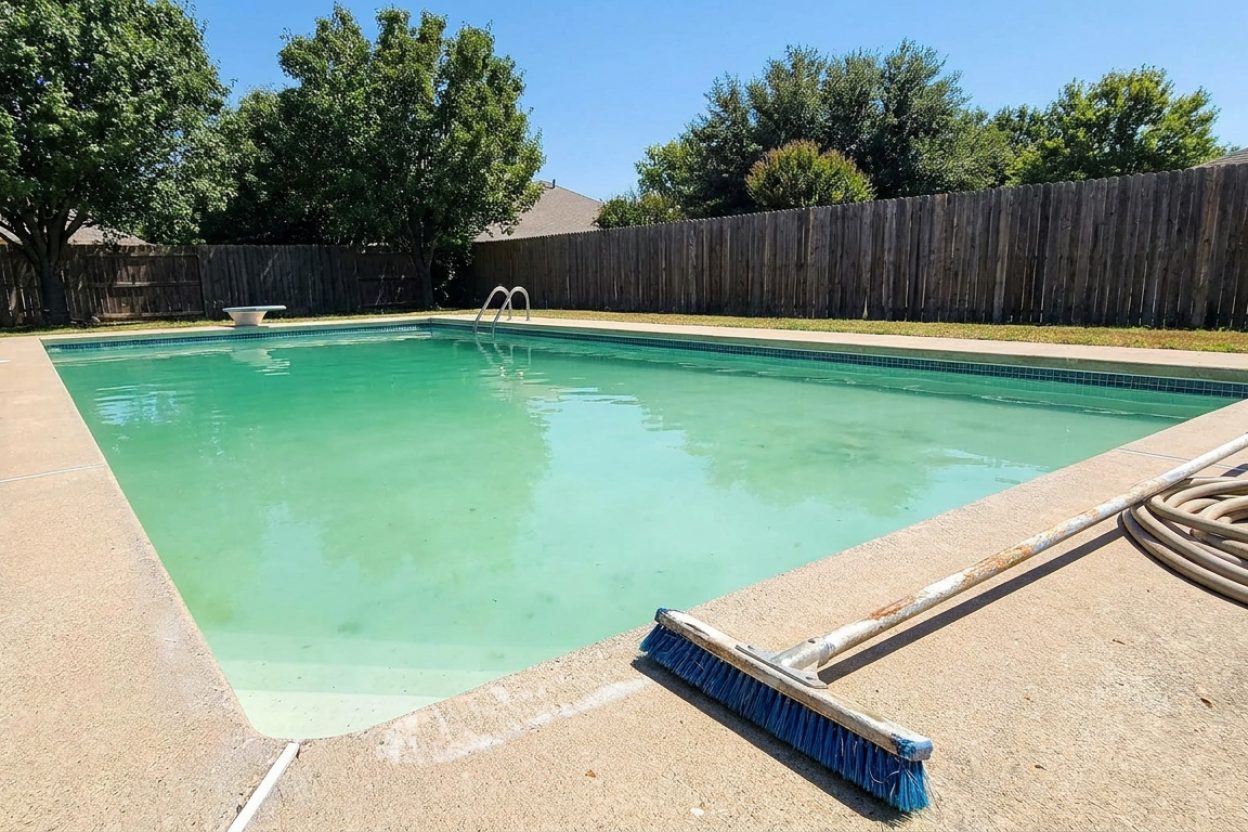
Do I Need to Drain My Green Pool? Step-by-Step Solution

Green pool - do I really need to drain it or are stores upselling?
Read full question
Despite my husband insisting our algae-covered pool "looks like a swamp that needs to be drained," I'm wondering if the pool store's costly advice is actually necessary. The local pool store is telling me I need to drain the whole thing and start fresh, which sounds incredibly expensive and wasteful. They're also trying to sell me a bunch of expensive chemicals and treatments.
I've been reading about DIY methods like the SLAM process but I'm not sure if that actually works or if I'm just wasting time. Has anyone successfully cleared a green pool without draining? I'm tired of throwing money at this problem and would love to know if there's a realistic way to fix this myself without the nuclear option of starting over.
Quick Answer
You typically don't need to drain a green pool. Most algae problems can be resolved using the SLAM (Shock Level And Maintain) method with proper chemical balancing and filtration.
When Draining IS Necessary
Before diving into the treatment process, let's identify the rare situations where draining might be your only option:
- Black or extremely dark water - If you can't see the bottom at the shallow end
- Structural damage visible - Cracks, staining, or deterioration that needs repair
- Contamination issues - Sewage backup, chemical spills, or hazardous materials
- Extremely high TDS - Very high TDS relative to your fill water (note: saltwater pools normally run high TDS, so TDS alone rarely makes balancing impossible)
- Multiple failed treatment attempts - After 2-3 weeks of proper SLAMShock Level And Maintain — raise free chlorine to a target based on your CYA and hold it there until the algae is gone. It's a process, not a one-time dose. the SLAM walkthrough → with no improvement
Step-by-Step Green Pool Recovery Without Draining
Step 1: Test Your Water Chemistry
- Use a reliable test kit like the Taylor K-2006C to measure current levels
- Test for Free Chlorine (FCFree Chlorine — The chlorine actively sanitizing your water right now. This is the number you keep an eye on. how much you need →), pH, Total Alkalinity (TATotal Alkalinity — The buffer that keeps your pH from bouncing around. Get this in range and pH gets a lot easier to manage. learn more →), Cyanuric Acid (CYACyanuric Acid (stabilizer) — Sunscreen for your chlorine — it keeps sunlight from burning it off. The catch: the more you have, the more chlorine you need to keep. learn more →), and Calcium Hardness (CH)
- Record all readings - you'll need baseline numbers to track progress
- If CYA is over 100 ppm, consider partial draining to dilute stabilizer levels
Step 2: Calculate Your Shock Level
- Determine your shock level based on CYA reading using the all-in-one pool calculator:
- CYA 30-40 ppm: Shock level 12-16 FC
- CYA 50 ppm: Shock level 20 FC
- CYA 60-70 ppm: Shock level 24-28 FC
- Calculate chlorine needed: 1 gallon of 12.5% liquid chlorine per 10,000 gallons raises FC by about 12-13 ppm (adjust proportionally for different concentrations - check your product label)
Step 3: Balance pH and Total Alkalinity
- Lower pH to 7.2-7.4 using muriatic acid if above this range
- Don't chase pH during the SLAM - high free chlorine makes the pH test read artificially high, so you can't measure it reliably anyway. Set it to ~7.2 before you start and leave it; liquid chlorine is roughly pH-neutral over a full cycle
- Adjust Total Alkalinity to 80-120 ppm for regular pools (60-80 for salt water generators)
- Add 1.5 lbs of sodium bicarbonate per 10,000 gallons to raise TA by 10 ppm
Step 4: Begin the SLAM Process
- Add enough liquid chlorine to reach your calculated shock level
- Run your pump and filter 24/7 throughout the entire process
- Brush all pool surfaces thoroughly - walls, steps, corners, and behind ladders
- Clean or backwash your filter when pressure rises 8-10 psi above clean pressure
- For sand filters, backwash daily during heavy algae treatment
Step 5: Maintain Shock Level
- Test FC levels every 2-4 hours during daylight
- Add more liquid chlorine to maintain your shock level - algae consumes chlorine rapidly
- Continue brushing twice daily to break up algae colonies
- Don't add algaecides - the shock-level chlorine already kills the algae, and it just gets oxidized (wasting money), with polyquat types tending to foam
Step 6: Monitor Progress and Test for Completion
- Water should begin clearing within 24-48 hours
- Perform the Overnight Chlorine Loss Test (OCLT) once water is clear
- Test FC levels before bed and again first thing in the morning
- Loss should be 1 ppm or less overnight when algae is dead
- Confirm combined chlorine (CCCombined Chlorine — "Used-up" chlorine left over from doing its job. Above about 0.5 ppm is the classic sign water needs a shock. learn more →) is 0.5 ppm or less, and the overnight chlorine loss (OCLT) is 1 ppm or less, with the water clear, before ending SLAM (those are TFP's three exit criteria, all met at the same time)
Why Avoid Draining When Possible
Draining your pool creates several risks and expenses:
- Structural damage - Pools can crack or "pop" out of the ground without water weight
- Equipment damage - Pumps can run dry and burn out
- Higher costs - Refilling costs $200-600 depending on size and water rates
- Chemical restart - You'll need to rebalance entirely new water
- Time loss - Refilling and rebalancing takes 2-3 days minimum
Special Considerations
Sand Filter Users: Consider flocculant (floccing) if your sand filter can't clear fine particles. Add about 4 lbs of aluminum sulfate per 10,000 gallons (alum is dosed in pounds, not ounces — roughly 2-8 lbs depending on how cloudy the water is), let settle 24 hours, then vacuum to waste.
Cartridge Filter Users: Have spare cartridges ready - you'll need to clean or replace them frequently during treatment. Rotate between sets while cleaning.
DE Filter Users: Expect to break down and clean your filter multiple times. Don't add new DE until the algae is completely dead.
Timeline Expectations
Most green pools clear within 3-7 days using proper SLAM technique. Factors affecting timeline include:
- Severity of algae bloom
- Filter type and condition
- Consistency in maintaining shock levels
- Thoroughness of brushing
- Starting chemical balance
Safety Warning: Always add chemicals to water, never water to chemicals. Wear safety goggles and gloves when handling pool chemicals. Ensure proper ventilation when using muriatic acid.
For the full breakdown of safe chlorine levels by CYA level, see our pool water chemistry guide.
 Taylor K-2006C Complete FAS-DPD Pool & Spa Test Kit
The FAS-DPD kit pool pros trust — reads chlorine accurately even at shock/SLAM levels, plus pH, alkalinity, calcium hardness and CYA. View on Amazon →
Taylor K-2006C Complete FAS-DPD Pool & Spa Test Kit
The FAS-DPD kit pool pros trust — reads chlorine accurately even at shock/SLAM levels, plus pH, alkalinity, calcium hardness and CYA. View on Amazon →
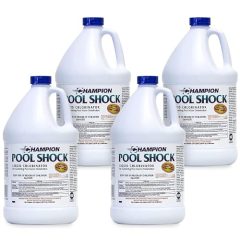 Liquid Chlorine / Sodium Hypochlorite (12.5%)
Everyday sanitizer — the B in BBB View on Amazon →
Liquid Chlorine / Sodium Hypochlorite (12.5%)
Everyday sanitizer — the B in BBB View on Amazon →
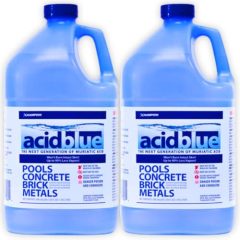 Acid Blue - Low Fume Muriatic Acid for Swimming Pools & Spas - Lower's pH, Reduces Alkalinity - 2 Gallon
View on Amazon →
Acid Blue - Low Fume Muriatic Acid for Swimming Pools & Spas - Lower's pH, Reduces Alkalinity - 2 Gallon
View on Amazon →
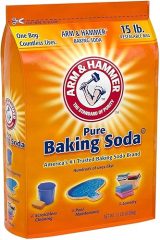 Arm & Hammer Pure Baking Soda (Alkalinity Up)
Raises Total Alkalinity cheaply View on Amazon →
Arm & Hammer Pure Baking Soda (Alkalinity Up)
Raises Total Alkalinity cheaply View on Amazon →
Still need help? Ask a Pool & Spa Expert AD
Get a personalized answer from PoolGuy810 — 30 years owning a pool and spa repair company. Describe your issue and get step-by-step help.
Related Pool Guides
Need More Help?
Try our free pool calculators and tools to help diagnose and fix your pool problems.
Browse Pool ToolsSLAM calculator, pH calculator, salt dosing & more