
Cartridge vs Sand Filter: Is Switching Worth It?

Is Switching From a Cartridge to a Sand Filter Worth It?
Read full question
Three summers of hauling cartridges out of my filter housing, blasting them with a hose, and letting them dry in the backyard — and I'm at my breaking point. The funny thing is it only really feels unbearable when it's above 85°F outside, because that's when the algae pressure picks up and I'm pulling the cartridges every couple of weeks instead of once a month. During the cooler shoulder season the system works fine and I barely think about it.
My neighbor runs a sand filter and swears he just backwashes it every few weeks and forgets about it. Replacement cartridges for my setup run me somewhere around $100–$150 a pop, and they don't last as long as I'd like. I'm seriously considering making the jump to sand — but I want to know what that conversion actually costs, whether I'll regret the water clarity trade-off, and whether the long-term math actually works out in my favor.
Is converting from cartridge to sand a genuinely smart move for a medium-sized in-ground pool, or am I just reacting to a hot-weather frustration? What are the real trade-offs I should be thinking through before I commit?
Quick Answer
Switching from a cartridge to a sand filter can dramatically reduce hands-on maintenance, but you'll trade some water clarity and use more water per backwash cycle. Sand filters are a strong fit for larger pools with heavy debris loads, while cartridge filters shine when water conservation and maximum clarity matter most. The right answer depends on your pool size, local water costs, and just how much upkeep you're willing to accept.
Why Your Cartridge Filter Feels Like a Part-Time Job in Summer
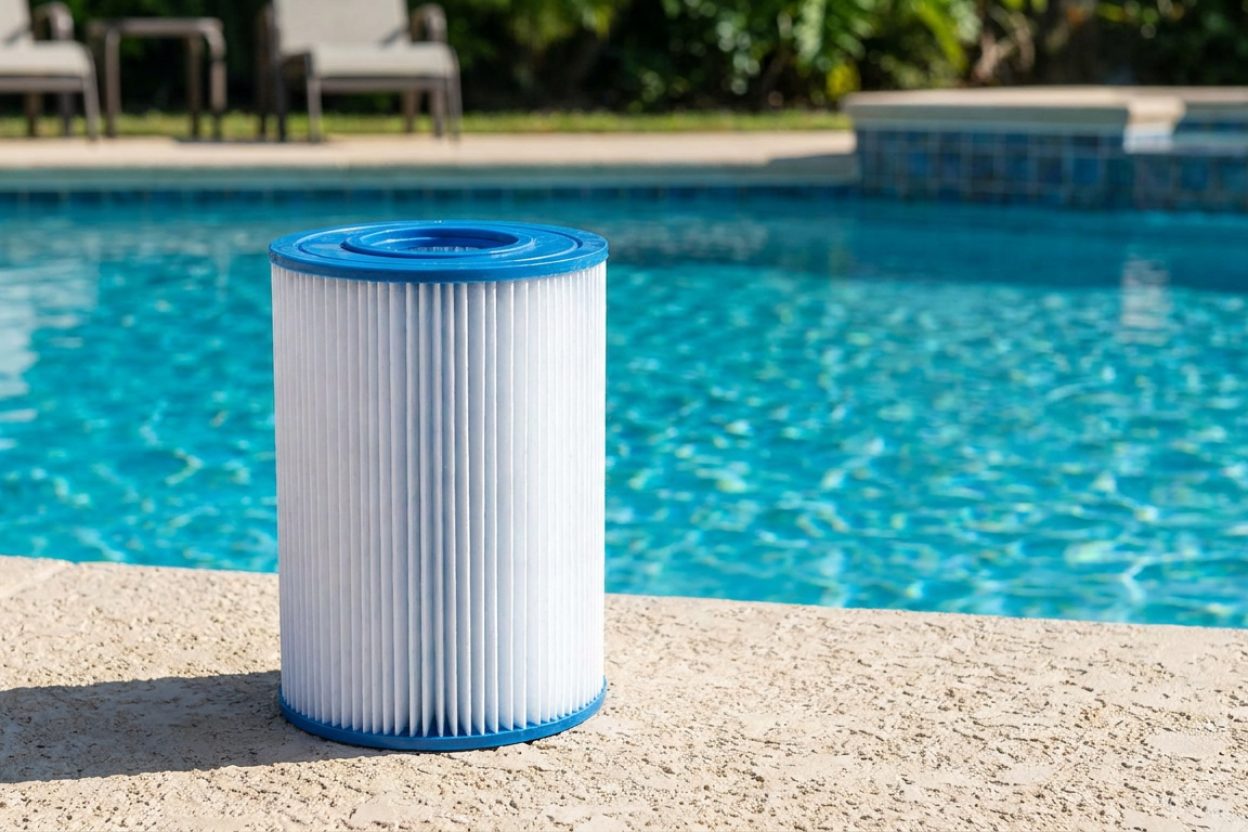
There's a real mechanical reason this problem spikes in hot weather, and it's worth understanding before you swap equipment. When water temperatures climb, algae and organic material reproduce faster, bather load tends to increase, and your filter media gets clogged far more quickly than during cooler months. A cartridge filter's pleated design is remarkably efficient — capturing particles down to roughly 10–20 microns — but that fine filtration is also why it loads up fast under heavy debris or algae pressure. The filter is doing exactly what it was designed to do; it's just doing it under conditions that punish you for it.
Sand filters work on a different principle entirely. Water passes down through a bed of silica sand, and particles get trapped in the gaps between grains. Filtration generally occurs in the roughly 20–40 micron range under typical conditions, though actual performance varies with sand grade and bed age. This means finer particles and some algae cells pass through — but also means the media doesn't blind off as fast. When the pressure builds, you backwash: water flows in reverse, flushes the trapped debris to waste, and the filter is ready to go again in a few minutes. No pulling anything apart, no hosing down pleats, no drying time.
What a Conversion Actually Costs
Budget-wise, switching to sand isn't an enormous leap. Entry-level sand filters from established brands typically start around $200–$400 for smaller residential tanks, while larger-capacity units can run $800–$1,500 or more. Comparable cartridge filter systems occupy a similar price range at the higher end. Prices vary by retailer and change frequently — check current listings before budgeting.
The ongoing cost picture shifts meaningfully, though. Sand media costs vary but are generally inexpensive — a bag of #20 silica sand runs a few dollars at most hardware or pool supply stores, and a full tank load typically costs well under $100–$200 depending on tank size and local pricing. Check current prices locally before budgeting. Sand media needs replacement only every few years under normal conditions. Cartridge elements typically last one to three years for well-sized systems under normal conditions, though heavily loaded or undersized filters may require more frequent replacement. Replacement cartridge costs vary widely by filter model but often run $80–$200 or more per element — check current pricing for your specific filter before budgeting. The catch is water: every backwash cycle sends a meaningful amount of water to waste — commonly 50–200 gallons or more per cycle depending on your pump flow rate and how long you run the backwash. If you're backwashing frequently during algae season, that volume adds up quickly. In areas with water restrictions or high utility costs, that adds up. If you're in a drought-prone region or pay a premium for water, factor that into your long-term math.
The Filtration Quality Trade-Off Is Real — But May Not Matter to You
Cartridge filters genuinely do produce cleaner-looking water. That 10–20 micron filtration threshold captures particles that slip right through sand media. For pools with a light bather load, no trees overhead, and an owner who wants competition-level clarity, cartridge is the better tool.
But for a medium-to-large in-ground pool — say, 15,000 gallons or more — with heavy debris input, active algae pressure in summer, or significant bather traffic, a properly sized sand filter does a capable job. It also has one useful characteristic that cartridge filters don't: during an algae event, you can backwash freely and keep circulation going without the chore of pulling and cleaning media. For our complete guide to pool filter types, including how to size any filter correctly for your pool volume, that's worth reading before you buy.
Sand Filter Lifespan vs. Cartridge Long-Term Cost
One of the strongest arguments for sand is durability. A well-maintained sand filter tank can last many years — commonly well over a decade under normal conditions — with the multiport valve being the component most likely to need attention over time. The tank itself is essentially inert once installed. Cartridge filter housings are similarly long-lived, but the ongoing cartridge replacement cost is a recurring line item that sand simply doesn't have at the same frequency.
In some configurations, sand filters may operate at lower resistance than a loaded cartridge filter, but actual operating pressure depends heavily on your specific plumbing, pump, and how recently the filter was backwashed or the cartridge was cleaned. No blanket pressure advantage applies to all setups.
Practical Checklist Before You Commit
- Pool volume: Sand filters are particularly well-suited for pools 15,000 gallons and above. Smaller pools often do better staying with cartridge, which can keep smaller water volumes cleaner more efficiently.
- Debris load: Heavy leaf fall, nearby trees, or a pool that gets a lot of use? Sand handles high-volume flow well and recovers quickly with a backwash.
- Water costs in your area: If water is expensive or restricted where you live, the ongoing waste from backwashing matters. Cartridge avoids this entirely.
- Plumbing compatibility: Check whether your existing return and suction plumbing can accommodate the new filter's port sizes. A simple adapter often handles this, but confirm before ordering.
- Pump sizing: Your current pump should be adequate for a comparable sand filter, but verify the flow rate against the new filter's design specifications.
My Take: Who Should Switch and Who Shouldn't
If your core complaint is the physical labor of cartridge cleaning — especially when it ramps up during hot weather algae seasons — then yes, a sand filter is a genuinely worthwhile upgrade. Backwashing takes a few minutes and requires no disassembly. Sand media replacement is infrequent and inexpensive. The system is robust, simple, and forgiving.
If, on the other hand, your water clarity expectations are high, your pool is on the smaller side, or you're in a water-restricted area, the cartridge system is still the smarter tool. You might also consider whether a larger-capacity cartridge filter would solve your problem without a full conversion — a bigger filter surface area means longer intervals between cleanings, which might be all you actually need.
Whatever direction you go, keep in mind that your filter is only one part of a balanced water chemistry program. Proper sanitizer levels scaled to your CYACyanuric Acid (stabilizer) — Sunscreen for your chlorine — it keeps sunlight from burning it off. The catch: the more you have, the more chlorine you need to keep. learn more →, good circulation, and a consistent testing routine do more for water quality than any single piece of equipment. Check out our pool water chemistry guide to make sure your chemistry foundation is solid — a great filter can't compensate for unbalanced water.
Still need help? Ask a Pool & Spa Expert AD
Get a personalized answer from PoolGuy810 — 30 years owning a pool and spa repair company. Describe your issue and get step-by-step help.
Related Pool Guides
Need More Help?
Try our free pool calculators and tools to help diagnose and fix your pool problems.
Browse Pool ToolsSLAM calculator, pH calculator, salt dosing & more