
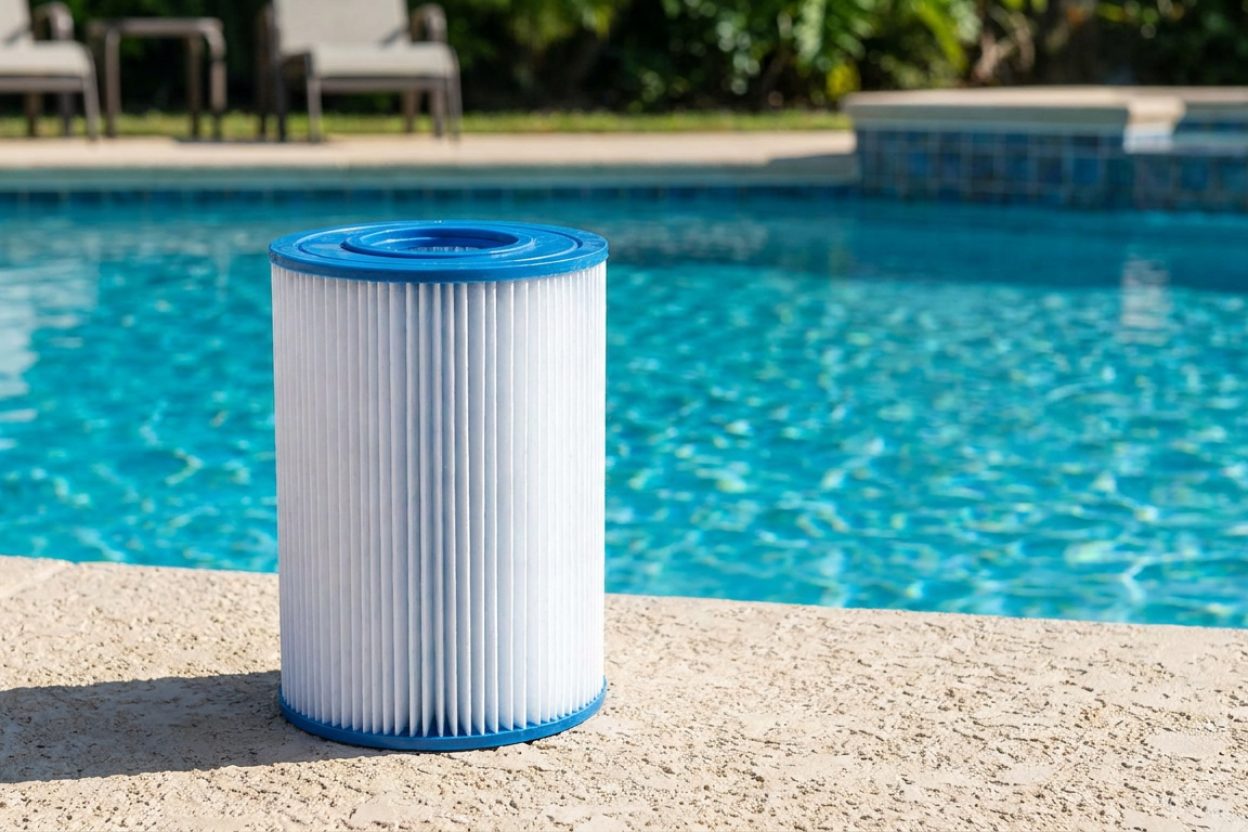
Pool Filter Balls vs Sand: Complete Replacement Guide

Can I replace my sand filter media with filter balls instead?
Read full question
Noticed my pool filter isn't performing like it used to — can't afford professional service right now, so is switching from sand to filter balls a DIY job under $100? The pool store mentioned they might work better than traditional sand, but I want to make sure before I make the switch.
Are filter balls actually a good replacement for sand in my filter system? I'm curious about things like how well they filter compared to sand, if they're easier to work with, and whether the maintenance routine changes at all. Any guidance would be really helpful!
Quick Answer
Filter balls work in a sand filter, and a few things are just true: a small bag replaces a 50-pound bag of sand, they're washable, and they run at lower pressure than packed sand. Everything past that is unsettled — how well they filter, how often they need cleaning, and how long they last are things owners report differently, and the 3-micron figure is a manufacturer claim not a proven number. The real reason to try them is weight and handling; performance you'll judge for yourself.
Understanding Filter Ball Technology
Pool filter balls are a lightweight, washable alternative to traditional sand media. Each ball is made of tightly wound polyethylene fibers that create a dense maze for water to pass through. Where sand strains particles mainly at the surface, filter balls use depth filtration—trapping debris throughout the fiber mass—and the fibers are designed to compress slightly under flow to tighten that maze.
How well that works in practice is where reports diverge. Many owners get water every bit as clear as sand; others describe fine dirt slipping back to the pool through the returns (channeling), where water finds a path through gaps in the packed fibers instead of filtering evenly. Sand isn't immune to its own quirks—it slowly rounds off over many years and can channel if the bed is disturbed—so neither medium is flawless. The honest summary is that fiber media is newer and less proven than sand, not that it's worse.
Filtration Performance Comparison
Traditional sand filters typically capture particles down to about 20-40 microns. Manufacturers claim filter balls trap particles as small as 3 microns—which, if accurate, would actually beat most cartridge filters (commonly 10-20 microns), not just match them. That's a big claim for a simple fiber medium, and there's no independent testing behind it, so it's best read as marketing rather than a verified spec. Real-world clarity reports run the full range: plenty of owners see results on par with sand, some see better, some see worse.
One thing that is consistent: filter balls run at lower pressure and let water move more freely than a packed sand bed. That's usually a plus, but low pressure on its own isn't proof of good filtration—if pressure is low and the water is cloudy, that points to channeling rather than cleaner water. Most pool systems are somewhat oversized, so a modest pressure drop is normally fine; just watch your gauge and your water clarity together for the first few weeks.
Installation Process
Removing Existing Sand
- Turn off the pump at the breaker (lockout/tagout) so it can't start while you work.
- Open the air relief valve on top of the tank, then pull the drain cap or plug at the bottom of the filter body to let the tank drain. (The multiport valve position doesn't empty the tank—the bottom drain does.)
- Remove the multiport valve or top-mount assembly.
- Carefully lift out the standpipe and laterals—these are fragile and expensive to replace.
- Remove the old sand with a wet/dry vacuum or by hand with a small container.
- Inspect the laterals for cracks or damage while they're exposed.
Installing Filter Balls
- Reinstall the standpipe and lateral assembly, checking alignment, seal integrity, and that every lateral is seated correctly.
- Add the balls gradually, distributing them evenly around the standpipe.
- Match the amount to your filter's rated sand capacity using the product's coverage chart—roughly 1 to 1.5 pounds of balls per 50 pounds of sand the tank normally holds, so a 200-300 lb tank needs several bags, not one. Ratios vary a lot by brand, so follow the chart on the bag you bought.
- Gently hand-compress the balls to remove large air pockets without overpacking.
- Reinstall the multiport valve, replacing gaskets if needed.
- Reconnect the plumbing and restore system pressure slowly.
Initial System Setup
After installation, run a backwash cycle immediately to flush any loose fibers and settle the media. Set the multiport valve to "Backwash" and run for 2-3 minutes until the waste line runs clear, then follow with a 30-second rinse before returning to "Filter." Monitor your pressure gauge closely for the first week. Filter balls usually start at a lower baseline than sand, often 2-4 PSI lower; establish that new baseline and plan to backwash when pressure climbs 8-10 PSI above it.
Maintenance and Longevity
Day to day, filter balls use the same backwash routine as sand: backwash when pressure rises about 8-10 PSI above your established baseline. Some owners find the balls need cleaning more often than sand because fiber media can hold onto fine gunk that a quick backwash doesn't fully clear; others run them for weeks without trouble. How often you'll backwash depends on your pool, your bather load, and the brand—it's not something testing has pinned down.
Lifespan is the same story. Sand has a long, known track record—commonly 5-7 years or more before it needs changing—simply because it's been used in pools for decades. Filter balls are newer, and reports range widely: some owners replace them within a year or two, others get longer with light use and careful cleaning, and manufacturers often claim up to 5 years. There isn't independent data to settle which is typical, so budget conservatively and judge by how your own set holds up. When backwashing stops bringing pressure back down, you can often refresh the balls by washing them in a washing machine on a gentle, cold cycle with liquid detergent (no fabric softener, low or no spin); rinse them thoroughly before reinstalling so leftover detergent doesn't foam in the pool. It helps, though it gets less effective as the fibers wear.
Chemical Compatibility and Water Balance
Filter balls work with all standard pool chemicals and don't throw off your water balance the way some alternative media can. Keep following normal water chemistry: maintain free chlorine (FCFree Chlorine — The chlorine actively sanitizing your water right now. This is the number you keep an eye on. how much you need →) against your stabilizer (CYACyanuric Acid (stabilizer) — Sunscreen for your chlorine — it keeps sunlight from burning it off. The catch: the more you have, the more chlorine you need to keep. learn more →) level using a standard FC/CYAFC/CYA chart — The chart that sets your chlorine target from your stabilizer (CYA) level — the two go together. see the chart → chart, keep pH between 7.4-7.6, and total alkalinity between 80-120 ppm for a chlorine pool.
Don't count on the filter itself changing your chemical use much in either direction—filtration removes particles, but sanitizer demand is driven mainly by sunlight, bather load, and organics in the water. If you ever notice rising chlorine demand or water that won't clear, deep-clean the balls in case trapped organics are part of the problem.
Common Concerns and Solutions
Fiber Shedding
Some users report white fibers returning to the pool, especially in the first few weeks. This is usually normal and settles after several backwash cycles. If it persists, check that your laterals aren't cracked and letting media bypass into the returns.
Pressure Issues
Unusually high starting pressure often means the balls are overpacked—remove some media to restore flow. If pressure stays very low and the water looks poorly filtered, add more balls until you reach proper density.
Cost-Benefit Analysis
Filter balls run about $20-45 per bag depending on size and brand, and a typical sand filter needs enough to match its sand capacity—often more than one bag for a mid-size or larger tank, so price the full amount, not a single bag. Sand is cheaper up front ($15-25 a bag), so the case for balls isn't about saving money; it's about weight and handling—no hauling and pouring 50- to 100-pound bags of sand—plus the lower running pressure.
That handling advantage is the part you can count on. The performance questions—how finely they filter and how long they last—are genuinely unsettled, so treat filter balls as a reasonable, newer alternative worth trying rather than a guaranteed upgrade. They make the most sense on smaller above-ground pools where the weight savings are most welcome, but plenty of owners run them happily on larger pools too. Try a set, watch your pressure and clarity, and keep the sand option open if the results don't satisfy you.
For the full breakdown of safe chlorine levels by CYA level, see our pool water chemistry guide.
Still need help? Ask a Pool & Spa Expert AD
Get a personalized answer from PoolGuy810 — 30 years owning a pool and spa repair company. Describe your issue and get step-by-step help.
Related Pool Guides
Need More Help?
Try our free pool calculators and tools to help diagnose and fix your pool problems.
Browse Pool ToolsSLAM calculator, pH calculator, salt dosing & more