
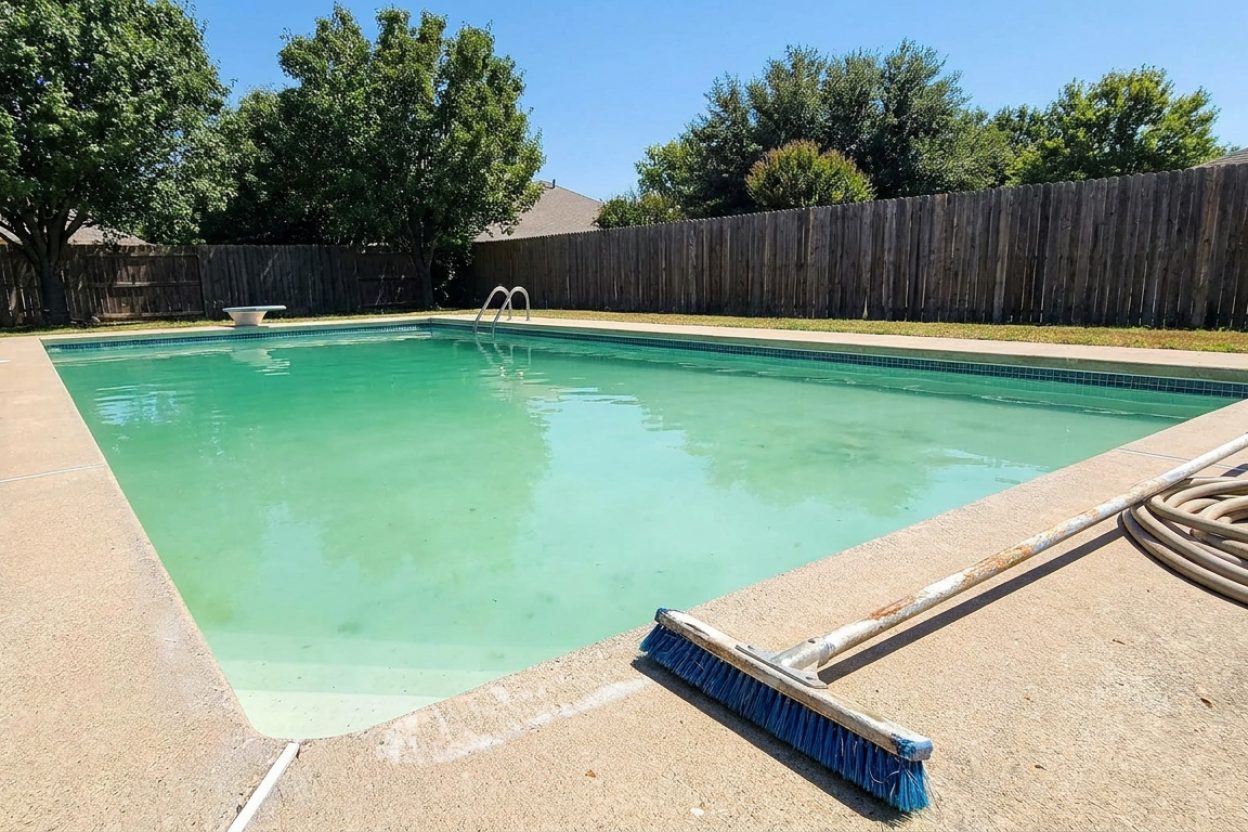
Pool Algaecide Types: Quat vs Poly-Quat vs Copper

Quat vs. Poly-Quat vs. Copper Algaecide — What's the Difference?
Read full question
Nobody warned me the algaecide aisle would feel like a chemistry exam. My pool store's manual just says 'add algaecide weekly,' but when I actually went to buy some, there were four completely different product types all using that same word — a cheap 'quat' bottle for $14, a poly-quat one for $50, a blue copper-based formula, and something mentioning sodium bromide. The manual acts like they're interchangeable, which clearly they're not given the price gap.
I've got a 20,000-gallon plaster pool that stays open May through October here in Georgia. Right now I'm in maintenance mode — no visible algae — but last summer I had a bad mustard algae breakout that took weeks to clear. I want to actually understand what I'm buying this time. Which of these types is doing what, which ones foam, which ones can stain my plaster, and which one makes the most sense for weekly prevention versus nuking an active bloom?
Quick Answer
The short answer: for a plaster pool in maintenance mode, a polymer (poly-quat) algaecide is your best bet — non-foaming, non-staining, and long-lasting. Cheap quats work but foam and need frequent re-dosing. Copper-based products hit active blooms fast but risk staining plaster. Each type has a specific job, and picking the right one depends on whether you're preventing or fighting.
Start Here: The Right Pick for Most Maintenance Situations
If you're not dealing with an active algae outbreak right now and you just want dependable weekly prevention on a plaster pool, skip the cheap quat and go straight to a polymer (poly-quat) algaecide. It's the most expensive option on the shelf, but it's the one least likely to cause you headaches — no foaming, no staining risk, and a much longer window before your next dose. Premium poly-quat products in 60% concentration represent what the top tier looks like — check current pricing at your local pool supply store or retailer, as costs vary by brand and region. Now let's break down why, and when the other types actually make sense.
The Four Types, Plainly Explained
Quaternary Ammonium (Quat) — The Cheap One
This is what's usually in those $12–$18 quart bottles labeled "10%" or "50%" concentration. Quats are cationic surfactants — they carry a positive electrical charge, and since algae cell membranes carry a negative charge, the quat molecules are attracted to the cell wall and disrupt it until the cell dies. It's a legitimate mechanism, and for green algae prevention in a heavily-used or warm-weather pool, quats work. The catch is that surfactants foam, and if you overdose even slightly — or if your pool has any agitation from jets or a waterfall — you'll get a frothy surface. They also need to be re-applied every one to two weeks in hot weather. For a pool like yours in Georgia, that's a lot of re-dosing through summer.
Polymer (Poly-Quat) — The Premium Workhorse
Poly-quats use the same basic positive-charge-attracts-negative-algae principle, but the molecules are much larger, longer-chain polymers. That size difference matters: the larger polymer chains are thought to interact with algae cell membranes more broadly, which contributes to their effectiveness — though the exact mechanism is more nuanced than simple cell rupture. Because they aren't surfactants in the traditional sense, they don't foam, and because they contain no metals, there's no staining risk on plaster or vinyl. They're sold in 30% and 60% concentrations, with 60% being the better value even though the sticker price is higher. Some manufacturers claim extended protection windows — always follow the specific product's label interval as a baseline, and be prepared to dose more frequently in hot weather or high-use conditions. This is the category I'd point most plaster pool owners toward for routine use.
Metallic (Copper-Based) — The Fast Responder
Copper-based algaecides work differently — copper ions penetrate the algae cell wall and interfere directly with photosynthesis and metabolic enzymes. Copper formulas can help against green and mustard algae blooms; black algae is significantly harder to eradicate due to its protective outer layers and typically requires more aggressive mechanical brushing and shock treatment in addition to any algaecide. Given your history with mustard algae, this category is worth understanding. Copper-based products are typically sold in concentrations ranging from around 3% to 10% copper — check the label for the active ingredient percentage, as dosing and risk vary accordingly. The tradeoff is real: copper can stain plaster, concrete, and vinyl if your water chemistry isn't balanced first, especially if your pH is low or your total alkalinity is out of range. Many newer formulas use "chelated" copper — meaning the copper ions are chemically bound to a carrier molecule that keeps them dissolved and reduces (but doesn't eliminate) staining risk. They can also temporarily suppress your free chlorine, so don't rely on them as a chlorine substitute. The rule of thumb: copper algaecides are a treatment tool, not a maintenance routine. Use them to hit a bloom hard, then switch back to poly-quat for ongoing prevention.
When Algaecide Isn't Enough — Consider a Full SLAM
For stubborn black algae or catastrophic infestations, no algaecide category is likely to solve the problem on its own. Black algae in particular has a protective outer layer that makes it extremely resistant to chemical treatment alone. At that point, a full SLAM (Shock, Level, and Maintain) process — combined with aggressive mechanical brushing — is usually more practical and more effective than reaching for a specialty algaecide. Most residential pool owners dealing with severe outbreaks will get better results from a thorough SLAMShock Level And Maintain — raise free chlorine to a target based on your CYA and hold it there until the algae is gone. It's a process, not a one-time dose. the SLAM walkthrough → than from any product on the algaecide shelf.
The Foam and Stain Breakdown at a Glance
- Quats: Can foam if over-applied or with agitation. No staining risk.
- Poly-Quats: Non-foaming. No staining risk. Safe for plaster, vinyl, and fiberglass.
- Copper-based: No foam. Staining risk on plaster and vinyl — use chelated formulas and balance water chemistry first. Can temporarily deplete chlorine.
- Severe outbreaks: Consider a full SLAM process rather than relying on algaecide alone. Aggressive mechanical brushing is essential for black algae.
How to Dose Without Guessing
Dosing varies significantly by product concentration and type — a 10% quat and a 60% poly-quat require very different volumes for the same pool. Always start with the label dose for the specific product you have. As a starting point for estimating how much you need, you'll want to know your pool's exact volume — our pool volume calculator can nail that down quickly if you're not sure.
One more thing worth emphasizing: algaecide works best in properly balanced water. If your pH is off or your free chlorine is depleted, even the best poly-quat won't perform well. Free chlorine targets aren't one-size-fits-all — they scale with your CYACyanuric Acid (stabilizer) — Sunscreen for your chlorine — it keeps sunlight from burning it off. The catch: the more you have, the more chlorine you need to keep. learn more → (stabilizer) level, which is especially important in a hot-weather Georgia pool. See our pool water chemistry guide for how those numbers interact before you add anything to your water.
The Practical Recommendation for Your Situation
For your 20,000-gallon plaster pool in maintenance mode: use a 60% poly-quat algaecide as your weekly or monthly preventive treatment. When mustard algae shows up again — and in Georgia heat, it might — switch to a chelated copper formula as a targeted treatment, make sure your pH and chlorine are dialed in first to minimize staining risk, and then return to the poly-quat routine once the bloom is cleared. The cheap quat is fine in a pinch, but the foaming and re-dosing frequency make it a false economy on a pool your size.
Still need help? Ask a Pool & Spa Expert AD
Get a personalized answer from PoolGuy810 — 30 years owning a pool and spa repair company. Describe your issue and get step-by-step help.
Related Pool Guides
Need More Help?
Try our free pool calculators and tools to help diagnose and fix your pool problems.
Browse Pool ToolsSLAM calculator, pH calculator, salt dosing & more