
Can Pool pH Be Too High? Problems & How to Lower It

Is my pool pH too high? Kids getting irritated eyes
Read full question
Between my pool test strips screaming dangerously high pH and my kids' eyes burning like fire every swim, something's definitely not adding up here. I tested it yesterday and it's reading around 8.0, which seems higher than normal. The water also looks a bit cloudy even though I've been adding chlorine regularly.
I'm concerned about whether it's safe for the kids to keep swimming. What problems does high pH actually cause, and how can I bring it down safely? I want to make sure the water quality is good before they get back in the pool.
Quick Answer
Yes, pool pH can definitely be too high. When pH exceeds 7.8, it causes cloudy water, reduced chlorine effectiveness, and equipment scaling, plus water that can feel slippery or dry (burning eyes are more often from chloramines than from high pH). Lower it gradually with muriatic acid or sodium bisulfate.
Problems Caused by High pH
High pool pH creates a cascade of issues that affect both your pool equipment and swimming experience:
Reduced Chlorine Effectiveness
This is the most critical problem. At pH 8.0, only about a quarter of your chlorine is in the strong, active (hypochlorous acid) form, and by pH 8.5 roughly 10% is. (These are the active-form fractions — shorthand, not a literal kill rate, since the weaker hypochlorite ion still sanitizes a little.) The effect is still real: at high pH, even an adequate chlorine reading sanitizes much more slowly, leaving swimmers vulnerable to bacteria and algae growth.
Cloudy Water and Scale Formation
High pH causes calcium carbonate to precipitate out of solution, creating that milky, cloudy appearance. This calcium also deposits as scale on your pool surfaces, tile line, and equipment. Once scale forms, it's difficult and expensive to remove, often requiring acid washing or media blasting.
Equipment Damage
Scale buildup in your heater, pump, and filter reduces efficiency and shortens equipment life. Heat exchangers are particularly vulnerable - scale acts as an insulator, forcing your heater to work harder and potentially causing expensive damage.
Swimmer Discomfort
High pH water can feel slippery and leave skin feeling dry. Note that burning eyes and itchy skin are usually caused by combined chlorine (chloramines) or water that is well off-balance, more than by mildly elevated pH alone.
What Causes High Pool pH
Understanding why pH rises helps prevent future problems:
- Aeration: Water features, returns pointed upward, and heavy swimmer activity drive off CO2, raising pH
- High Total Alkalinity: When TATotal Alkalinity — The buffer that keeps your pH from bouncing around. Get this in range and pH gets a lot easier to manage. learn more → is high, it strongly buffers pH and tends to let pH drift upward over time as CO2 off-gasses
- Liquid chlorine additions: Most liquid chlorine has a pH around 13, gradually raising pool pH
- Plaster pools: New plaster continuously releases calcium hydroxide, driving pH up for months
- Saltwater chlorine generators: The electrolytic process naturally raises pH
How to Lower Pool pH Safely
Lowering pH requires acid, but the process must be done carefully and gradually.
Choose Your Acid
Muriatic acid (hydrochloric acid) is the most cost-effective option. It's typically sold at about 31% (full strength) or about 14.5% (a safer diluted version) and works quickly. However, it also lowers total alkalinity along with pH.
Sodium bisulfate (dry acid) is safer to handle and store, but more expensive. It has less impact on total alkalinity than muriatic acid.
How Much to Add
For muriatic acid, use approximately 1 pint per 10,000 gallons to lower pH by 0.2-0.3 points (actual reduction varies based on starting alkalinity and pH levels). For sodium bisulfate, use about 1.5 pounds per 10,000 gallons for the same pH reduction. Always start with smaller amounts - you can add more, but you can't take it out. For the amount that fits your pool, size the dose with our pool calculator rather than working it out by hand, then add gradually and retest.
Application Process
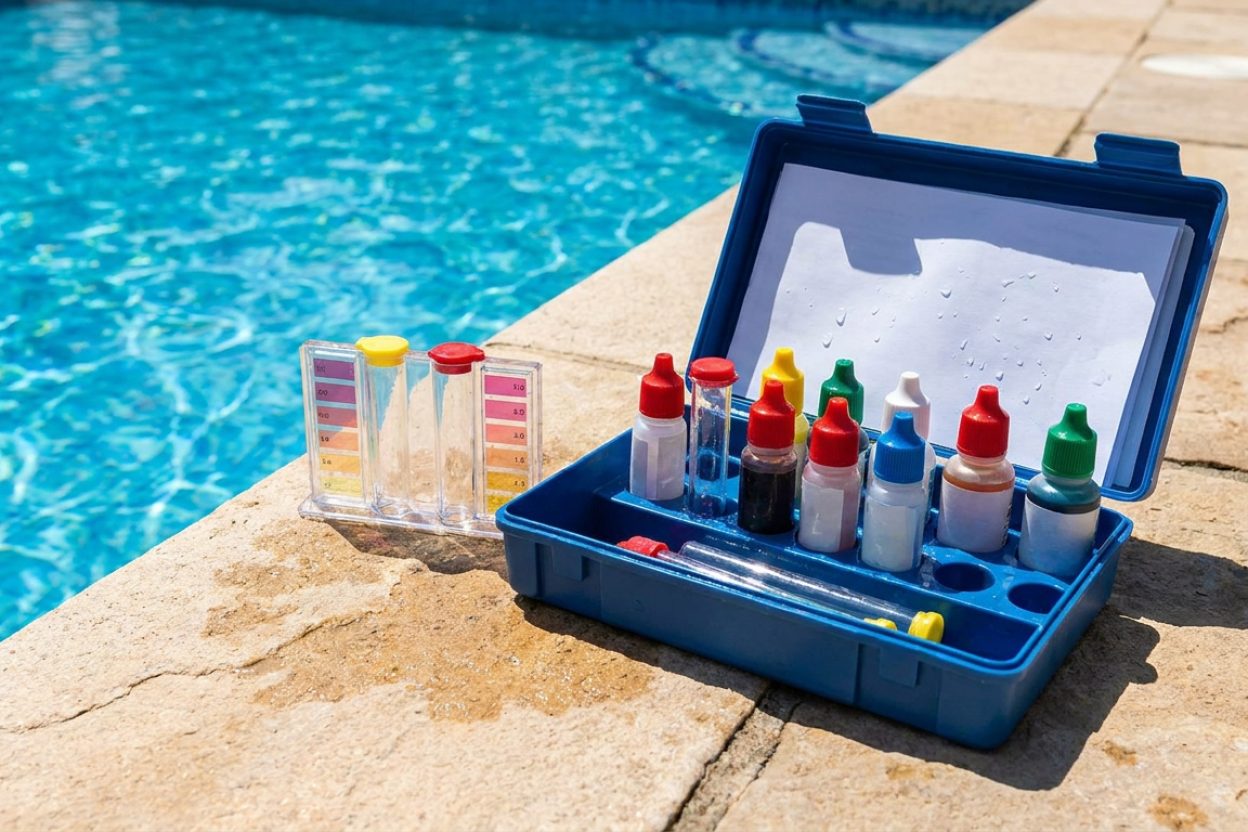
- Test your current pH and total alkalinity levels using a reliable test kit like the Taylor K-2006
- Turn on your circulation system
- Add acid to the deep end of the pool with the pump running (always add acid to water, never add water to acid)
- For muriatic acid, pour it slowly near a return jet (or along the deep-end wall) close to the water surface while standing upwind
- For sodium bisulfate, pre-dissolve in a bucket of pool water, then distribute evenly
- Allow circulation for at least 2 hours before retesting
- Retest and repeat if necessary, but never lower pH more than 0.4 points at once
Managing Total Alkalinity
If your pH keeps rising despite treatment, your total alkalinity is likely too high. The target range is 80-120ppm for regular pools, or 60-80ppm for saltwater pools.
When total alkalinity is high, lower it with the acid-and-aerate method: add muriatic acid (pump on, poured slowly in front of a return) to bring pH down to about 7.0-7.2, then aerate the water (point returns up to break the surface, run waterfalls or spa jets) to drive pH back toward 7.6 while alkalinity stays down. How you pour the acid does not change this - a given dose lowers pH and TA together no matter how it is distributed (TFP/onBalance). Retest and repeat the acid-then-aerate cycle until TA reaches the target range.
Prevention Strategies
Preventing high pH is easier than constantly correcting it:
- Maintain proper total alkalinity levels
- Adjust water features and returns to minimize aeration
- For saltwater pools, add muriatic acid weekly as part of regular maintenance
- Monitor pH twice weekly during swimming season
- Address rising trends early rather than waiting for pH to spike
When to Call a Professional
Contact a pool professional if: pH consistently rises despite proper chemical balance, you're uncomfortable handling acids, or you have scale buildup requiring removal. Some situations, particularly in new plaster pools or with severe scale problems, benefit from professional expertise.
Remember, maintaining proper pH isn't just about water clarity - it's essential for sanitizer effectiveness, equipment longevity, and swimmer comfort. Regular testing and gradual adjustments will keep your pool in the ideal 7.2-7.6 range.
For the full breakdown of safe chlorine levels by CYACyanuric Acid (stabilizer) — Sunscreen for your chlorine — it keeps sunlight from burning it off. The catch: the more you have, the more chlorine you need to keep. learn more → level, see our pool water chemistry guide.
 Taylor K-2006C Complete FAS-DPD Pool & Spa Test Kit
The FAS-DPD kit pool pros trust — reads chlorine accurately even at shock/SLAM levels, plus pH, alkalinity, calcium hardness and CYA. View on Amazon →
Taylor K-2006C Complete FAS-DPD Pool & Spa Test Kit
The FAS-DPD kit pool pros trust — reads chlorine accurately even at shock/SLAM levels, plus pH, alkalinity, calcium hardness and CYA. View on Amazon →
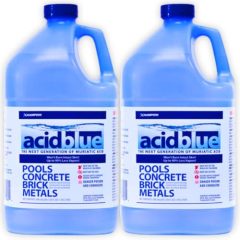 Acid Blue - Low Fume Muriatic Acid for Swimming Pools & Spas - Lower's pH, Reduces Alkalinity - 2 Gallon
View on Amazon →
Acid Blue - Low Fume Muriatic Acid for Swimming Pools & Spas - Lower's pH, Reduces Alkalinity - 2 Gallon
View on Amazon →
Still need help? Ask a Pool & Spa Expert AD
Get a personalized answer from PoolGuy810 — 30 years owning a pool and spa repair company. Describe your issue and get step-by-step help.
Related Pool Guides
Need More Help?
Try our free pool calculators and tools to help diagnose and fix your pool problems.
Browse Pool ToolsSLAM calculator, pH calculator, salt dosing & more