
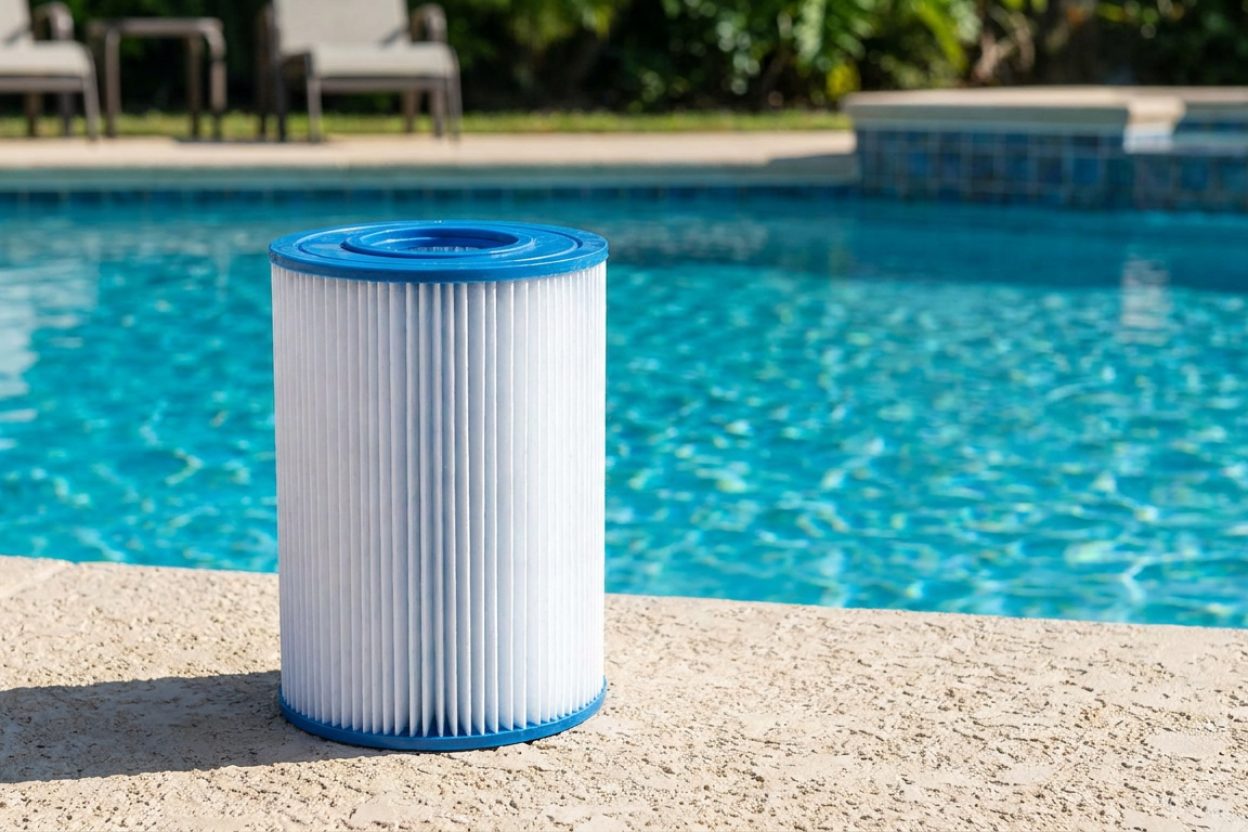
How Long Do Pool Cartridge Filters Last? Replacement Guide

How often should I replace my pool cartridge filters?
Read full question
Between my pool store saying 2-4 weeks and everything online claiming 2-4 months, I'm completely lost on when to actually replace my cartridge filter. How long between cleanings? When do I throw them out completely and buy new ones?
Running my pool daily during summer. Want to stay on top of maintenance but not waste money replacing too early.
Quick Answer
Clean a cartridge filter when pressure rises about 8-10 PSI (roughly 25%) above the clean reading, not on a fixed calendar — in practice that's often every 1-3 months, and a well-sized filter can go a full season. Replace the cartridge entirely every 2-5 years depending on usage, bather load, and care.
Cleaning vs. Replacement Schedule
Between Cleanings: Driven by Pressure
How fast the pressure climbs depends on several factors:
- Pool usage: Heavy bather load reduces time to 1-2 weeks
- Environmental conditions: Pollen, dust, and debris shorten intervals
- Water chemistry: Poor balance leads to faster clogging
- Filter size: Larger surface area lasts longer between cleanings
Complete Replacement: Every 2-5 Years
Even with regular cleaning, cartridge filter media eventually breaks down. Replace filters when you notice:
- Pleats starting to fray or separate
- Filter media becoming discolored or stained
- Cleaning becomes less effective
- Pressure differential increases quickly after cleaning
Signs Your Filter Needs Attention
Time to Clean (Weekly Check)
Monitor your pressure gauge weekly. When pressure rises 8-10 PSI above the clean starting pressure, it's time to clean your cartridges. For example, if your clean pressure is 12 PSI, clean when it reaches 20-22 PSI.
Time to Replace (Monthly Assessment)
Inspect cartridges monthly for these replacement indicators:
- Frayed pleats: Media separating from the plastic frame
- Permanent staining: Brown, green, or yellow discoloration that won't clean off
- Shortened cleaning cycles: Pressure rises faster than usual after cleaning
- Visible wear: Thin spots or holes in the filter media
- Poor water clarity: Cloudy water despite proper chemistry
Factors That Affect Filter Life
Pool Usage Patterns
Bather load dramatically impacts filter life. Each swimmer introduces oils, lotions, hair products, and organic contaminants. A busy family pool or one used for entertaining will require cleaning every 1-2 weeks, while a lightly used, well-balanced pool can go several months — sometimes a full season.
Environmental Conditions
Your location affects filter longevity:
- Windy areas: More debris means more frequent cleaning
- Trees nearby: Leaves, pollen, and organic matter reduce intervals
- Dusty climates: Fine particles clog filters faster
- Rainy seasons: Increased organic growth and debris
Water Chemistry Balance
Proper water balance extends filter life significantly. Maintain these TFP-recommended levels:
- pH: 7.4-7.6 for comfort and balanced water
- Free Chlorine: Follow the FC/CYAFC/CYA chart — The chart that sets your chlorine target from your stabilizer (CYA) level — the two go together. see the chart → relationship — our all-in-one pool calculator estimates the free chlorine target for your CYACyanuric Acid (stabilizer) — Sunscreen for your chlorine — it keeps sunlight from burning it off. The catch: the more you have, the more chlorine you need to keep. learn more →.
- Total Alkalinity: 60-80 ppm for SWGSalt Water Generator — The "salt cell" that makes chlorine from the salt in a saltwater pool. Same chlorine — it just makes its own. pool terms →, 80-120 for regular chlorine
- Calcium Hardness: 250-350 ppm for plaster pools
Poor chemistry leads to algae growth, scale formation, and increased organic loading that clogs filters rapidly.
Maximizing Filter Lifespan
Rotation System
Use a two-set rotation system. While one set filters your pool, the other set air-dries completely. This rotation extends filter life and ensures you always have clean filters ready.
Proper Cleaning Technique
Clean cartridges with a garden hose spray nozzle, working from top to bottom at a 45-degree angle. Avoid pressure washers, which damage the filter media. For deep cleaning, soak in a cartridge cleaner/degreaser, and only if mineral scale remains, follow with a brief dilute acid soak (about 1 part acid to 20 parts water; wear safety gear).
Chemical Balance Maintenance
Test water 2-3 times weekly using a Taylor K-2006C test kit. Maintain proper sanitizer levels to prevent algae growth that rapidly clogs filters. If water turns green, immediately begin a SLAMShock Level And Maintain — raise free chlorine to a target based on your CYA and hold it there until the algae is gone. It's a process, not a one-time dose. the SLAM walkthrough → process using liquid chlorine to restore clarity and reduce filter strain.
When to Replace Prematurely
Sometimes filters need early replacement:
- After algae blooms: Green water events can permanently stain and clog filters
- Following storms: Heavy debris loads may damage filter media
- Chemical accidents: Over-chlorination or pH swings can degrade filter material
- Winter damage: Freezing can crack or damage cartridge frames
Cost-Effective Filter Management
Quality cartridge filters cost $15-40 each, making replacement a significant expense. Extend value by:
- Buying filters in bulk during sales
- Maintaining proper water chemistry to prevent premature clogging
- Using a skimmer basket and leaf trap to reduce debris load
- Showering before swimming to reduce oils and lotions
Safety Note: When using muriatic acid for deep cleaning, always wear gloves, eye protection, and work in a well-ventilated area. Add acid to water, never water to acid.
For the full breakdown of safe chlorine levels by CYA level, see our pool water chemistry guide.
Still need help? Ask a Pool & Spa Expert AD
Get a personalized answer from PoolGuy810 — 30 years owning a pool and spa repair company. Describe your issue and get step-by-step help.
Related Pool Guides
Need More Help?
Try our free pool calculators and tools to help diagnose and fix your pool problems.
Browse Pool ToolsSLAM calculator, pH calculator, salt dosing & more