
Ducks in Your Pool? How to Keep Them Out for Good

Ducks Won't Stop Using My Pool — How Do I Get Rid of Them?
Read full question
Three straight days of rain last week apparently convinced a pair of mallards that my backyard pool is their new favorite pond. Every morning I come out and they're splashing around on the steps and leaving droppings all along the waterline and on the surrounding deck. It's pretty gross to deal with, and I'm starting to wonder whether the water itself is even safe to swim in after all that.
I've heard mixed things about those floating alligator decoys or the big plastic swan deterrents you can buy online — do those actually work, or do ducks wise up to them pretty quickly? I'd rather not spend money on something that only works for a week before they ignore it completely.
My bigger concern right now is honestly the water safety side of things. Is duck waste a real health hazard for swimmers, or am I overthinking it? And if I do need to treat the pool after a duck visit, what's the right way to do that? We have a 20,000-gallon in-ground with a salt chlorinator if that matters.
Quick Answer
Ducks in your pool are more than just a nuisance — their droppings can introduce harmful bacteria and put a real strain on your sanitizer. The most effective long-term strategy combines physical deterrents (like a solar cover or motion-activated sprinkler) with consistent water chemistry, including a chlorine shock after any significant duck activity. Visual decoys alone tend to lose their effectiveness quickly once ducks realize they pose no real threat.
When Your Pool Becomes a Duck Pond
It starts innocently enough — a pair of mallards gliding around on a quiet morning. But by the time you're scrubbing duck droppings off your pool steps for the third day in a row, the novelty has worn off completely. This is a surprisingly common problem, especially after rainy stretches when nearby ponds and puddles overflow and birds go looking for calmer water. The good news is there are reliable ways to stop it. The less good news: some of the most popular solutions don't work nearly as well as advertised.
The Honest Truth About Decoys
Let's address the alligator heads and plastic swans right away, because this question comes up constantly. Visual decoys can work — but typically only for a short time. Ducks are smarter than they look. A floating alligator that never moves, never changes position, and poses zero actual threat will be ignored within a week or two once the ducks realize nothing bad ever happens near it. If you do use a decoy, you need to move it to a different spot every day or two to maintain the illusion of a real predator. Even then, determined ducks often figure it out.
The same logic applies to plastic owl statues on the fence — static deterrents have a limited shelf life. They're worth trying as part of a layered strategy, but don't rely on them alone.
What Actually Keeps Ducks Out
Physical Barriers (Most Reliable)
The single most effective duck deterrent is also one you may already own: a solar cover or safety cover. If the water surface is covered when the pool isn't in use — especially overnight and in the early morning hours when ducks are most active — they simply have nowhere to land. This is the no-fail solution, and it has the bonus of reducing evaporation and cutting your heating costs.
If a cover isn't practical for your setup, consider these alternatives:
- Motion-activated sprinklers — These are highly effective. Ducks startle easily, and a sprinkler that fires whenever something approaches the pool edge will deter them quickly. After a few unpleasant surprises, most birds move on for good.
- Pool noodles or fishing line strung across the surface — Sounds low-tech, but ducks prefer to land directly on open water. Crisscrossing the pool with a few lines of monofilament fishing line — spaced close enough that ducks can't easily glide between them — makes landing uncomfortable and uninviting. Many pool owners report excellent results with this method.
- A dog — If you happen to have one, letting your dog patrol the yard in the morning is extremely effective. Even the presence of a dog's scent near the pool edge can be enough to redirect wildlife elsewhere.
- Liquid deterrent sprays — Products containing methyl anthranilate (a grape-derived compound that birds find irritating but is harmless) can be applied around the pool deck and steps. These need to be reapplied after rain, but they work well as a complement to other methods.
Layering Your Approach
The most successful duck management uses two or three of these methods simultaneously. A motion sprinkler at one end of the pool, fishing line across the surface, and a decoy that gets repositioned every couple of days is a far more convincing deterrent package than any single method on its own.
Is Duck Waste Actually a Health Risk? Yes — Take It Seriously
This isn't overthinking it. Duck droppings can carry pathogens including E. coli, Salmonella, Cryptosporidium, and Campylobacter. Crypto is worth singling out because it's extremely chlorine-tolerant — a standard shock will clear the bacteria (E. coli, Salmonella, Campylobacter) but will not reliably kill Crypto, especially in a salt pool with elevated CYACyanuric Acid (stabilizer) — Sunscreen for your chlorine — it keeps sunlight from burning it off. The catch: the more you have, the more chlorine you need to keep. learn more →. The CDC's Crypto protocol requires reaching a CT of 15,300 (for example, 20 ppm free chlorine for about 12.75 hours) with CYA reduced to near zero — impractical for a routine duck visit, which is why Crypto from a couple of mallards is a low-probability risk rather than something a normal shock 'solves.' The CDC has documented recreational water illness outbreaks tied to waterfowl contamination, so this is a real concern, not a theoretical one.
The volume of droppings matters too. A pair of ducks visiting daily can produce a significant biological load, and if your free chlorine has been running low (which is easy to miss on a salt system if the cell needs cleaning or the output is set too conservatively), that contamination can linger.
How to Treat the Water After Duck Activity
If ducks have been regularly using your pool, especially if you've noticed visible droppings in the water or on the steps, Treat it as a contamination event and run through a proper shock treatment. The process is similar to the SLAM method: raise your free chlorine to shock level based on your current CYA, hold it there for an extended period (at least 24 hours of sustained elevated chlorine), and confirm with testing before swimming.
Free chlorine targets are not one-size-fits-all — they must be calibrated to your pool's CYA (stabilizer) level. A salt pool often runs higher CYA, which means the chlorine level needed to be effective is also higher. Don't rely on a flat number; check the pool water chemistry guide to find the correct free chlorine target for your specific CYA reading. You can use the chlorine dosing calculator to estimate how much product to add to hit your shock level.
After the shock treatment, run your filter continuously, backwash or clean it as needed, and retest before declaring the water safe. For Crypto specifically, the required contact time only works if CYA is first lowered to near zero (stabilizer makes the CDC's dose-and-time math unachievable at normal levels), and some sources recommend maintaining shock-level chlorine for a longer period than a standard SLAMShock Level And Maintain — raise free chlorine to a target based on your CYA and hold it there until the algae is gone. It's a process, not a one-time dose. the SLAM walkthrough → — the CDC provides guidance on extended contact times for this pathogen if you have reason to believe it may be present.
Keeping It From Happening Again
Once you've treated the water and your deterrents are in place, a few habits will help you stay ahead of the problem. Check your pool every morning during duck season, keep your salt cell output and water chemistry dialed in (a well-sanitized pool is more resilient to contamination events), and consider the solar cover your first line of defense on any night you're not planning to use the pool the following morning. With a consistent approach, most duck pairs will relocate to easier territory within a week or two.
 Taylor K-2006C Complete FAS-DPD Pool & Spa Test Kit
The FAS-DPD kit pool pros trust — reads chlorine accurately even at shock/SLAM levels, plus pH, alkalinity, calcium hardness and CYA. View on Amazon →
Taylor K-2006C Complete FAS-DPD Pool & Spa Test Kit
The FAS-DPD kit pool pros trust — reads chlorine accurately even at shock/SLAM levels, plus pH, alkalinity, calcium hardness and CYA. View on Amazon →
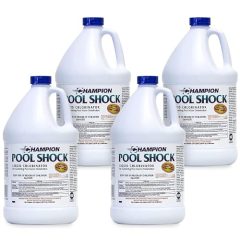 Liquid Chlorine / Sodium Hypochlorite (12.5%)
Everyday sanitizer — the B in BBB View on Amazon →
Liquid Chlorine / Sodium Hypochlorite (12.5%)
Everyday sanitizer — the B in BBB View on Amazon →
Still need help? Ask a Pool & Spa Expert AD
Get a personalized answer from PoolGuy810 — 30 years owning a pool and spa repair company. Describe your issue and get step-by-step help.
Need More Help?
Try our free pool calculators and tools to help diagnose and fix your pool problems.
Browse Pool ToolsSLAM calculator, pH calculator, salt dosing & more