
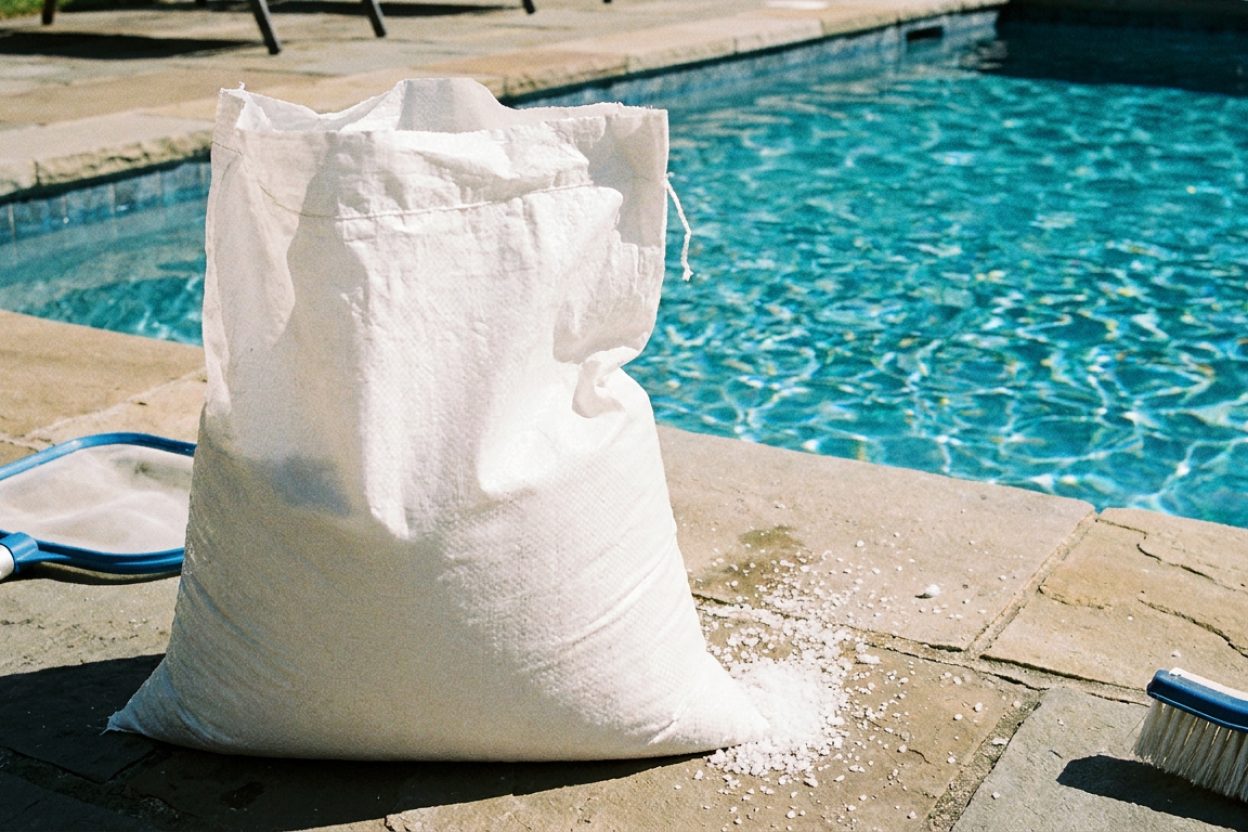
Do Saltwater Pools Need Chemicals? Yes - Here's What You Need

What chemicals do saltwater pools actually need besides salt?
Read full question
Despite having a 15,000 gallon saltwater pool with a functioning salt system, the pool store keeps pushing $200+ worth of chemicals every month. They keep telling me I need all these pH adjusters, alkalinity boosters, and other expensive stuff on top of the salt. I thought the whole point of going saltwater was to avoid dealing with a bunch of chemicals!
I'm looking to handle this myself and cut down on costs, but I want to make sure I'm not missing something important. Does the salt chlorine generator really only make chlorine? What other chemicals do I actually NEED to keep my water balanced, and what can I skip?
Quick Answer
Yes, saltwater pools still need chemicals including pH adjusters, alkalinity increasers, stabilizer, and calcium hardness increasers. The salt chlorine generator only produces chlorine - you must manually balance all other water chemistry parameters. Maintain calcium hardness between 250-350 ppm for plaster pools, or 175-225 ppm for vinyl/fiberglass. Your salt chlorine generator should maintain free chlorine levels around 6-9 ppm automatically (scaling with your CYA level of 70-80 ppm).
Essential Chemicals Every Saltwater Pool Needs
pH Decreaser (Muriatic Acid or Sodium Bisulfate)
Salt chlorine generators naturally raise pH as they operate, often pushing levels above 8.0. You'll need muriatic acid or dry acid to bring pH down to the ideal range of 7.4-7.6. Expect to add pH decreaser weekly or bi-weekly. For a 20,000-gallon pool, start with 1 quart of muriatic acid to lower pH by approximately 0.2 units, then retest after 4 hours of circulation.
Alkalinity Increaser (Sodium Bicarbonate)
Total alkalinity acts as a pH buffer and should stay between 60-80 ppm for saltwater pools (lower than traditional pools). When alkalinity drops too low, pH becomes unstable and difficult to control. Add sodium bicarbonate (baking soda) to bring it back into range. Always broadcast alkalinity increaser evenly across the pool surface with the pump running.
Stabilizer (Cyanuric Acid)
Saltwater pools need adequate stabilizer levels - target 70-80 ppm to protect the chlorine your generator produces. Without adequate stabilizer, sunlight destroys chlorine faster than your SWGSalt Water Generator — The "salt cell" that makes chlorine from the salt in a saltwater pool. Same chlorine — it just makes its own. pool terms → can produce it. Add cyanuric acid (stabilizer) to reach that range. Pre-dissolve stabilizer in a bucket of hot water before adding to prevent cloudy water, or use the SOCK method (put the CYACyanuric Acid (stabilizer) — Sunscreen for your chlorine — it keeps sunlight from burning it off. The catch: the more you have, the more chlorine you need to keep. learn more → in a sock/nylon in the skimmer basket, or hang it in front of a return, squeezing occasionally). Dissolves slowly, retest after a few days or up to a week, don't add more until you're sure.
Calcium Hardness Increaser
Maintain calcium hardness between 250-350 ppm for plaster pools, or 175-225 ppm for vinyl/fiberglass. Low calcium causes corrosive water that damages pool surfaces and equipment. Add calcium chloride to bring hardness into range.
Why Salt Generators Don't Eliminate Chemical Needs
Salt chlorine generators work through electrolysis, converting dissolved salt into chlorine gas and sodium hydroxide. While this process creates sanitizer, it also:
- Tends to raise pH over time—mainly from aeration (CO2 off-gassing), not from the cell dosing lye, since the acidic chlorine offsets the alkaline hydroxide
- Requires balanced water chemistry to function efficiently
- Needs adequate stabilizer levels for chlorine protection
- Cannot adjust alkalinity, calcium hardness, or other parameters
Many pool owners mistakenly believe saltwater pools are "chemical-free," but this misconception leads to water balance problems and equipment damage.
Testing and Maintenance Schedule
Test your saltwater pool chemistry twice weekly using a quality test kit like the Taylor K-2006C. Check free chlorine, pH, total alkalinity, and salt levels each test. Monthly, test cyanuric acid and calcium hardness levels.
Weekly chemical additions typically include:
- pH decreaser (muriatic acid) - most common addition
- Alkalinity increaser as needed
- Salt (sodium chloride) if levels drop below 3,200 ppm
Your salt chlorine generator should maintain free chlorine levels around 6-9 ppm automatically (scaling with your CYA level of 70-80 ppm), but verify this with testing. If chlorine levels stay low despite proper salt levels and generator operation, check your cyanuric acid - insufficient stabilizer causes rapid chlorine loss.
Special Considerations for Saltwater Pools
Salt pools require specific water balance ranges for optimal performance. Keep total alkalinity lower than traditional pools (60-80 ppm) because high alkalinity combined with salt generator operation causes pH to rise rapidly and scale formation on the generator cell.
Safety warning: Never add muriatic acid directly to the skimmer or while people are in the pool. Always add acid to the deep end with the pump running, and wait at least 30 minutes before swimming.
Monitor your generator cell monthly for calcium buildup. If you see white, flaky deposits, the cell needs cleaning with a diluted muriatic acid solution (about 1 part acid to 4 parts water). Proper water balance prevents excessive scaling and extends cell life.
Cost Comparison
While saltwater pools reduce the need for liquid chlorine purchases, you'll still spend money on pH adjusters, alkalinity increasers, and other balancing chemicals. Budget approximately $100-200 annually for chemicals in an average-sized saltwater pool, compared to $300-500 for traditional chlorine pools.
For the full breakdown of safe chlorine levels by CYA level, see our pool water chemistry guide or use the all-in-one pool calculator for an estimate of the free chlorine for your CYA.
 Taylor K-2006C Complete FAS-DPD Pool & Spa Test Kit
The FAS-DPD kit pool pros trust — reads chlorine accurately even at shock/SLAM levels, plus pH, alkalinity, calcium hardness and CYA. View on Amazon →
Taylor K-2006C Complete FAS-DPD Pool & Spa Test Kit
The FAS-DPD kit pool pros trust — reads chlorine accurately even at shock/SLAM levels, plus pH, alkalinity, calcium hardness and CYA. View on Amazon →
 Acid Blue - Low Fume Muriatic Acid for Swimming Pools & Spas - Lower's pH, Reduces Alkalinity - 2 Gallon
View on Amazon →
Acid Blue - Low Fume Muriatic Acid for Swimming Pools & Spas - Lower's pH, Reduces Alkalinity - 2 Gallon
View on Amazon →
 Arm & Hammer Pure Baking Soda (Alkalinity Up)
Raises Total Alkalinity cheaply View on Amazon →
Arm & Hammer Pure Baking Soda (Alkalinity Up)
Raises Total Alkalinity cheaply View on Amazon →
 Pool Mate 4-Pounds Premium Pool Stabilizer and Conditioner, Concentrated Cyanuric Acid for Pools, Helps Chlorine Last Longer
View on Amazon →
Pool Mate 4-Pounds Premium Pool Stabilizer and Conditioner, Concentrated Cyanuric Acid for Pools, Helps Chlorine Last Longer
View on Amazon →
Still need help? Ask a Pool & Spa Expert AD
Get a personalized answer from PoolGuy810 — 30 years owning a pool and spa repair company. Describe your issue and get step-by-step help.
Related Pool Guides
Need More Help?
Try our free pool calculators and tools to help diagnose and fix your pool problems.
Browse Pool ToolsSLAM calculator, pH calculator, salt dosing & more