
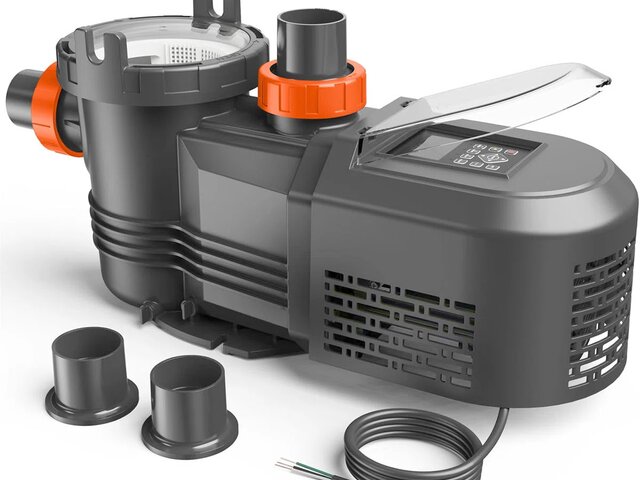
Does Variable Speed Pool Pump Need Timer? Complete Guide

Should I add a timer to my variable speed pump for safer pool?
Read full question
Looked outside this morning and my variable speed pump is cycling on and off randomly throughout the day without any timer system programmed. My kids swim every day after school and I want to make sure the water is always properly circulated and filtered for their safety.
The pump has its own programming features, but I'm concerned about what happens if something goes wrong with the built-in controls. Would having a backup timer give me better peace of mind and help ensure the pool stays clean and safe? I just want to make sure I'm not missing anything that could affect water quality when my children are swimming.
Quick Answer
Variable speed pool pumps don't technically need external timers since most have built-in programming capabilities, but a basic external timer offers only limited backup power-cycling and cannot match or replace the pump's built-in variable-speed scheduling.
Understanding Variable Speed Pump Controls
Variable speed pumps represent a significant advancement over traditional single-speed pumps, and their control systems reflect this sophistication. Most quality variable speed pumps from manufacturers like Pentair, Hayward, and Jandy include built-in digital control panels with comprehensive programming capabilities.
These internal controls allow you to set multiple daily schedules, adjust speeds for different functions (filtration, cleaning, heating), and monitor energy consumption. The pump's onboard computer can manage complex timing sequences that would be impossible with a simple mechanical timer.
Built-in Programming Capabilities
Modern variable speed pumps offer several programming features that eliminate the need for external timers in most situations:
- Multi-speed scheduling: Set different RPM levels for various times of day
- Multiple daily cycles: Program up to 8 different speed settings and run periods per day
- Seasonal adjustments: Modify schedules without rewiring
- Energy optimization: Automatic adjustment for maximum efficiency
- Feature integration: Coordinate with pool heaters, cleaners, and water features
For example, you might program your pump to run at 1,200 RPM for 12 hours during filtration, ramp up to 2,400 RPM for 2 hours during automatic cleaner operation, and boost to 3,200 RPM for 30 minutes when the spa jets activate.
When External Timers Make Sense
Despite built-in capabilities, there are several scenarios where adding an external timer provides value:
Backup Control
An external timer only switches the incoming power; it cannot run the pump if the internal control board fails, because the board is what drives the motor. So a timer is not a true backup for a board failure. Control board replacement can cost $200-400 and take several days to obtain, during which your pool water could deteriorate without circulation.
Utility Time-of-Use Programs
Some utility companies offer special rates for pool equipment that operates only during off-peak hours. An external timer can provide an additional layer of control to ensure your pump never operates during peak rate periods, even if internal programming is accidentally changed.
Integration with Pool Automation Systems
If you have an older pool automation system that wasn't designed for variable speed pumps, an external timer can bridge the compatibility gap while you plan for system upgrades.
Simplified Operation
Some pool owners prefer the simplicity of a basic on/off timer combined with manual speed adjustment, especially if they have consistent daily routines and don't need complex scheduling.
Timer Installation Considerations
If you decide to install an external timer with your variable speed pump, proper installation is crucial:
Electrical Requirements
Safety Warning: Always turn off power at the breaker before working on pool electrical systems. Variable speed pumps typically require 220-240V service and must be installed according to local electrical codes. Note that adding external timers to variable speed pumps with integrated controls may void manufacturer warranties - consult your pump's documentation before installation.
The timer should be installed between the electrical panel and the pump, not between the pump and its control panel. This ensures the pump's internal systems receive power when the timer activates the circuit.
Timer Selection
Choose a timer rated for your pump's electrical requirements. Variable speed pumps typically draw 6-35+ amps at maximum speed depending on horsepower rating, so select a timer rated for at least 125% of your pump's maximum amperage draw at 240V to provide adequate safety margin.
Digital timers offer more programming flexibility than mechanical ones and can handle the complex scheduling that maximizes variable speed pump efficiency.
Optimizing Pump Scheduling
Whether using built-in controls or external timers, proper scheduling is essential for water quality and energy efficiency:
Filtration Scheduling
Run your pump long enough to turn over your pool water at least once daily. Calculate turnover time by dividing your pool volume by your pump's flow rate at your chosen filtration speed. For most residential pools, 8-12 hours at low speed (1,200-1,800 RPM) provides adequate filtration while minimizing energy costs.
Equipment Coordination
Schedule higher speeds when operating pool cleaners, heaters, or water features. Most automatic cleaners require 2,200-2,800 RPM for proper operation, while spa jets might need 3,000+ RPM for adequate flow.
Seasonal Adjustments
Increase run times during summer months when bather loads and temperatures are higher. Winter operation might require only 4-6 hours daily in mild climates, while summer could demand 10-14 hours for optimal water quality.
Energy Efficiency Benefits
Variable speed pumps can reduce energy consumption by 50-90% compared to single-speed pumps, but only with proper programming. Running at lower speeds for longer periods is more efficient than short bursts at high speed due to the pump affinity laws – reducing speed by half cuts energy consumption by approximately 87.5%.
A typical programming schedule might include: 6 hours at 1,200 RPM for basic filtration (using about 100 watts), 2 hours at 2,400 RPM for cleaning cycles (using about 800 watts), and 30 minutes at 3,200 RPM for water feature operation (using about 1,500 watts).
Maintenance and Troubleshooting
Whether using internal or external timers, regular maintenance ensures reliable operation:
- Check timer settings monthly and after power outages
- Clean control panel displays to ensure visibility
- Verify pump is operating at programmed speeds using the display readings
- Test backup timer operation quarterly if installed
- Update programming seasonally for optimal efficiency
If your pump fails to start according to schedule, first check that the timer (internal or external) shows the correct time and programming. Power outages can reset clocks and clear custom programming on some models.
Still need help? Ask a Pool & Spa Expert AD
Get a personalized answer from PoolGuy810 — 30 years owning a pool and spa repair company. Describe your issue and get step-by-step help.
Related Pool Guides
Need More Help?
Try our free pool calculators and tools to help diagnose and fix your pool problems.
Browse Pool ToolsSLAM calculator, pH calculator, salt dosing & more