
How Long to Wait Before Swimming After Pool Chemicals

Safe wait times after adding different pool chemicals?
Read full question
Apparently I'm standing in my garage staring at three different pool chemicals I added this morning with no clue how long I actually need to wait before diving in. Yesterday I added liquid chlorine to bring my levels up from 1.2 ppm to around 3.0 ppm, and I wasn't sure if we could swim that evening or needed to wait until the next day.
I'm planning to shock the pool this weekend with calcium hypochlorite since we've had some cloudy water issues, and I also need to adjust the pH which has been running high at 7.8. The kids are eager to get back in the pool, but I want to make sure I'm following proper safety guidelines. Do different chemicals have different waiting periods, and should I always test the water first regardless of how much time has passed?
Quick Answer
Wait times vary by chemical: 15-30 minutes for liquid chlorine, 8-24 hours for calcium hypochlorite shock, and 30 minutes for pH adjusters. Always test water levels before swimming. For CYA, 1 pound per 10,000 gallons raises CYA by approximately 12 ppm. Pre-dissolve CYA in a bucket of hot water or use the SOCK method to avoid damage to the pool.
Wait Times by Chemical Type
Chlorine Products
Liquid Chlorine (Sodium Hypochlorite): Wait 15-30 minutes with pump running. This is the fastest-acting chlorine source and dissipates quickly when properly dosed. Test free chlorine levels - they should be approximately 7.5% of your CYACyanuric Acid (stabilizer) — Sunscreen for your chlorine — it keeps sunlight from burning it off. The catch: the more you have, the more chlorine you need to keep. learn more → level for normal swimming (e.g., CYA 40 → FCFree Chlorine — The chlorine actively sanitizing your water right now. This is the number you keep an eye on. how much you need → ~3 ppm; CYA 70-80 → FC ~6-8 ppm).
Calcium Hypochlorite (Cal-Hypo Shock): Wait 8-24 hours depending on dosage. This granular shock dissolves slowly and can leave undissolved particles that irritate skin. Never swim until you can clearly see the bottom and main drain, and free chlorine has dropped from shock levels to your normal range. Per the CDC pool code (Model Aquatic Health Code), free chlorine should not exceed 10 ppm while anyone is in the water, so wait until it is below 10 ppm to swim. The same code also calls for the water to be clear enough to see the bottom and pH held at 7.0-7.8. You can vacuum at any FC.
Sodium Dichlor: Wait 30-60 minutes. This stabilized chlorine dissolves quickly but adds cyanuric acid (CYA) to your pool. Test both free chlorine and CYA levels before swimming.
Trichlor Tablets: These dissolve continuously in your skimmer or floater. No specific wait time, but monitor that localized chlorine concentrations near the dissolution point aren't at shock levels.
pH and Alkalinity Adjusters
Muriatic Acid (Hydrochloric Acid): Wait 30 minutes minimum with circulation running. Add acid to the deep end away from return jets to prevent localized low pH spots. Test pH before swimming - target 7.4-7.6.
Sodium Carbonate (Soda Ash): Wait 30 minutes with pump running. This pH increaser dissolves quickly but can temporarily cloud water. Ensure pH doesn't exceed 7.8 before swimming.
Sodium Bicarbonate (Baking Soda): Wait 30 minutes for circulation. Used to raise total alkalinity, it dissolves readily and is generally safe once mixed.
Specialty Chemicals
Algaecide: Follow manufacturer instructions, typically 15-30 minutes. Copper-based algaecides require longer wait times and careful testing to prevent staining.
Clarifier/Flocculant: Wait 30 minutes for clarifier, 24-48 hours for flocculant. Never swim with active floc in the water as it makes water unsafe and must be vacuumed to waste. (This needs a sand or DE filter with a multiport "waste" valve — cartridge filters have no waste setting, so with a cartridge you vacuum through the filter and then clean or replace it, or run a separate utility/manual pump that sends the water out of the pool.)
Cyanuric Acid (Stabilizer): Wait 24 hours for complete dissolution when added directly to pool. Better to pre-dissolve in a bucket of hot water and pour in slowly, or use the SOCK method (put the CYA in a sock/nylon in the skimmer basket, or hang it in front of a return, squeezing occasionally). Test CYA levels - target 30-50 ppm for regular pools, 70-80 ppm for salt water generators.
Safety Testing Protocol
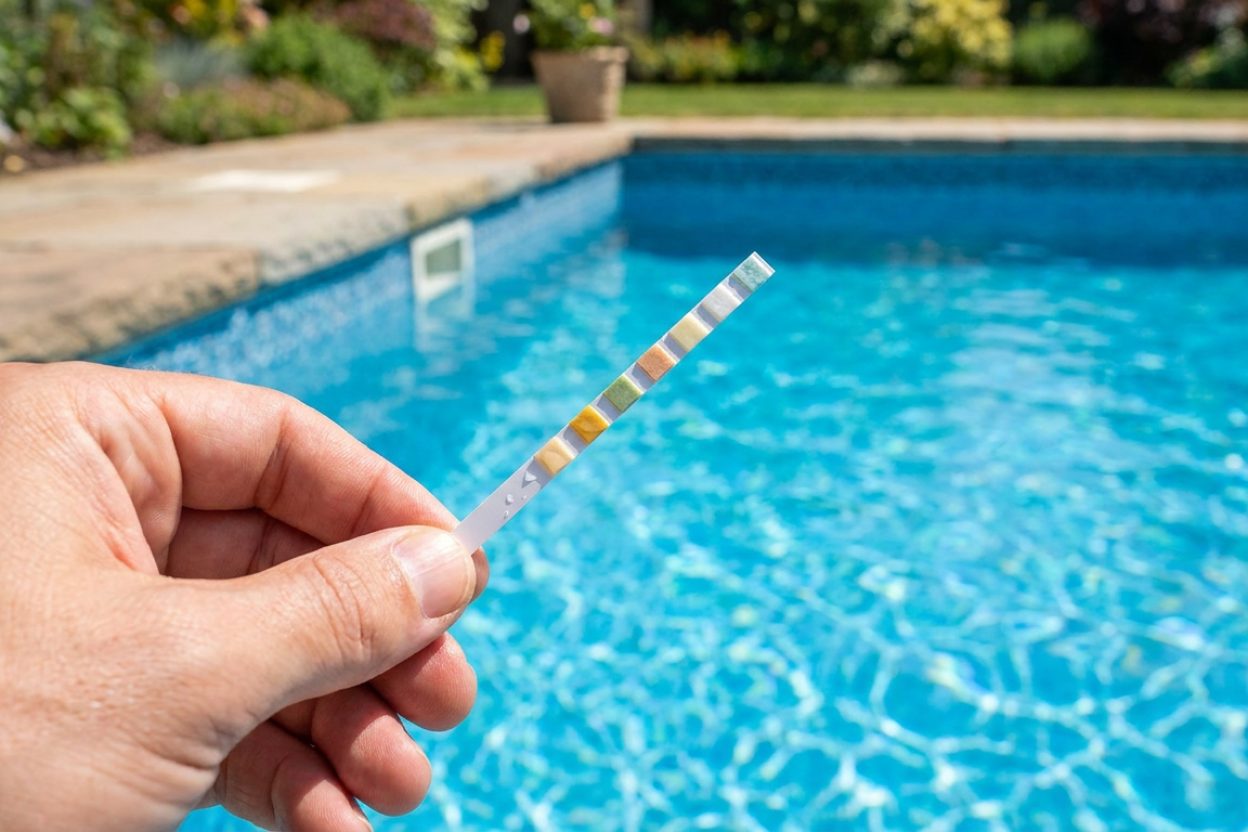
Never rely solely on wait times. Always test your water before swimming:
- Free Chlorine: Target approximately 7.5% of CYA (e.g., CYA 40 → FC ~3 ppm; CYA 70-80 → FC ~6-8 ppm for normal swimming)
- pH Level: 7.4-7.6 for comfort and chemical effectiveness
- Total Alkalinity: 80-120 ppm for regular pools, 60-80 ppm for salt systems
- Water Clarity: Must be able to clearly see the bottom and main drain
Use a reliable test kit like Taylor K-2006 or comparable digital tester. Test strips are less accurate for critical safety measurements.
Factors Affecting Wait Times
Circulation and Mixing
Proper circulation dramatically reduces wait times. Your pump should run continuously during and after chemical addition. Poor circulation can create chemical hot spots that are unsafe for swimming even after the recommended wait period.
Pool Volume and Dosage
Larger chemical additions require longer wait times. When shocking a green pool using the SLAMShock Level And Maintain — raise free chlorine to a target based on your CYA and hold it there until the algae is gone. It's a process, not a one-time dose. the SLAM walkthrough → method (raise FC to the shock level for your CYA, about 40% of CYA, and hold until combined chlorine < 0.5 ppm and overnight FC loss < 1 ppm), you might add several gallons of liquid chlorine, requiring extended circulation time. To estimate the shock level, use our all-in-one pool calculator.
Water Temperature
Warmer water accelerates chemical dissolution and mixing. Cold water pools may need extended wait times, especially for granular products like calcium hypochlorite.
Emergency Chemical Situations
If you accidentally over-dose chemicals:
- High Chlorine (shock levels): Wait for natural dissipation or add sodium thiosulfate to neutralize
- Low pH (below 7.0): Add soda ash gradually, test frequently
- High pH (above 8.0): Add muriatic acid carefully, avoid swimming until below 7.8
Best Practices for Chemical Safety
Add chemicals in early evening when possible - UV rays break down chlorine quickly during daytime. Always add chemicals to water, never water to chemicals. Store all chemicals in cool, dry locations away from direct sunlight. Keep chlorine and other oxidizers away from acids and fuels — combining them can release toxic chlorine gas or start a fire.
For routine maintenance, liquid chlorine provides the fastest return to swimming. For weekly shocking, calcium hypochlorite is cost-effective but requires overnight waiting. Plan chemical additions around your swimming schedule for minimal disruption.
For the full breakdown of safe chlorine levels by CYA level, see our pool water chemistry guide.

Still need help? Ask a Pool & Spa Expert AD
Get a personalized answer from PoolGuy810 — 30 years owning a pool and spa repair company. Describe your issue and get step-by-step help.
Related Pool Guides
Need More Help?
Try our free pool calculators and tools to help diagnose and fix your pool problems.
Browse Pool ToolsSLAM calculator, pH calculator, salt dosing & more