
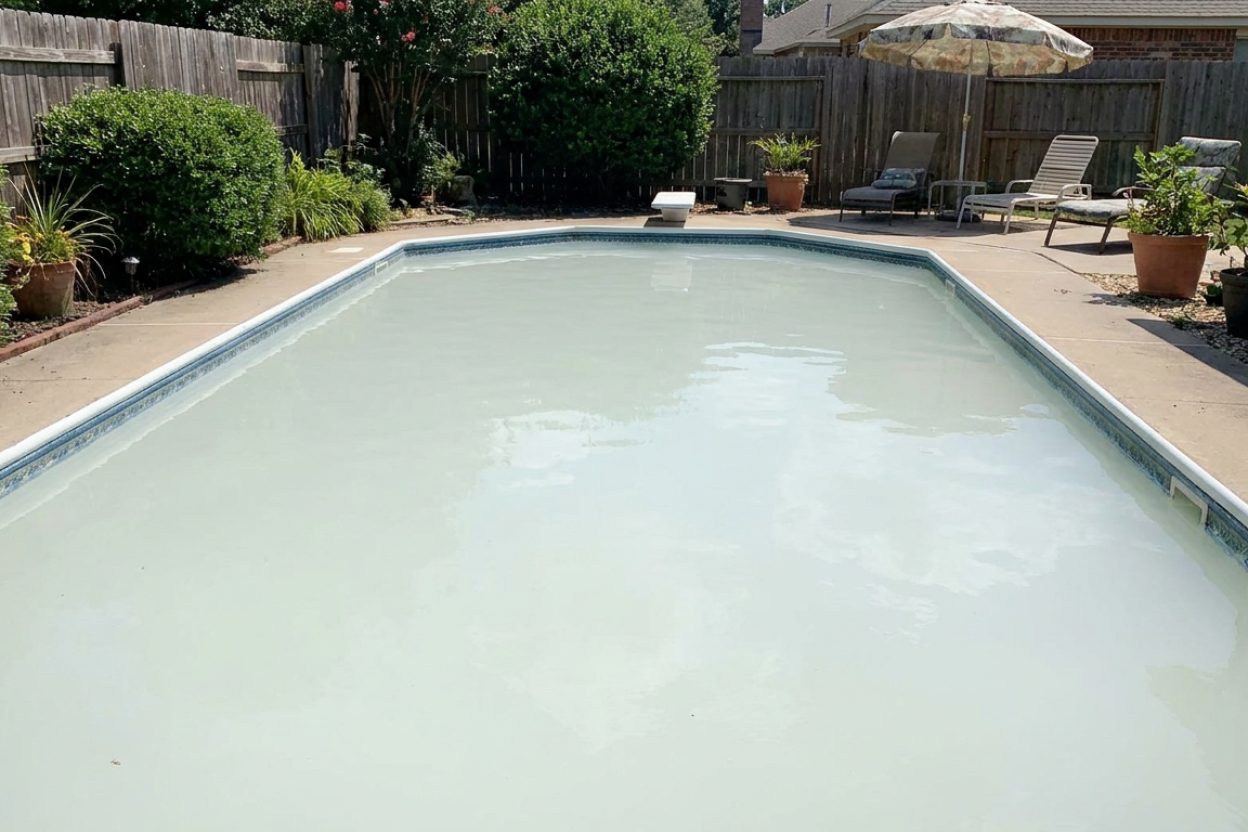
Why is my pool cloudy after shocking?

Why is my pool cloudy after shocking?
Read full question
I shocked my pool last night to clear up the green algae, but I woke up this morning to a milky, cloudy mess instead of crystal clear water. I didn't think the shock would make it look worse, but now I'm worried I messed up the chemistry. What caused this cloudiness, and what steps do I need to take to get the water looking right again today?
Quick Answer
Why is my pool cloudy after shocking? It is frustrating to shock your pool only to wake up to murky water, but this is often a temporary side effect of the oxidization process. The cloudiness is usually caused by calcium clouding (if you used calcium-based shock) or the filter struggling to catch the dead algae bodies. If the water is thick like milk, your filter media is likely overwhelmed. However, if the water is just hazy, it means the chlorine is still fighting off bacteria and particles.
Why is my pool cloudy after shocking?
It is frustrating to shock your pool only to wake up to murky water, but this is often a temporary side effect of the oxidization process. The cloudiness is usually caused by calcium clouding (if you used calcium-based shock) or the filter struggling to catch the dead algae bodies. If the water is thick like milk, your filter media is likely overwhelmed. However, if the water is just hazy, it means the chlorine is still fighting off bacteria and particles.
Most Likely Causes
- Calcium Clouding (Scale): If you used calcium hypochlorite (Cal-Hypo) shock and your pH is above 7.8, the calcium will precipitate out of the water, turning it white and milky.
- Filter Overwhelmed: The shock oxidized the algae, killing it, but the dead organic debris is now floating in suspension. If your filter didn't catch them immediately, they will remain cloudy until removed.
- High pH During Shock: If your pH is too high (above 7.8) when you shock, the chlorine becomes less effective, and calcium precipitates, causing cloudiness.
- Insufficient Filter Runtime: Trying to clear a cloudy pool with a filter that is only running 8 hours a day usually won't work. You need 24-48 hours of continuous filtration.
Step-by-Step Fix to Clear the Water
To fix this immediately, you need to address both the chemistry and the filtration system.
Step 1: Test and Balance Chemistry
Grab your test kit and check your Free Chlorine (FCFree Chlorine — The chlorine actively sanitizing your water right now. This is the number you keep an eye on. how much you need →), pH, and Total Alkalinity.
- Target Free Chlorine: Raise FC to about 40% of your CYACyanuric Acid (stabilizer) — Sunscreen for your chlorine — it keeps sunlight from burning it off. The catch: the more you have, the more chlorine you need to keep. learn more → (commonly 12-20 ppm) temporarily during shock treatment. This is higher than normal swimming levels but is necessary to kill algae. Keep it in that range until the water clears up and you can see the bottom of the pool again.
- Target pH: Keep it between 7.2 and 7.6. If your pH is above 7.8, you must lower it. Use muriatic acid carefully - add acid to a bucket of pool water first, then pour the diluted solution into the deep end with the pump running, or add acid directly to the deep end with circulation running. Start with small amounts and test frequently rather than following rigid dosing charts, as pool conditions vary.
- Check Calcium Hardness: If your Calcium Hardness is already very high (over 400 ppm) and pH is high, you may need to partially drain and refill the pool.
Step 2: Run Filter 24/7 and Backwash
You must run your filter system continuously for 24 to 48 hours. Set your timer or keep the pump on manually.
- Monitor your pressure gauge. If the pressure rises about 8 to 10 psi above your "clean" pressure, it usually means the filter is dirty and due for a backwash or cleaning (the most common cause).
- Perform a backwash or clean your cartridges immediately to restore flow.
- Brush the pool walls and floor every few hours. This keeps the dead algae suspended in the water column so the filter can actually catch it.
Step 3: Add a Clarifier or Flocculant
If the water is thick (chocolate milk consistency) and the filter pressure is normal, your filter media is too fine for the particles. You need to coagulate them.
- If the water is hazy: Add a pool clarifier. This helps the filter catch microscopic particles.
- If the water is thick: Add a flocculant, then turn off the pump and let the pool sit undisturbed for 8-12 hours. This makes the particles sink to the bottom. You will need to vacuum to waste (or the drain) manually the next morning to remove the sludge at the bottom. With a cartridge filter (no waste setting), vacuum through the filter and clean it afterward, or use a separate pump to send the sludge out of the pool. Note that vacuuming to waste will significantly lower your water level and require refilling.
Safety Note
Wait to swim until you can clearly see the bottom and main drain of the pool - that visibility is the real safety standard, since you need to be able to spot a swimmer in trouble. Free chlorine should be under 10 ppm before anyone swims (the CDC limit while bathers are in the water); a properly stabilized pool often runs 6-7+ ppm FC and is perfectly fine to swim in. With muriatic acid, the rules that matter are: add acid to water (never water to acid), pour it slowly with the pump running, keep it away from chlorine, and don't breathe the fumes - doing it outdoors handles most of that. Wear gloves and eye protection when handling the full-strength jug.
For the full breakdown of safe chlorine levels by CYA level, see our pool water chemistry guide.
Still need help? Ask a Pool & Spa Expert AD
Get a personalized answer from PoolGuy810 — 30 years owning a pool and spa repair company. Describe your issue and get step-by-step help.
Need More Help?
Try our free pool calculators and tools to help diagnose and fix your pool problems.
Browse Pool ToolsSLAM calculator, pH calculator, salt dosing & more