
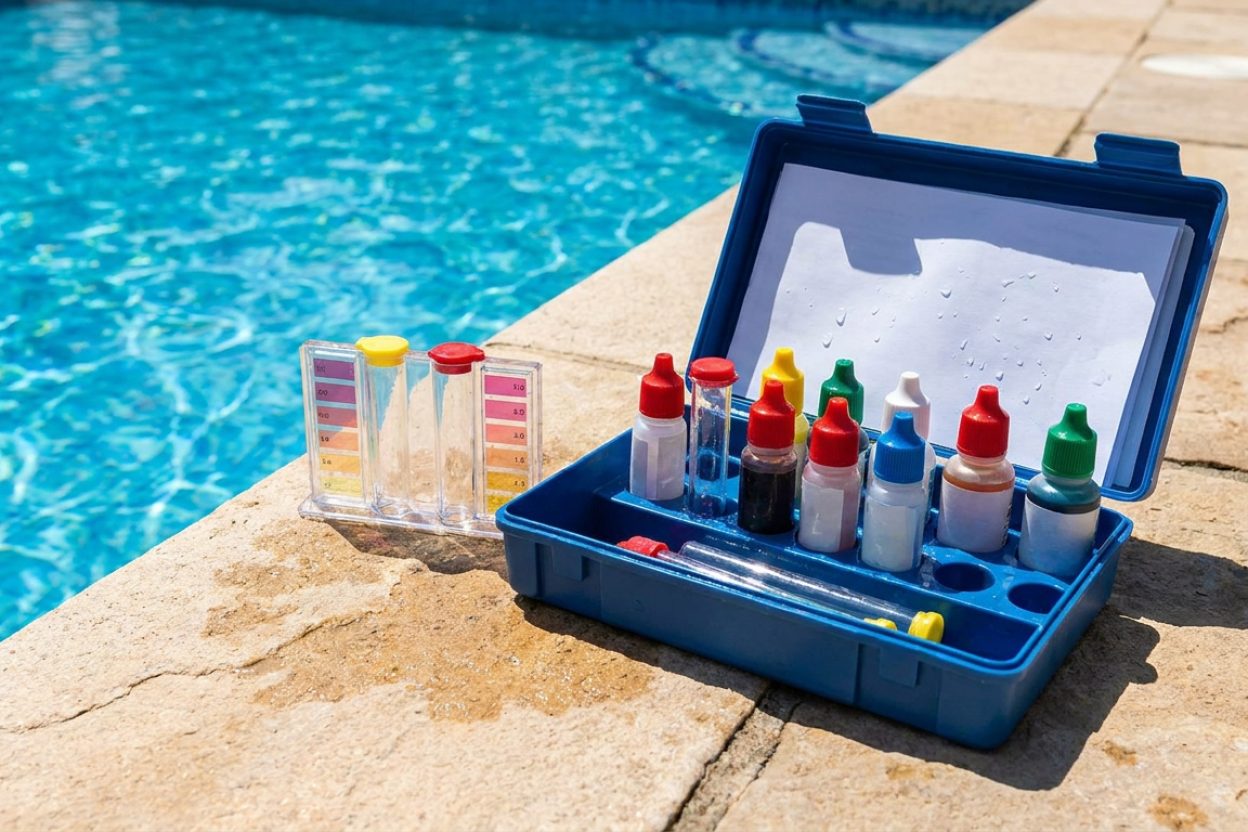
Can You Shock Pool With Low pH? Safe Step-by-Step Guide

Should I shock my pool when pH levels are below normal range?
Read full question
pH test strip is showing 6.8 and my pool is also green with algae. Want to shock it tonight before the weekend but everything online says fix pH first. Can I just shock with low pH or will I be wasting my money on chemicals that won't work?
Quick Answer
You can shock a pool with low pH, but it's more effective to raise the pH to 7.2-7.6 first. Low pH doesn't weaken chlorine — it actually raises the active (HOCl) fraction — but it is corrosive to equipment and surfaces, so raise pH before shocking to protect your pool.
Step-by-Step Procedure for Shocking with Low pH
- Test your current water chemistry
Use a reliable test kit like the Taylor K-2006C to measure:- Free Chlorine (FCFree Chlorine — The chlorine actively sanitizing your water right now. This is the number you keep an eye on. how much you need →)
- pH level
- Total Alkalinity (TATotal Alkalinity — The buffer that keeps your pH from bouncing around. Get this in range and pH gets a lot easier to manage. learn more →)
- Cyanuric Acid (CYACyanuric Acid (stabilizer) — Sunscreen for your chlorine — it keeps sunlight from burning it off. The catch: the more you have, the more chlorine you need to keep. learn more →)
- Calculate your shock dosage
Use our all-in-one pool calculator for a good dose estimate. Low pH does not require more chlorine — dose to your target FC for your CYA as usual. Raising pH first is about protecting equipment and surfaces, not boosting sanitizing power. For SLAMShock Level And Maintain — raise free chlorine to a target based on your CYA and hold it there until the algae is gone. It's a process, not a one-time dose. the SLAM walkthrough → (Shock Level and Maintain) process, target FC levels should be based on your CYA reading using the FC/CYA chart. - Choose the right shock product
Use liquid chlorine (sodium hypochlorite) rather than cal-hypo shock when pH is low. Liquid chlorine has a pH around 13, so it nudges pH up briefly when added, but it's roughly pH-neutral over a full cycle - don't rely on it to fix low pH (soda ash is the real fix for that). Liquid chlorine keeps pH simpler during shocking, but cal-hypo works fine too - expect a small pH bump and adjust if needed (and it's a good pick if your calcium is low). - Pre-dilute the chlorine
Fill a clean 5-gallon bucket with pool water. Slowly add the calculated amount of liquid chlorine to the bucket. When using cal-hypo, pre-dissolve it in a bucket first; liquid chlorine can be poured directly and slowly over a return with the pump running and doesn't need pre-diluting. - Add shock with pump running
Ensure your circulation system is running. Pour the diluted chlorine solution slowly around the pool perimeter, focusing on areas with poor circulation. Never dump chlorine in one spot, especially with low pH, as this can cause localized bleaching. - Brush the pool thoroughly
Immediately after adding shock, brush all pool surfaces including walls, steps, and corners. Low pH makes surfaces more reactive, so thorough brushing prevents staining and ensures even chemical distribution. - Wait 30 minutes and retest
Allow the chlorine to circulate for at least 30 minutes, then test FC and pH levels again. The shock should have raised your pH slightly, but it may still be low. - Adjust pH if still low
If pH remains below 7.2 after shocking, add soda ash (sodium carbonate) to raise it. Use approximately 6 oz of soda ash per 10,000 gallons to raise pH by 0.2 units (actual amount varies based on current alkalinity levels). Add soda ash slowly to the deep end with the pump running. - Monitor and maintain shock level
If performing SLAM process, maintain your target FC level by testing every few hours and adding more liquid chlorine as needed. With proper pH (7.2-7.6), your chlorine will work much more effectively. - Continue until process is complete
For algae treatment, maintain shock level until combined chlorine (CCCombined Chlorine — "Used-up" chlorine left over from doing its job. Above about 0.5 ppm is the classic sign water needs a shock. learn more →) is 0.5 ppm or less and you can pass the overnight chlorine loss test (OCLT). For routine shocking, maintain elevated FC for 4-6 hours, then allow to return to normal levels.
Why Low pH Affects Shocking Effectiveness
Understanding the chemistry behind pH and chlorine helps explain why adjustment is crucial. At pH 6.8, roughly 80% of your chlorine is in the strong, active form (hypochlorous acid) and only about 20% is the weaker hypochlorite ion (OCl-) — so sanitizing isn't the problem at low pH; corrosion is. At pH 7.5 the active fraction actually drops to roughly half HOCl, so low pH is, if anything, slightly better for raw sanitizing power — the reason to raise low pH before shocking is to avoid corroding equipment and etching surfaces, not wasted chlorine.
Potential Risks of Shocking with Low pH
Several problems can occur when shocking with very low pH:
- Equipment damage: Low pH is corrosive to metal components, heaters, and pump seals
- Surface etching: Plaster and concrete surfaces can be permanently damaged
- Corrosive water: Very low pH is corrosive and uncomfortable; hypochlorite only off-gasses meaningful chlorine gas at extremely acidic pH well below the normal pool range, so this isn't a routine risk
- Corrosion and etching: Low pH is hard on metal equipment, plaster, and grout
- Skin and eye irritation: Low pH causes burning sensations for swimmers
When to Shock First, Adjust Later
There are emergency situations where shocking immediately takes priority:
- Green or black algae outbreak
- Fecal contamination incident
- Overwhelming bather load
- Equipment failure leading to zero chlorine
In these cases, getting sanitizer in the water quickly outweighs pH optimization. Just be prepared to use more chlorine and adjust pH promptly afterward.
Prevention Tips
To avoid future low pH situations:
- Test water 2-3 times per week during swimming season
- Keep Total Alkalinity between 80-120 ppm (60-80 for salt water pools) to buffer pH
- Use a Taylor K-2006C or similar FAS-DPDFAS-DPD test — A drop-based test that reads chlorine accurately even at high "shock" levels, where test strips give up. see test kits → test kit for accurate readings
- Address pH issues immediately rather than letting them compound
- Consider switching to liquid chlorine for regular maintenance if you frequently battle low pH
Safety reminder: Always add chemicals to water, never water to chemicals. Wear safety equipment including goggles and gloves when handling pool chemicals, especially in low pH conditions where reactions can be more volatile.
For the full breakdown of safe chlorine levels by CYA level, see our pool water chemistry guide.
 Taylor K-2006C Complete FAS-DPD Pool & Spa Test Kit
The FAS-DPD kit pool pros trust — reads chlorine accurately even at shock/SLAM levels, plus pH, alkalinity, calcium hardness and CYA. View on Amazon →
Taylor K-2006C Complete FAS-DPD Pool & Spa Test Kit
The FAS-DPD kit pool pros trust — reads chlorine accurately even at shock/SLAM levels, plus pH, alkalinity, calcium hardness and CYA. View on Amazon →
 Liquid Chlorine / Sodium Hypochlorite (12.5%)
Everyday sanitizer — the B in BBB View on Amazon →
Liquid Chlorine / Sodium Hypochlorite (12.5%)
Everyday sanitizer — the B in BBB View on Amazon →
 Poolvio 20" 2-in-1 Pool Brush Head (Walls & Floor)
Sturdy 20-inch brush head that clips onto any standard telescopic pole. View on Amazon →
Poolvio 20" 2-in-1 Pool Brush Head (Walls & Floor)
Sturdy 20-inch brush head that clips onto any standard telescopic pole. View on Amazon →
 UKNOW Anti-Fog Chemical Splash Safety Goggles
Sealed splash goggles for handling muriatic acid and chlorine. View on Amazon →
UKNOW Anti-Fog Chemical Splash Safety Goggles
Sealed splash goggles for handling muriatic acid and chlorine. View on Amazon →
Still need help? Ask a Pool & Spa Expert AD
Get a personalized answer from PoolGuy810 — 30 years owning a pool and spa repair company. Describe your issue and get step-by-step help.
Related Pool Guides
Need More Help?
Try our free pool calculators and tools to help diagnose and fix your pool problems.
Browse Pool ToolsSLAM calculator, pH calculator, salt dosing & more