
Can Pool Cover Replace Safety Fence? Legal Requirements

Pool Cover vs Fence: Meeting Legal Safety Requirements
Read full question
Apparently my pool installation has a city permit hanging in limbo, a contractor demanding expensive perimeter fencing, AND an automatic cover salesman swearing their ASTM system satisfies every legal requirement. My research indicates that automatic safety covers meeting ASTM standards provide excellent protection, but I'm uncertain about regulatory requirements.
Specifically, I need to understand if jurisdictions typically accept ASTM-compliant automatic pool covers as the primary safety barrier, or if permanent perimeter barriers like fencing remain mandatory regardless of cover installation. What are the standard legal requirements for pool safety barriers, and can covers serve as fence replacements?
Quick Answer
Pool covers cannot replace safety fences in most jurisdictions. Safety covers must meet the ASTM F1346 standard (manual or automatic covers can qualify), but local codes typically require permanent barriers like fences around pools.
Step-by-Step Guide to Pool Safety Compliance
- Check Local Building Codes First
Contact your local building department or municipal office to obtain specific pool barrier requirements for your area. Most residential jurisdictions follow the International Residential Code (IRC), which mandates a 4-foot minimum barrier height (the IBC applies to commercial construction). Some areas may accept alternative barrier systems, but this varies significantly by location. - Understand Safety Cover Requirements
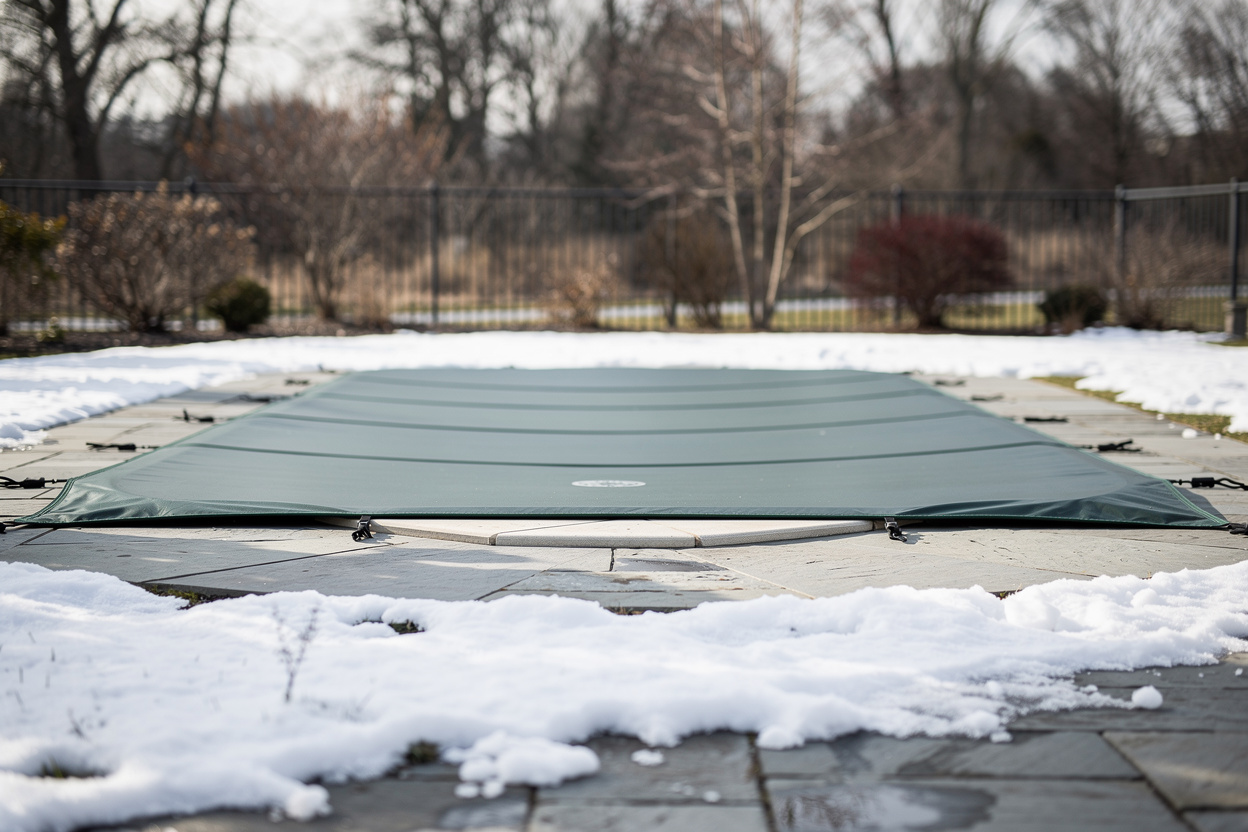
If your area allows safety covers as primary barriers, they must meet ASTM F1346 standards for safety covers. These covers must pass the ASTM F1346 static-load test (a heavy weight distributed across the cover per the standard test method), have no openings larger than 4 inches in any dimension, and include proper labeling. Manual covers can meet ASTM F1346 requirements if properly designed with adequate support structure, though automatic safety covers are the more common solution for meeting these stringent requirements. - Install ASTM-Compliant Automatic Safety Cover
Choose automatic-cover manufacturers like Coverstar, Aquamatic, or Automatic Pool Covers, Inc. that produce ASTM F1346 compliant covers. Professional installation is required, involving track systems anchored into the pool deck. The cover must completely span the pool with no gaps and operate via key-switch control to prevent unauthorized removal by children. - Implement Additional Safety Layers
Even with compliant safety covers, install door alarms on pool access doors, self-closing/self-latching gates if partial fencing exists, and pool alarms that detect water disturbance. The Consumer Product Safety Commission recommends multiple barrier layers for maximum protection. - Obtain Proper Permits and Inspections
Submit plans showing your barrier system to local authorities for permit approval before installation. Schedule required inspections after installation to ensure compliance. Keep all documentation including ASTM certification, installation records, and inspection certificates for insurance and legal purposes. - Maintain Cover System Properly
Inspect the cover monthly for tears, worn tracks, or mechanical issues. Clean debris regularly to prevent damage. Service the motor system annually through qualified technicians. Any damage compromises safety compliance and may void permits until repairs are completed. - Consider Traditional Fencing Alongside Covers
Many pool owners install both safety covers and perimeter fencing for maximum protection. A 4-foot fence with self-closing gates provides constant protection, while covers offer additional security and energy savings. This dual approach often satisfies the most stringent local requirements.
Legal and Safety Considerations
Insurance requirements often mandate specific barrier types regardless of local code allowances. Contact your homeowner's insurance provider to confirm coverage requirements. Many insurers require traditional fencing and may not accept covers as sole barriers, potentially voiding coverage in drowning incidents.
Liability concerns extend beyond legal compliance. Even in jurisdictions allowing safety covers as primary barriers, homeowners face significant liability if covers fail or aren't properly maintained. Traditional fencing provides more predictable, constant protection without mechanical failure risks.
When Safety Covers May Be Acceptable
Some scenarios where safety covers might substitute for fencing include:
- Indoor pools in enclosed structures with controlled access
- Specific municipal codes allowing alternative barrier systems
- Commercial installations with different safety standards
- Existing pools with grandfathered permits (varies by jurisdiction)
Cost Comparison and Practical Considerations
Automatic safety covers cost $12,000-$20,000 installed, compared to $3,000-$8,000 for perimeter fencing. However, covers provide additional benefits including reduced chemical usage, heat retention, and debris protection. Factor in annual maintenance costs of $300-$500 for cover systems versus minimal fence maintenance.
Consider pool usage patterns when choosing barrier types. Families with frequent pool use may find constantly operating safety covers inconvenient, while occasional users benefit from covers' dual safety and maintenance functions.
Professional Recommendations
Consult with certified pool contractors familiar with local codes before making barrier decisions. Many professionals recommend combination approaches using both covers and partial fencing to maximize safety while maintaining pool accessibility and aesthetic appeal.
Still need help? Ask a Pool & Spa Expert AD
Get a personalized answer from PoolGuy810 — 30 years owning a pool and spa repair company. Describe your issue and get step-by-step help.
Related Pool Guides
Need More Help?
Try our free pool calculators and tools to help diagnose and fix your pool problems.
Browse Pool ToolsSLAM calculator, pH calculator, salt dosing & more