
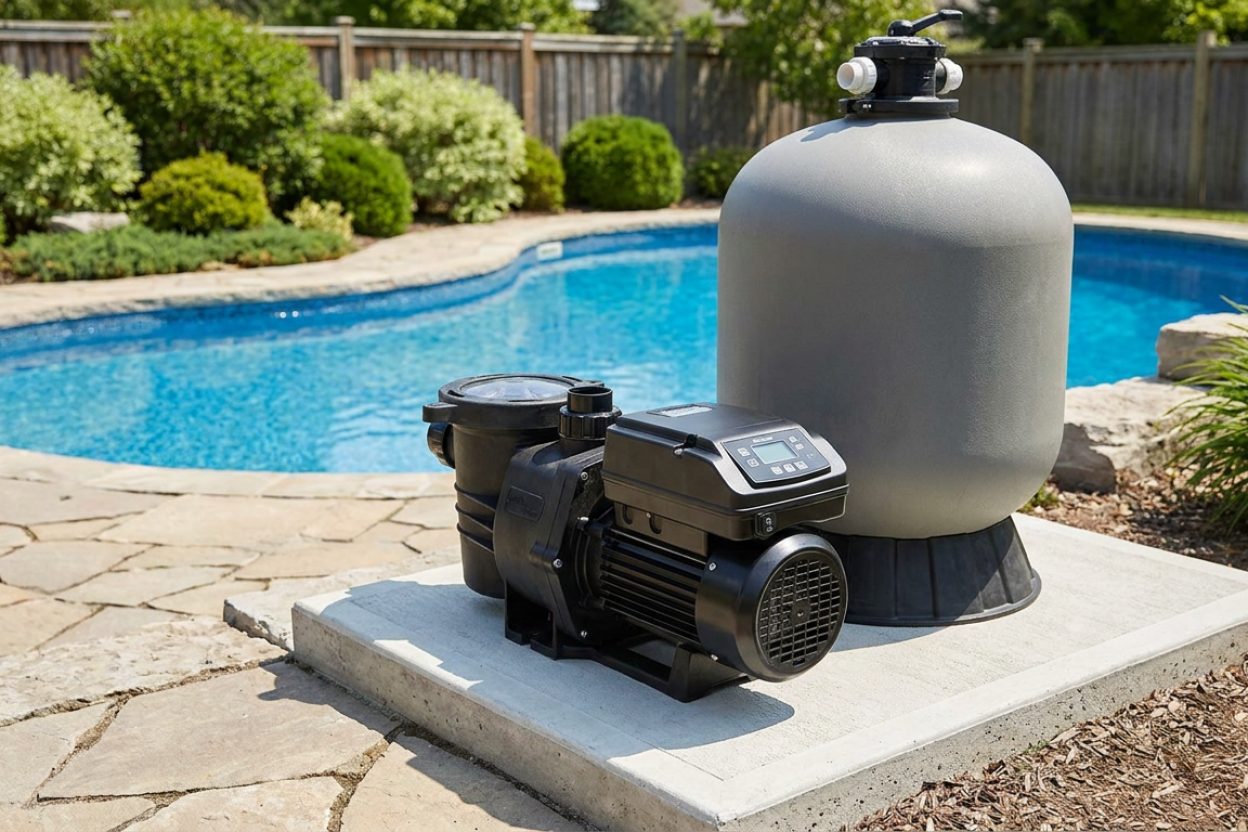
How Variable Speed Pool Pumps Save Money on Electric Bills

Will a variable speed pump keep my pool clean while saving money?
Read full question
Noticed my electric bill spiking every summer and now I'm standing in the pool supply store staring at variable speed pumps with no clue if they'll actually help. They're in the pool almost every day during summer, and I need to make sure the water stays properly filtered and clean.
Can these variable speed pumps really reduce electricity costs without compromising water circulation and filtration? I don't want to save money at the expense of water quality that could put my children at risk.
Quick Answer
Variable speed pool pumps save money by running at lower, more efficient speeds that dramatically reduce electricity consumption while maintaining proper water circulation and filtration.
The Math Behind the Savings
Understanding why variable speed pumps save so much money comes down to basic physics. Pool pumps (which are centrifugal pumps) follow what's called the "affinity laws" or "cube rule," which means:
- Energy consumption varies by the cube of the speed change
- At 50% speed, energy use drops to 12.5% (0.5³ = 0.125)
- At 75% speed, energy use drops to 42% (0.75³ = 0.42)
- Flow rate only decreases proportionally to speed changes
For example, if your single-speed pump uses 2,000 watts at full speed, running a variable speed pump at 50% speed would only consume about 250 watts while still moving half the water volume.
Real-World Energy Savings
Here's how the savings typically work in practice:
Single-Speed Pump Operation
A typical 1.5 HP single-speed pump draws roughly 1,500-2,000 watts and runs 8-12 hours a day, which adds up quickly on your electric bill.
Variable Speed Pump Operation
The same pool with a variable speed pump might run:
- 2 hours at 75% speed for skimming (about 840 watts)
- 6 hours at 50% speed for filtration (about 250 watts)
- 2 hours at 25% speed for chemical circulation (about 100-150 watts in real-world use)
A variable-speed pump run slowly for the same turnover draws a small fraction of that power, so many owners save a few hundred dollars a year. Plug your own wattages, hours, and electricity rate into our pump runtime & energy calculator to see your numbers.
Operational Money-Saving Features
Programmable Schedules
Variable speed pumps include built-in timers that automatically adjust speeds throughout the day. You can program lower speeds during peak electricity rate hours and higher speeds during off-peak times when rates are cheaper.
Equipment Longevity
Running at lower speeds reduces wear on the pump motor, impeller, and plumbing system. Variable speed pumps typically last 10-15+ years compared to 8-12 years for single-speed pumps. The reduced mechanical stress also means fewer repair calls and part replacements.
Improved Filtration Efficiency
Slower water movement through the filter allows better particle capture. This means your filter media lasts longer and requires less frequent cleaning or replacement. The gentler flow also reduces chemical consumption by maintaining more stable water chemistry.
Additional Cost Benefits
Utility Rebates
Many electric utilities offer rebates of $100-400 for upgrading to variable speed pumps due to their energy efficiency. Some areas also have special time-of-use rates that make running pumps during off-peak hours even more economical.
Reduced Chemical Costs
Better water circulation at consistent lower speeds helps maintain more stable pH and chlorine levels, reducing the need for frequent chemical adjustments. The improved filtration also means less need for clarifiers and flocculants.
Quieter Operation
While not a direct cost saving, variable speed pumps running at lower speeds produce significantly less noise, which can be valuable if you've had neighbor complaints or wanted to run filtration cycles at night during cheaper electricity rate periods.
Maximizing Your Savings
To get the most money-saving benefit from your variable speed pump:
- Start with manufacturer recommended speeds and adjust down gradually while monitoring water clarity
- Run the pump during off-peak electricity hours when possible
- Use the lowest effective speed for each function (skimming, filtration, heating)
- Program longer run times at very low speeds rather than shorter times at high speeds
- Monitor your electric bill for the first few months to verify savings
Payback Period
Variable speed pumps typically cost $400-1,000 more than single-speed pumps initially. With annual savings commonly in the $500-$900 range, most pool owners see complete payback within 1-2 years. After that, the savings go directly to your bottom line for the remaining 10-13 years of pump life.
The combination of reduced electricity consumption, longer equipment life, and improved pool maintenance efficiency makes variable speed pumps one of the most cost-effective upgrades any pool owner can make.
Still need help? Ask a Pool & Spa Expert AD
Get a personalized answer from PoolGuy810 — 30 years owning a pool and spa repair company. Describe your issue and get step-by-step help.
Related Pool Guides
Need More Help?
Try our free pool calculators and tools to help diagnose and fix your pool problems.
Browse Pool ToolsSLAM calculator, pH calculator, salt dosing & more