
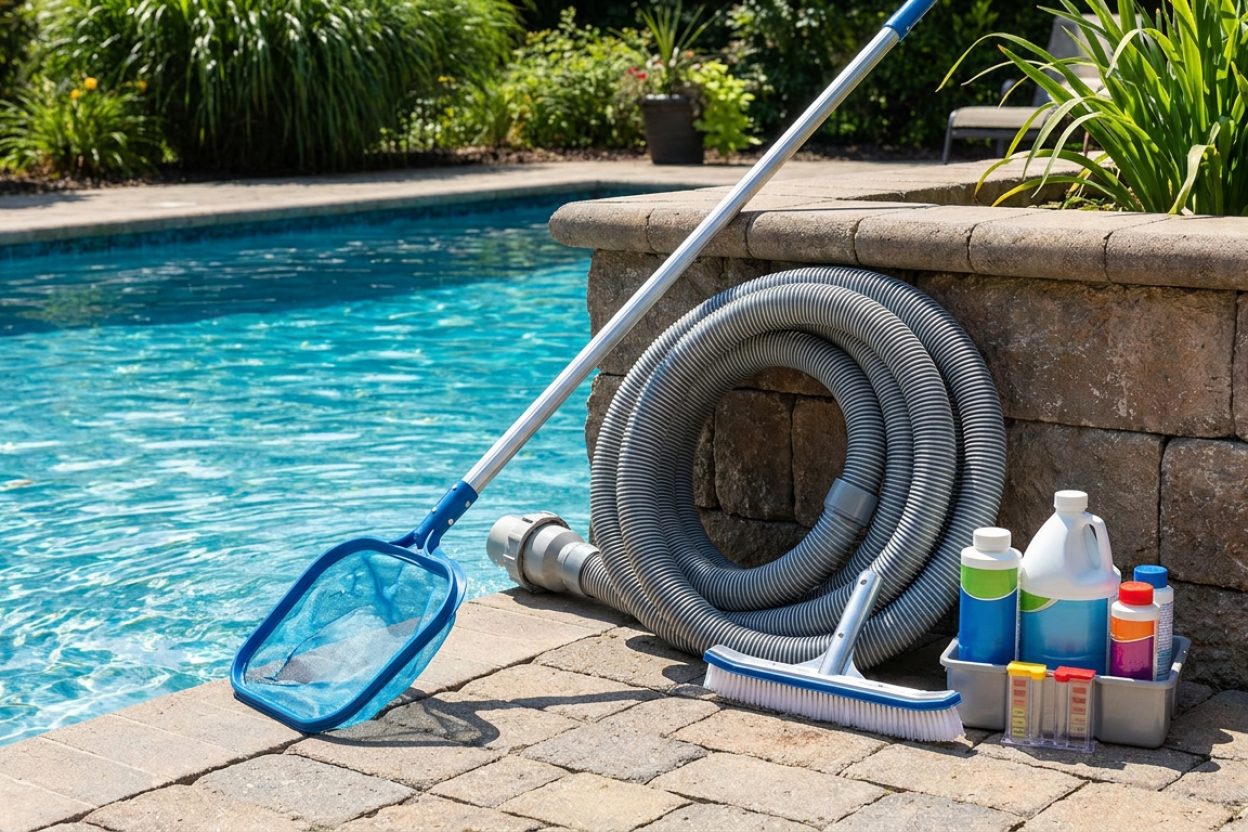
How Pool Shock Works: Complete Chemistry Guide

Pool shock chemistry - how does it actually work to clean water?
Read full question
Spent hundreds on every shock product available, followed instructions perfectly, even doubled doses — but my 20,000 gallon inground pool chemistry still makes zero sense to me. I know it raises chlorine levels temporarily, but what's the chemical process that's actually cleaning my water?
My pool gets a lot of use during summer - kids swimming daily, sunscreen, sweat, the occasional algae bloom if I'm not careful with maintenance. When I shock it, usually with calcium hypochlorite, the water clears up within 24 hours. But I'd love to understand the chemistry of how shock treatment breaks down contaminants and restores water quality. What exactly is happening at the molecular level when those chlorine levels spike?
Quick Answer
Pool shock works by rapidly raising chlorine levels to oxidize organic contaminants like sweat, sunscreen, and algae. It breaks down chloramines (combined chlorine) and restores free chlorine sanitization power.
How Pool Shock Works: The Chemistry
The short answer: pool shock is like a chemical reset button that nukes everything contaminating your water, but understanding the oxidation process behind it will save you money and headaches. When you shock your pool, you're essentially flooding the water with oxidizing chemicals that break down accumulated waste products like sweat, sunscreen, body oils, and organic debris that regular chlorine levels can't handle.
The key mechanism involves oxidation - a chemical reaction where shock treatments donate oxygen atoms to organic compounds, effectively breaking them down into harmless byproducts like carbon dioxide and water. This process also destroys chloramines (combined chlorine), which are responsible for that strong "chlorine" smell and eye irritation.
Types of Pool Shock and Their Mechanisms
Calcium Hypochlorite (Cal-Hypo)
The most common pool shock contains 65-70% available chlorine. When dissolved in water, cal-hypo releases hypochlorous acid (HOCl), the active sanitizing form of chlorine. This type adds both chlorine and calcium to your pool, making it ideal for pools with low calcium hardness but problematic for those with high calcium levels.
Dichlor
Contains about 56-62% available chlorine (56% dihydrate, 62% anhydrous) and includes cyanuric acid (stabilizer). Dichlor dissolves quickly and won't affect pH as dramatically as cal-hypo. However, repeated use builds up CYACyanuric Acid (stabilizer) — Sunscreen for your chlorine — it keeps sunlight from burning it off. The catch: the more you have, the more chlorine you need to keep. learn more → levels, which can eventually reduce chlorine effectiveness.
Potassium Peroxymonosulfate (Non-Chlorine Shock)
This oxidizer works differently than chlorine shocks. It oxidizes organic contaminants without adding chlorine, making it useful for routine oxidation without raising FCFree Chlorine — The chlorine actively sanitizing your water right now. This is the number you keep an eye on. how much you need → levels. However, it won't kill bacteria or algae like chlorine-based shocks.
The Oxidation Process in Detail
When shock enters your pool water, several chemical reactions occur simultaneously:
- Chloramine destruction: Free chlorine combines with and destroys chloramines, restoring proper sanitization
- Organic waste oxidation: Contaminants like body oils and sunscreen are broken down into smaller, filterable particles
- Algae elimination: High chlorine levels overwhelm algae cell walls, causing cellular destruction
- Bacteria and virus inactivation: Elevated sanitizer levels ensure complete pathogen elimination
Shock Level Calculations
Effective shocking requires reaching specific chlorine levels based on your pool's CYA (stabilizer) level. For pools with 30-50 ppm CYA, shock to roughly 40% of your CYA—about 12 ppm at 30 CYA up to 20 ppm at 50 CYA. Pools with higher CYA need proportionally higher shock levels - use the FC/CYAFC/CYA chart — The chart that sets your chlorine target from your stabilizer (CYA) level — the two go together. see the chart → relationship — our all-in-one pool calculator estimates the free chlorine target for your CYA.
Dosing guidelines:
- For routine shocking, add enough to raise FC 5-7 ppm above normal operating level
- For problem algae or cloudy water, use SLAMShock Level And Maintain — raise free chlorine to a target based on your CYA and hold it there until the algae is gone. It's a process, not a one-time dose. the SLAM walkthrough → method - maintain shock level FC until water clears and combined chlorine is below 0.5 ppm, and overnight FC loss is less than 1 ppm. Use our all-in-one pool calculator to determine the shock level for your CYA.
Timing and Application Methods
Shocking in the evening is best (daytime sun burns off chlorine faster), but you can shock during the day when you need to — like a fresh opening or a green pool — just expect to use a bit more. For cal-hypo, pre-dissolve in a bucket of pool water before adding to the deep end with pump running for proper circulation. Never use small containers or mix with other chemicals.
Test FC levels 1 hour after shocking to verify target levels were reached. Continue testing every 2-4 hours during SLAM procedures until overnight FC loss is less than 1 ppm.
When Shock Treatment is Most Effective
Regular shocking prevents problems, but certain conditions require immediate shock treatment:
- Combined chlorine (CCCombined Chlorine — "Used-up" chlorine left over from doing its job. Above about 0.5 ppm is the classic sign water needs a shock. learn more →) levels above 0.5 ppm
- Heavy bather loads or pool parties
- Visible algae growth or green water
- Strong chlorine odor indicating chloramine buildup
- Cloudy water with normal chemical balance
pH Impact and Correction
Cal-hypo shock raises pH significantly, often requiring muriatic acid addition afterward. Add acid slowly - dosing varies significantly based on current pH and alkalinity levels, so add small amounts and retest frequently. Always retest and adjust pH to 7.4-7.6 range within 24 hours of shocking.
Safety Considerations
Never mix different shock types as this can create dangerous chemical reactions. Store shock products in cool, dry locations away from other pool chemicals — especially acids (chlorine + acid releases toxic gas) and any fuels or organics (an oxidizer + fuel can ignite). Always add shock to water, never water to shock, to prevent violent reactions.
Swimming is safe when the water is clear to the bottom and FC is back under about 10 ppm. This typically takes 8-24 hours depending on CYA levels and shock amount used.
For the full breakdown of safe chlorine levels by CYA level, see our pool water chemistry guide.
 Taylor K-2006C Complete FAS-DPD Pool & Spa Test Kit
The FAS-DPD kit pool pros trust — reads chlorine accurately even at shock/SLAM levels, plus pH, alkalinity, calcium hardness and CYA. View on Amazon →
Taylor K-2006C Complete FAS-DPD Pool & Spa Test Kit
The FAS-DPD kit pool pros trust — reads chlorine accurately even at shock/SLAM levels, plus pH, alkalinity, calcium hardness and CYA. View on Amazon →
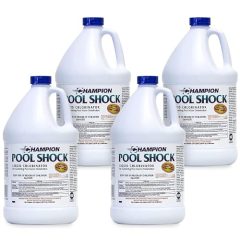 Liquid Chlorine / Sodium Hypochlorite (12.5%)
Everyday sanitizer — the B in BBB View on Amazon →
Liquid Chlorine / Sodium Hypochlorite (12.5%)
Everyday sanitizer — the B in BBB View on Amazon →
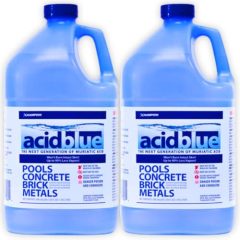 Acid Blue - Low Fume Muriatic Acid for Swimming Pools & Spas - Lower's pH, Reduces Alkalinity - 2 Gallon
View on Amazon →
Acid Blue - Low Fume Muriatic Acid for Swimming Pools & Spas - Lower's pH, Reduces Alkalinity - 2 Gallon
View on Amazon →
Still need help? Ask a Pool & Spa Expert AD
Get a personalized answer from PoolGuy810 — 30 years owning a pool and spa repair company. Describe your issue and get step-by-step help.
Need More Help?
Try our free pool calculators and tools to help diagnose and fix your pool problems.
Browse Pool ToolsSLAM calculator, pH calculator, salt dosing & more