

How Long Do Pool Chemicals Take to Work? Complete Timeline

What's the exact timeline for different pool chemicals to take effect?
Read full question
The pool chemicals are sitting right here and I'm ready to get this water balanced perfectly — just need the exact timing windows to plan everything out. I understand that different chemicals have vastly different activation periods, but I'm looking for specific timeframes for each major category.
Specifically, I need to know how long chlorine sanitizers take to become effective, the working time for pH adjustment chemicals, and the dissolution period for stabilizers like cyanuric acid. This information is critical for determining when it's safe to swim after chemical treatments and for planning sequential chemical additions without interference.
Quick Answer
Most pool chemicals work within 2-8 hours, but timing varies significantly by chemical type. Chlorine works in minutes, pH adjusters take 2-4 hours, while stabilizer can take 24-48 hours to fully dissolve and circulate. CYA should be pre-dissolved in a bucket of hot water or added to a sock in the skimmer for gradual dissolution.
Quick Chemical Timeline Reference
Add chlorine shock at the first sign of cloudy water and you'll knock it back within hours (with the filter doing the final clearing) — wait until your pool turns green and you're looking at days of chemical battles. Understanding these timelines helps you test at the right intervals and avoid over-dosing. Here's what you need to know about each major chemical category.
Sanitizers: Fast-Acting Water Treatment
Liquid Chlorine (Sodium Hypochlorite)
Liquid chlorine is the fastest-acting pool sanitizer, beginning to work within 15-30 minutes of addition. You'll see measurable free chlorine (FCFree Chlorine — The chlorine actively sanitizing your water right now. This is the number you keep an eye on. how much you need →) levels on your Taylor test kit within this timeframe. However, for complete circulation and even distribution, wait 2-4 hours before taking your final reading.
When shocking a pool using the SLAMShock Level And Maintain — raise free chlorine to a target based on your CYA and hold it there until the algae is gone. It's a process, not a one-time dose. the SLAM walkthrough → method (Shock Level And Maintain), liquid chlorine reaches its target shock level quickly, but you'll need to maintain that level consistently. Test every few hours during active SLAM treatment, as chlorine consumption can be rapid when fighting algae or contamination.
Granular Chlorine and Cal-Hypo
Granular chlorine dissolves slower than liquid, typically taking 1-2 hours to fully dissolve and circulate. Always pre-dissolve granular products in a bucket before adding to avoid bleaching pool surfaces. Wait at least 4 hours before swimming and 6-8 hours before taking accurate test readings.
pH and Alkalinity Adjusters: Moderate Timeline
Muriatic Acid (pH Down)
Muriatic acid works relatively quickly, lowering pH within 2-4 hours of proper application. Add acid to the deep end with your pump running, and always add acid to water, never water to acid. The pH will continue dropping slightly for up to 6 hours, so avoid the temptation to add more too quickly.
For pools requiring significant pH reduction (from 8.2+ down to the ideal 7.4-7.6 range), add acid in stages. Test after 4 hours, then add more if needed rather than dumping large quantities at once.
Sodium Bicarbonate (Alkalinity Increaser)
Total alkalinity (TATotal Alkalinity — The buffer that keeps your pH from bouncing around. Get this in range and pH gets a lot easier to manage. learn more →) adjustments take longer to stabilize, typically requiring 6-12 hours for accurate readings. Baking soda raises both TA and pH, but the pH rise happens first. You'll see pH changes within 2-4 hours, but wait overnight before testing TA levels for dosing decisions.
Target TA levels of 80-120 ppm for traditional chlorine pools, or 60-80 ppm for salt water generator systems to prevent excessive pH rise.
Stabilizer: The Slow Worker
Cyanuric Acid (CYA)
Stabilizer is notoriously slow to dissolve and distribute, often taking 24-48 hours for complete integration. Powdered CYACyanuric Acid (stabilizer) — Sunscreen for your chlorine — it keeps sunlight from burning it off. The catch: the more you have, the more chlorine you need to keep. learn more → should be pre-dissolved in a bucket of hot water before adding to the pool, or added to a sock in the skimmer for gradual dissolution.
Never test CYA levels immediately after addition - you'll get falsely low readings. Wait at least 48 hours with continuous circulation before testing. Target 30-50 ppm for regular chlorine pools, or 70-80 ppm for salt water generator systems.
Warning: CYA is nearly impossible to remove except through water dilution, so add conservatively. For a quick estimate, use our all-in-one pool calculator.
Specialty Chemicals and Clarifiers
Calcium Hardness Increasers
Calcium chloride dissolves and circulates within 4-6 hours, but can temporarily cloud the water. Pre-dissolve in a bucket and add slowly around the pool perimeter. Target calcium hardness of 250-350 ppm for plaster pools, 175-225 ppm for vinyl or fiberglass.
Clarifiers and Flocculants
Pool clarifiers begin working within 6-12 hours, with full effectiveness in 24-48 hours. These products work by binding tiny particles together, making them large enough for your filter to capture. Flocculants work faster (12-24 hours) but require vacuuming to waste rather than filtration. (This needs a sand or DE filter with a multiport "waste" valve — cartridge filters have no waste setting, so with a cartridge you vacuum through the filter and then clean or replace it, or run a separate utility/manual pump that sends the water out of the pool.)
Testing Schedule for Optimal Results
Proper timing of chemical tests is crucial for accurate water balance:
- Chlorine adjustments: Test after 4 hours, retest before swimming
- pH changes: Initial test after 2 hours, final reading after 6 hours
- Alkalinity adjustments: Wait 6-12 hours before retesting
- Stabilizer additions: Test after 48 hours minimum
- Calcium hardness: Test after 6 hours, retest in 24 hours
Factors That Affect Chemical Speed
Several conditions influence how quickly chemicals work in your pool:
- Water circulation: Proper pump and filter operation speeds chemical distribution
- Water temperature: Warmer water accelerates chemical reactions
- Pool size and depth: Larger pools require more time for complete mixing
- Bather load: Heavy usage consumes sanitizers faster
- Sunlight exposure: UV rays rapidly destroy unprotected chlorine
Safety and Best Practices
Never rush chemical additions or ignore recommended waiting periods. Allow adequate time between different chemical additions - at least 4 hours between major adjustments. Always add chemicals with your pump running for proper circulation, and never mix different chemicals together.
Keep detailed records of chemical additions and test results using a Taylor K-2006 (which tests FC/CC, pH, TA, CH, and CYA) or similar quality test kit. This helps you track patterns and avoid over-correction, which often creates more problems than the original imbalance.
For the full breakdown of safe chlorine levels by CYA level, see our pool water chemistry guide.
 Taylor K-2006C Complete FAS-DPD Pool & Spa Test Kit
The FAS-DPD kit pool pros trust — reads chlorine accurately even at shock/SLAM levels, plus pH, alkalinity, calcium hardness and CYA. View on Amazon →
Taylor K-2006C Complete FAS-DPD Pool & Spa Test Kit
The FAS-DPD kit pool pros trust — reads chlorine accurately even at shock/SLAM levels, plus pH, alkalinity, calcium hardness and CYA. View on Amazon →
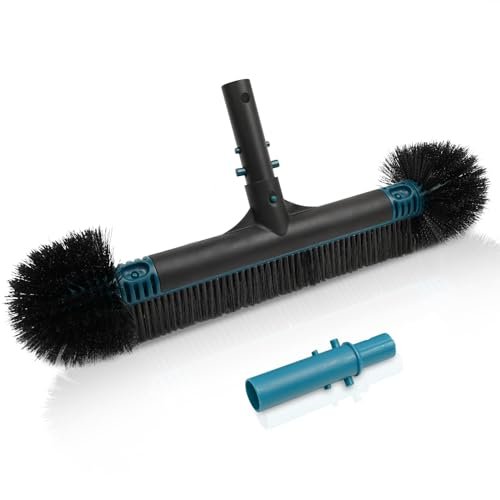 Poolvio 20" 2-in-1 Pool Brush Head (Walls & Floor)
Sturdy 20-inch brush head that clips onto any standard telescopic pole. View on Amazon →
Poolvio 20" 2-in-1 Pool Brush Head (Walls & Floor)
Sturdy 20-inch brush head that clips onto any standard telescopic pole. View on Amazon →
Still need help? Ask a Pool & Spa Expert AD
Get a personalized answer from PoolGuy810 — 30 years owning a pool and spa repair company. Describe your issue and get step-by-step help.
Related Pool Guides
Need More Help?
Try our free pool calculators and tools to help diagnose and fix your pool problems.
Browse Pool ToolsSLAM calculator, pH calculator, salt dosing & more