
Do Fiberglass Pools Need Calcium Hardness? Complete Guide

New pool owner - do I really need calcium hardness in fiberglass?
Read full question
Pool builder says my new fiberglass shell doesn't need calcium hardness adjustments like a plaster pool does. But the water test shows 150 ppm and the internet says that's too low for any pool. Who's right here — does fiberglass actually need calcium or not?
Quick Answer
Fiberglass pools don't need calcium to protect the surface — the shell has no calcium to etch. Keep a modest CH (roughly 150-250 ppm), mainly to protect a gas heater and balance the saturation index, and avoid letting it climb too high (scaling). Don't apply plaster's 350+ ppm target.
Why Keep Any Calcium in a Fiberglass Pool?
The instinct that a fiberglass pool doesn't need calcium for its surface is actually correct — the gelcoat isn't calcium-based, so there's no etching to worry about the way there is with plaster. There are still two genuine reasons to keep a modest amount and a balanced index:
- Equipment protection (the main one): aggressive, under-saturated water can corrode the metal heat exchanger in a gas heater and other metal components. If you have a heater, keep some calcium in the water and the saturation index balanced.
- Water balance: calcium hardness is one input to the saturation index (CSI, or the older LSI), which tells you whether your water is balanced, corrosive, or scale-forming — working together with pH, alkalinity and temperature.
What you don't need to worry about is the fiberglass surface itself dissolving — it won't. And calcium has nothing to do with how the water feels to swim in or how well it sanitizes.
Optimal Calcium Hardness Levels for Fiberglass
Unlike plaster pools that require 250-350 ppm calcium hardness, fiberglass pools operate safely at lower levels:
- Practical minimum: ~150 ppm if you have a heater or other metal equipment — below that, watch your saturation index for corrosive water (the concern is the equipment, not the fiberglass)
- Ideal Range: 175-225 ppm - Sweet spot for equipment protection and water balance
- Upper target: ~250 ppm - no need to go higher in a fiberglass pool
- Watch for scaling when CH runs high and your saturation index (CSI/LSI) is positive with high pH or alkalinity - it's the index that drives scaling, not the CH number alone
Regional Considerations
Your local water supply affects starting calcium levels. Hard water areas may require dilution, while soft water regions need calcium addition. Test your fill water first to understand your baseline.
Testing Calcium Hardness Accurately
Use a reliable test method for accurate calcium hardness readings:
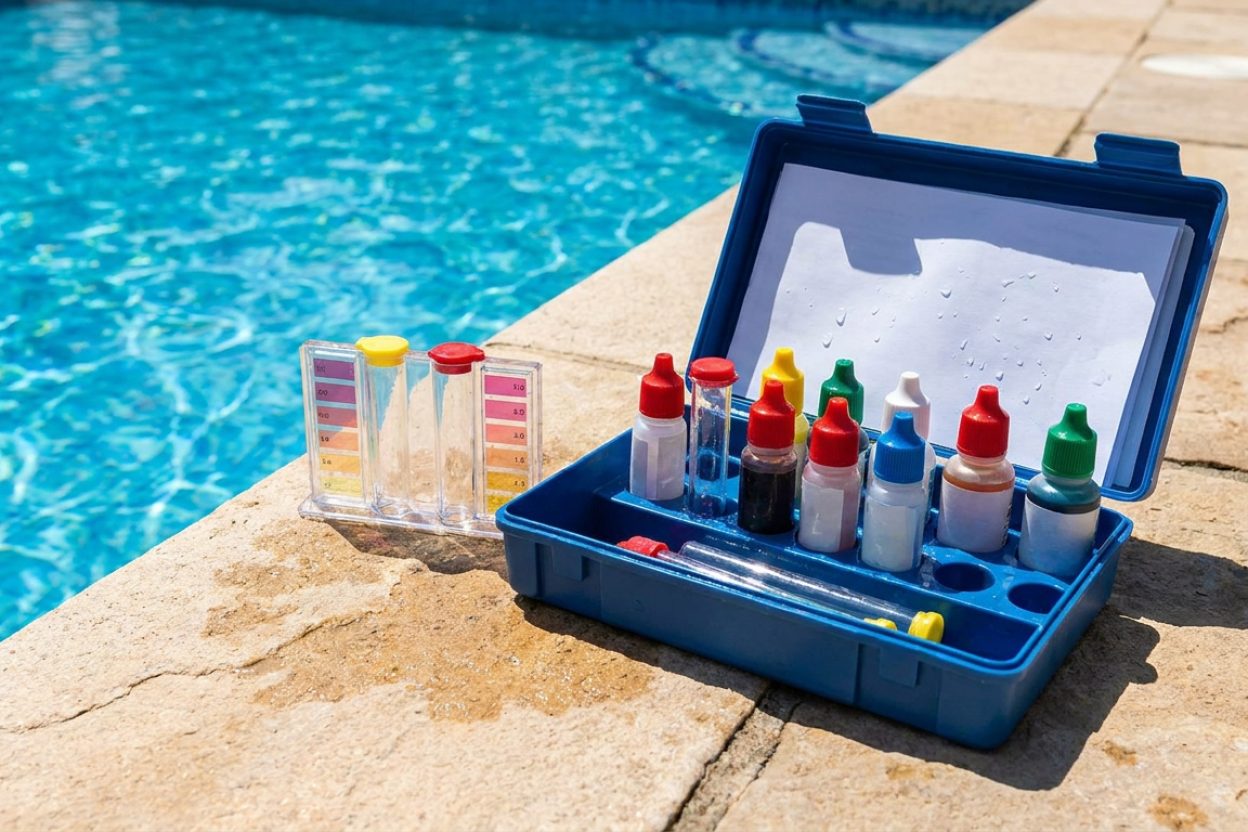
- Taylor K-2006C Test Kit: The gold standard for pool testing, uses drop count method for precise CH readings
- Taylor K-1770 Calcium Hardness Kit: Dedicated CH drop-test kit (EDTA titration)
- Test Frequency: Check calcium hardness monthly, or weekly if making adjustments
- Sample Collection: Take water sample from elbow-deep, away from returns and skimmers
Avoid test strips for calcium hardness - they're notoriously inaccurate for CH readings and can lead to improper dosing.
Adjusting Calcium Hardness in Fiberglass Pools
Raising Calcium Hardness
When CH is below 175 ppm, add calcium chloride (CaCl2):
- Starting Dose: About 1.25 lbs of calcium chloride per 10,000 gallons raises CH by roughly 10 ppm (to do it by hand — note that amounts vary with product concentration, so the calculator above is more reliable)
- Dissolve First: Pre-dissolve calcium chloride in a bucket of pool water - never add directly to pool
- Add Gradually: Pour dissolved solution around pool perimeter with pump running
- Wait and Retest: Allow 4-6 hours of circulation before retesting
- Repeat if Needed: Make incremental adjustments rather than large jumps
Safety Warning: Calcium chloride generates heat when dissolving. Always add chemical to water, never water to chemical.
Lowering Calcium Hardness
When CH climbs well above 250 ppm (or scaling appears) in fiberglass pools:
- Partial Drain and Refill: Most effective method - drain 25-50% of pool water
- Calculate Replacement: Test fill water CH levels to determine dilution effect
- Reverse Osmosis: Professional mobile RO service can lower CH without draining
- Rebalance Chemistry: After dilution, retest and adjust all parameters
Common Calcium Hardness Mistakes in Fiberglass Pools
- Ignoring CH Completely: Leads to aggressive water that damages equipment
- Using Plaster Pool Standards: the 250-350 ppm typical of plaster is unnecessary and problematic for fiberglass
- Relying on Test Strips: Inaccurate readings lead to improper adjustments
- Adding Undissolved Calcium: Can cause temporary clouding and uneven distribution
- Neglecting LSI Balance: Focusing only on CH without considering pH and total alkalinity
Calcium Hardness and Water Balance
Calcium hardness works with other parameters to achieve water balance:
- pH: Higher pH reduces calcium solubility, potentially causing scaling
- Total Alkalinity: Affects pH stability and LSI calculation
- Temperature: Warmer water raises the LSI, increasing the tendency to form scale (temperature is a direct input in the LSI calculation)
- LSI Target: Aim for LSI between -0.3 and +0.3 for fiberglass pools
Seasonal Calcium Management
Calcium hardness changes throughout the pool season:
- Spring Opening: Test CH after winter - may need adjustment
- Summer Monitoring: Evaporation concentrates calcium - watch for increases
- Heavy Rain: Dilutes CH levels - retest after significant rainfall
- Winter Prep: Balanced CH protects equipment during closure
Prevention and Maintenance Tips
- Maintain proper water balance year-round
- Use quality test kits for accurate readings
- Keep detailed records of CH levels and adjustments
- Address CH issues promptly to prevent equipment damage
- Consider professional water analysis if struggling with balance
For the full breakdown of safe chlorine levels by CYACyanuric Acid (stabilizer) — Sunscreen for your chlorine — it keeps sunlight from burning it off. The catch: the more you have, the more chlorine you need to keep. learn more → level, see our pool water chemistry guide.
 Taylor K-2006C Complete FAS-DPD Pool & Spa Test Kit
The FAS-DPD kit pool pros trust — reads chlorine accurately even at shock/SLAM levels, plus pH, alkalinity, calcium hardness and CYA. View on Amazon →
Taylor K-2006C Complete FAS-DPD Pool & Spa Test Kit
The FAS-DPD kit pool pros trust — reads chlorine accurately even at shock/SLAM levels, plus pH, alkalinity, calcium hardness and CYA. View on Amazon →
 Calcium Chloride — Calcium Hardness Up
Raises calcium hardness (plaster pools) View on Amazon →
Calcium Chloride — Calcium Hardness Up
Raises calcium hardness (plaster pools) View on Amazon →
 Poolvio 20" 2-in-1 Pool Brush Head (Walls & Floor)
Sturdy 20-inch brush head that clips onto any standard telescopic pole. View on Amazon →
Poolvio 20" 2-in-1 Pool Brush Head (Walls & Floor)
Sturdy 20-inch brush head that clips onto any standard telescopic pole. View on Amazon →
Still need help? Ask a Pool & Spa Expert AD
Get a personalized answer from PoolGuy810 — 30 years owning a pool and spa repair company. Describe your issue and get step-by-step help.
Related Pool Guides
Need More Help?
Try our free pool calculators and tools to help diagnose and fix your pool problems.
Browse Pool ToolsSLAM calculator, pH calculator, salt dosing & more