

Do You Need to Shock Above Ground Pools? Complete Guide

Do above ground pools need shocking like inground pools do?
Read full question
I'm wondering if I'm about to waste my money on pool shock for my above ground pool since I keep getting mixed advice on whether it's even necessary. Some people tell me that above ground pools don't need to be shocked as often as inground pools, while others say they need the same treatment. My chlorine levels have been staying around 2-3 ppm with regular chlorine tablets, but I've noticed the water getting a bit hazy after heavy use on weekends.
I'm wondering if above ground pools have different shocking requirements compared to inground pools, or if the maintenance routine should be exactly the same? Should I be shocking weekly during swim season, or is there a different schedule I should follow for an above ground setup?
Quick Answer
Above ground pools follow the same shocking rules as inground pools - and that means you don't shock on a fixed schedule. Keep free chlorine at the right level for your CYA, and shock only when you see algae, cloudy water, combined chlorine above 0.5 ppm, or free chlorine at zero.
When to Shock Your Above Ground Pool
Shock your above ground pool in these situations:
- After heavy use: Following pool parties or multiple swimmers
- After storms: Rain and debris introduce contaminants
- Cloudy water: When water loses clarity despite proper filtration
- Algae appearance: Any green, yellow, or black growth
- Strong chlorine smell: Indicates chloramines that need oxidizing
- Failed chlorine test: When free chlorine reads zero or very low
How Much Shock to Add
The amount depends on your pool size and current conditions. Use our chlorine calculator for dosing estimates, or follow these general guidelines for a one-time shock dose:
- Small pools (up to 5,000 gallons): 1/2 to 3/4 gallon 12.5% liquid chlorine (adjust amounts based on actual concentration)
- Medium pools (5,000-10,000 gallons): 3/4 to 1.5 gallons 12.5% liquid chlorine (adjust amounts based on actual concentration)
- Large pools (10,000+ gallons): 1.5 to 2+ gallons 12.5% liquid chlorine (adjust amounts based on actual concentration)
Don't know your pool's volume? Use our pool volume calculator to find out.
Important: Use liquid chlorine (which is sodium hypochlorite solution) rather than cal-hypo shock powder. Liquid chlorine doesn't add calcium hardness or cyanuric acid, making it ideal for above ground pools with vinyl liners.
Proper Shocking Procedure
Follow these steps for safe, effective shocking:
- Test current water chemistry using a Taylor K-2006 test kit or similar
- Calculate shock dose based on your pool's gallon capacity
- Add shock at dusk or night to prevent UV degradation
- Pour liquid chlorine slowly around pool perimeter with pump running
- Run filtration system for at least 8 hours after shocking
- Retest water after 24 hours to confirm proper levels
- Wait to swim until free chlorine drops below 10 ppm (per CDC)
Above Ground Pool Considerations
If you run tablets (trichlor) and keep FCFree Chlorine — The chlorine actively sanitizing your water right now. This is the number you keep an eye on. how much you need → around 2-3 ppm, the weekend haze you're seeing usually isn't a sign you need a weekly shock ritual. Tablets slowly raise your CYACyanuric Acid (stabilizer) — Sunscreen for your chlorine — it keeps sunlight from burning it off. The catch: the more you have, the more chlorine you need to keep. learn more → over time, and as CYA climbs, a fixed 2-3 ppm of FC eventually falls below the minimum for that CYA - so algae gets a foothold. The fix is to test CYA, then raise your FC target to match it (per the FC/CYAFC/CYA chart — The chart that sets your chlorine target from your stabilizer (CYA) level — the two go together. see the chart → chart), not to shock on a calendar.
Above ground pools have unique factors affecting shocking:
Vinyl Liner Protection
Never add shock directly to the pool floor near vinyl liners. If using granular shock, always pre-dissolve it first, or use liquid chlorine poured around the perimeter. Concentrated chemicals can bleach or damage vinyl.
Smaller Water Volume
Above ground pools typically hold less water than inground pools, meaning chemicals work faster but also get depleted quicker. Monitor levels more frequently, especially during hot weather or heavy use.
Limited Plumbing
Many above ground pools have simpler circulation systems. Ensure your pump runs longer after shocking to distribute chemicals evenly throughout the water.
SLAM Method for Problem Water
When your above ground pool develops algae or severe cloudiness, use the SLAM method (Shock Level And Maintain):
- Determine shock level using the FC/CYA chart based on your stabilizer level
- Add enough liquid chlorine to reach shock level (varies based on CYA level per FC/CYA chart)
- Maintain shock level by testing and adding chlorine every few hours
- Continue until water clears, combined chlorine (CCCombined Chlorine — "Used-up" chlorine left over from doing its job. Above about 0.5 ppm is the classic sign water needs a shock. learn more →) drops to 0.5 ppm or less, and the pool passes the overnight chlorine loss test (FC loss under 1 ppm)
- Run filter continuously and backwash/clean as needed
For a typical 8,000-gallon above ground pool with 30 ppm CYA, you'll need about 3/4 gallon of 12.5% liquid chlorine to reach shock level (roughly 12 ppm FC at CYA 30) from a normal starting level (amounts vary with liquid chlorine concentration).
Testing and Monitoring
After shocking, test these parameters:
- Free Chlorine (FC): Should be the right level for your CYA (typically 4-8 ppm for a stabilized outdoor pool) for daily swimming
- pH: Maintain 7.4-7.6 for comfort and chemical effectiveness
- Total Alkalinity: Keep at 80-120 ppm for pH stability
- Cyanuric Acid (CYA): Target 30-50 ppm for sun protection
Retest 24 hours after shocking to ensure levels have stabilized in the proper range.
Safety Warnings
Never mix different types of shock products. Don't add shock if anyone is swimming. Store chemicals in a cool, dry place away from other pool chemicals. Always add chemicals to water, never water to chemicals.
Above ground pools need the same careful chemical maintenance as any other pool type. Regular shocking keeps your water safe, clear, and enjoyable for swimming all season long.
For the full breakdown of safe chlorine levels by CYA level, see our pool water chemistry guide.
 Taylor K-2006C Complete FAS-DPD Pool & Spa Test Kit
The FAS-DPD kit pool pros trust — reads chlorine accurately even at shock/SLAM levels, plus pH, alkalinity, calcium hardness and CYA. View on Amazon →
Taylor K-2006C Complete FAS-DPD Pool & Spa Test Kit
The FAS-DPD kit pool pros trust — reads chlorine accurately even at shock/SLAM levels, plus pH, alkalinity, calcium hardness and CYA. View on Amazon →
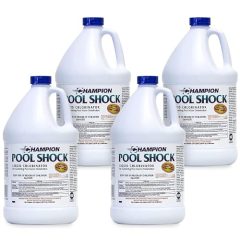 Liquid Chlorine / Sodium Hypochlorite (12.5%)
Everyday sanitizer — the B in BBB View on Amazon →
Liquid Chlorine / Sodium Hypochlorite (12.5%)
Everyday sanitizer — the B in BBB View on Amazon →
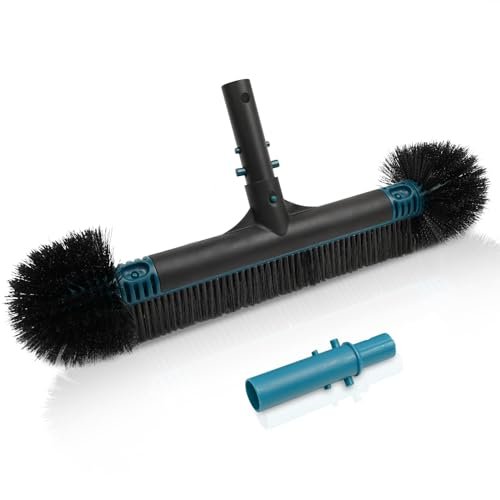 Poolvio 20" 2-in-1 Pool Brush Head (Walls & Floor)
Sturdy 20-inch brush head that clips onto any standard telescopic pole. View on Amazon →
Poolvio 20" 2-in-1 Pool Brush Head (Walls & Floor)
Sturdy 20-inch brush head that clips onto any standard telescopic pole. View on Amazon →
Still need help? Ask a Pool & Spa Expert AD
Get a personalized answer from PoolGuy810 — 30 years owning a pool and spa repair company. Describe your issue and get step-by-step help.
Related Pool Guides
Need More Help?
Try our free pool calculators and tools to help diagnose and fix your pool problems.
Browse Pool ToolsSLAM calculator, pH calculator, salt dosing & more