

Do I Need CYA (Stabilizer) in My Pool? Complete Guide

Is cyanuric acid safe and necessary for my family pool?
Read full question
Three months into pool season and I'm still confused about CYA levels, especially with my kids already begging to dive in.
Our pool gets full sun most of the day, and I've been using regular chlorine tablets. A neighbor mentioned something about CYA protecting chlorine from the sun, but I'm not sure if it's actually necessary or just another chemical I don't need. Will my chlorine work properly without it, and is it safe to have CYA in the water with kids swimming?
Quick Answer
Yes, you need CYA (cyanuric acid) in your pool if you use chlorine and your pool gets direct sunlight. CYA protects chlorine from UV degradation, and at normal pool levels it's safe to swim in, including for kids. The ideal CYA range depends on your pool type: 30-50 ppm for traditional chlorine pools, 70-80 ppm for salt water generator pools, and 0-30 ppm for indoor pools.
What Is CYA and Why It Matters
Cyanuric acid (CYACyanuric Acid (stabilizer) — Sunscreen for your chlorine — it keeps sunlight from burning it off. The catch: the more you have, the more chlorine you need to keep. learn more →), also called stabilizer or conditioner, forms a weak bond with free chlorine in your pool water. This bond protects chlorine molecules from being destroyed by ultraviolet rays from the sun. Without CYA protection, direct sunlight can eliminate a significant portion of your pool's chlorine within hours, with losses potentially reaching 50-75% on bright sunny days.
Think of CYA as sunscreen for your chlorine. Just as sunscreen protects your skin from UV damage, CYA protects your chlorine investment from solar destruction. This protection dramatically reduces your chlorine consumption and helps maintain consistent sanitizer levels throughout sunny days.
Is CYA Safe to Swim In With Kids?
Yes. Cyanuric acid at normal pool levels (the 30-80 ppm range covered below) is considered safe for swimming, including for young children. It isn't meaningfully absorbed through the skin, and the small amount a child might swallow incidentally is far below any level of concern. The real safety issue isn't the CYA itself — it's letting CYA climb so high that your chlorine can no longer sanitize, which is what actually leaves water unsafe.
Target CYA Levels for Different Pool Types
The ideal CYA range depends on your pool's chlorination method:
- Traditional chlorine pools: 30-50 ppm CYA
- Salt water generator pools: 70-80 ppm CYA
- Indoor pools: 0-30 ppm CYA (minimal UV exposure)
Salt water generators benefit from higher CYA levels because they produce chlorine continuously throughout the day. The higher stabilizer level helps protect this constant chlorine production from UV degradation.
How to Test Your CYA Levels
Accurate CYA testing uses a turbidity (cloudiness) test — you fill a small view tube until a black dot on the bottom just disappears — like the test included in the Taylor K-2006C (or the dedicated K-1720) kit. Ordinary test strips are often inaccurate for CYA.
Using the Taylor turbidity test:
- Fill the mixing bottle to the 7 mL line with pool water, then add R-0013 CYA reagent up to the 14 mL line
- Cap and shake for about 30 seconds — the sample turns cloudy
- Slowly pour the cloudy sample into the view tube while looking straight down at the black dot on the bottom
- Stop as soon as the black dot just disappears
- Read the CYA level in ppm directly off the tube at the liquid line, following your kit's instructions
Test CYA levels monthly. CYA doesn't evaporate, but it isn't permanent either — it declines slowly over a season (roughly a few percent a month, plus losses from dilution like splash-out and backwashing).
Adding CYA to Your Pool
When adding stabilizer to your pool, use pure cyanuric acid powder or granules. Many commercial "pool shock" products contain dichlor, which adds both chlorine and CYA - avoid these for routine chlorination as they'll quickly drive CYA levels too high.
Dosing calculations: Our all-in-one pool calculator estimates how much stabilizer to add for your pool size and target.
Application method:
- Pre-dissolve granular CYA in a bucket of hot water (it dissolves slowly and won't fully dissolve - pour the granules in too)
- Pour the solution around the pool perimeter while the pump runs
- Brush the pool bottom to prevent undissolved granules from settling
- Run filtration continuously for 24-48 hours
- Retest CYA levels after 2-3 days to confirm proper dissolution
The CYA-Chlorine Relationship
Higher CYA levels require higher free chlorine (FCFree Chlorine — The chlorine actively sanitizing your water right now. This is the number you keep an eye on. how much you need →) levels for effective sanitization. This relationship is crucial for proper pool maintenance:
- CYA 30 ppm: Minimum FC 2.0 ppm, shock at FC 12 ppm
- CYA 50 ppm: Minimum FC 3.0 ppm, shock at FC 20 ppm
- CYA 80 ppm: Minimum FC 6.0 ppm, shock at FC 32 ppm
Use the all-in-one pool calculator to determine your specific chlorine requirements based on your CYA level.
When You Don't Need CYA
Limited situations where CYA isn't necessary include:
- Completely indoor pools with no UV exposure
- Pools sanitized with non-chlorine systems (UV, ozone, minerals only)
- Temporary above-ground pools used only evenings or overcast days
Even partially shaded pools benefit from CYA protection, as reflected and scattered UV light can still degrade chlorine rapidly.
Managing High CYA Levels
CYA breaks down only very slowly, so in practice levels mainly increase over time through chemical additions. If CYA exceeds 100 ppm, chlorine becomes increasingly ineffective, creating reduced chlorine efficacy where even high FC levels won't sanitize properly.
The only practical way to lower CYA is partial water replacement. Draining 50% of your pool water and refilling will reduce CYA levels by approximately half.
Common CYA Mistakes to Avoid
- Using dichlor or trichlor products regularly (these add CYA continuously)
- Adding CYA without testing current levels first
- Expecting immediate results (CYA takes 2-3 days to fully dissolve and test accurately)
- Ignoring the FC/CYAFC/CYA chart — The chart that sets your chlorine target from your stabilizer (CYA) level — the two go together. see the chart → relationship when dosing chlorine
- Over-stabilizing pools (more isn't better with CYA)
Safety note: Always add chemicals to water, never water to chemicals. Wear safety equipment when handling pool chemicals and store them in cool, dry locations away from children and pets.
For the full breakdown of safe chlorine levels by CYA level, see our pool water chemistry guide.
 Taylor K-2006C Complete FAS-DPD Pool & Spa Test Kit
The FAS-DPD kit pool pros trust — reads chlorine accurately even at shock/SLAM levels, plus pH, alkalinity, calcium hardness and CYA. View on Amazon →
Taylor K-2006C Complete FAS-DPD Pool & Spa Test Kit
The FAS-DPD kit pool pros trust — reads chlorine accurately even at shock/SLAM levels, plus pH, alkalinity, calcium hardness and CYA. View on Amazon →
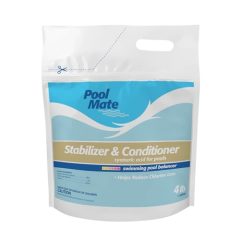 Pool Mate 4-Pounds Premium Pool Stabilizer and Conditioner, Concentrated Cyanuric Acid for Pools, Helps Chlorine Last Longer
View on Amazon →
Pool Mate 4-Pounds Premium Pool Stabilizer and Conditioner, Concentrated Cyanuric Acid for Pools, Helps Chlorine Last Longer
View on Amazon →
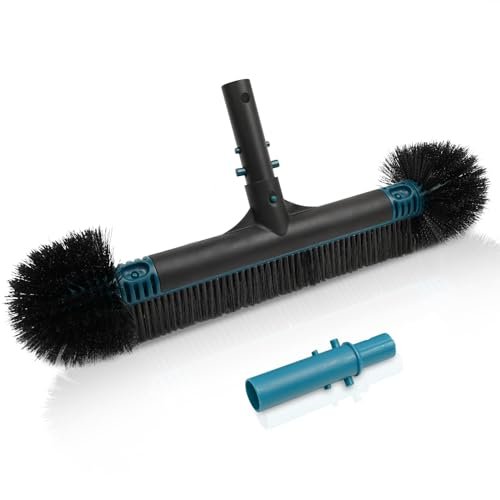 Poolvio 20" 2-in-1 Pool Brush Head (Walls & Floor)
Sturdy 20-inch brush head that clips onto any standard telescopic pole. View on Amazon →
Poolvio 20" 2-in-1 Pool Brush Head (Walls & Floor)
Sturdy 20-inch brush head that clips onto any standard telescopic pole. View on Amazon →
Still need help? Ask a Pool & Spa Expert AD
Get a personalized answer from PoolGuy810 — 30 years owning a pool and spa repair company. Describe your issue and get step-by-step help.
Related Pool Guides
Need More Help?
Try our free pool calculators and tools to help diagnose and fix your pool problems.
Browse Pool ToolsSLAM calculator, pH calculator, salt dosing & more