
Can Pool Chlorine Make You Sick? Health Effects Explained

What chlorine levels are safe? Getting sick from pool chemicals?
Read full question
Opened my pool this season after adjusting pH levels, switching chlorine brands, and getting professional water testing — but my family still gets red eyes and skin irritation after swimming. We've been experiencing eye irritation and some skin redness after swimming, but I'm also worried about not having enough chlorine to kill bacteria and other nasties.
My latest test results show chlorine at around 5-6 ppm, and my CYA is sitting at about 50 ppm. I've been using liquid chlorine and shocking weekly with calcium hypochlorite. Sometimes the chlorine drops really low between treatments, maybe down to 0.5-1 ppm, especially after heavy use or rain.
What's the sweet spot for chlorine levels to avoid both chemical irritation and harmful bacteria? I want to keep everyone healthy but not sure if I should be targeting higher or lower numbers based on my current CYA level.
Quick Answer
Pool chlorine can make you sick when levels are too high (causing irritation) or too low (allowing harmful bacteria). Proper chlorine levels based on your CYA level prevent illness. High levels (over 10 ppm) can cause skin, eye, and respiratory irritation, while low levels (below effective levels) allow harmful microorganisms to grow. Safe chlorine levels depend on CYA concentration, and the all-in-one pool calculator provides an estimate of the free chlorine for your CYA.
How Pool Chlorine Can Make You Sick
High Chlorine Levels (Over-Chlorination)
When free chlorine levels exceed 10 ppm, you may experience:
- Skin irritation: Rashes, dryness, and itching
- Eye irritation: Redness, burning, and tearing
- Respiratory problems: Coughing, wheezing, and difficulty breathing
- Hair damage: Dryness, discoloration, and brittleness
- Swimsuit bleaching: Fabric damage and color loss
Contrary to popular belief, that strong "chlorine smell" at pools isn't from too much chlorine - it's actually from chloramines (combined chlorine) formed when chlorine reacts with contaminants like sweat, urine, and body oils.
Low Chlorine Levels (Under-Chlorination)
When free chlorine drops below effective levels, harmful microorganisms can multiply, causing:
- Recreational Water Illnesses (RWIs): Diarrhea, ear infections, and skin infections
- E. coli and Cryptosporidium infections: Severe gastrointestinal illness
- Hot tub rash (Pseudomonas): Itchy, bumpy skin infection
- Algae-related issues: Slip hazards and bacterial growth
Determining Safe Chlorine Levels
Safe chlorine levels depend on your cyanuric acid (CYACyanuric Acid (stabilizer) — Sunscreen for your chlorine — it keeps sunlight from burning it off. The catch: the more you have, the more chlorine you need to keep. learn more →) concentration. Use this FC/CYAFC/CYA chart — The chart that sets your chlorine target from your stabilizer (CYA) level — the two go together. see the chart → relationship:
- CYA 30 ppm: FCFree Chlorine — The chlorine actively sanitizing your water right now. This is the number you keep an eye on. how much you need → should be 3-5 ppm
- CYA 40 ppm: FC should be 4-6 ppm
- CYA 50 ppm: FC should be 5-7 ppm
- CYA 60 ppm: FC should be 5-8 ppm
- CYA 70-80 ppm (SWGSalt Water Generator — The "salt cell" that makes chlorine from the salt in a saltwater pool. Same chlorine — it just makes its own. pool terms → pools): FC should be 4-6 ppm (salt cells can run a lower target because the cell continuously super-chlorinates)
Target CYA levels of 30-50 ppm for regular pools and 70-80 ppm for salt water generator pools.
Testing and Maintaining Safe Levels
Testing Requirements
- Test daily during swimming season using a reliable test kit like the Taylor K-2006C FAS-DPDFAS-DPD test — A drop-based test that reads chlorine accurately even at high "shock" levels, where test strips give up. see test kits → kit
- Test free chlorine (FC), combined chlorine (CCCombined Chlorine — "Used-up" chlorine left over from doing its job. Above about 0.5 ppm is the classic sign water needs a shock. learn more →), pH, and total alkalinity at minimum
- Test CYA monthly using the Taylor CYA test (R-0013)
- Test immediately after heavy use, rain, or chemical additions
Adjusting Chlorine Levels
To raise FC: Add liquid chlorine (sodium hypochlorite). Retest after 15-20 minutes of circulation.
To lower FC: Stop adding chlorine and let sunlight naturally reduce levels, or add sodium thiosulfate (chlorine neutralizer).
pH Balance and Chlorine Effectiveness
In water with no cyanuric acid (CYA), the active sanitizing fraction of chlorine (HOCl) drops as pH rises:
- pH 7.0: 73% effectiveness
- pH 7.5: 50% effectiveness
- pH 8.0: 23% effectiveness
- pH 8.5: 10% effectiveness
Maintain pH between 7.2 and 7.8 for swimmer comfort and to protect surfaces; pH has only a modest effect on chlorine activity in a stabilized pool. Use muriatic acid to lower pH or sodium carbonate (soda ash) to raise it.
Preventing Chlorine-Related Illness
For Pool Operators
- Maintain consistent FC levels based on your CYA reading
- Keep combined chlorine below 0.5 ppm - if higher, shock the pool
- Ensure proper circulation - run pumps 8-12 hours daily
- Clean filters regularly and backwash when pressure rises 8-10 psi
- Address algae immediately with SLAMShock Level And Maintain — raise free chlorine to a target based on your CYA and hold it there until the algae is gone. It's a process, not a one-time dose. the SLAM walkthrough → (Shock Level And Maintain) process
For Swimmers
- Shower before and after swimming to remove contaminants and chlorine
- Don't swim if you have diarrhea - wait until 2 weeks after diarrhea stops
- Avoid swallowing pool water even in properly maintained pools
- Exit the pool if you experience irritation and retest chemical levels
When to Shock Your Pool
Shock when combined chlorine exceeds 0.5 ppm or when dealing with contamination. For SLAM process:
- Raise FC to shock level (varies by CYA - typically 40% of CYA)
- Maintain shock level 24/7 until you pass the Overnight Chlorine Loss Test (OCLT)
- Test FC every few hours and add liquid chlorine to maintain shock level
- Continue until water clears and FC holds steady overnight
Common Mistakes That Cause Illness
- Relying on smell to judge chlorine levels - strong odors indicate chloramines, not high FC
- Using trichlor tabs as primary sanitizer - these add CYA continuously, eventually making chlorine ineffective
- Not testing CYA regularly - high CYA (over 80 ppm) requires very high FC levels
- Assuming all granular shock is just chlorine - cal-hypo also adds calcium and dichlor adds CYA, while liquid chlorine adds only chlorine
- Ignoring pH levels - high pH shifts chlorine toward its weaker form and promotes scaling (the effect on sanitizing is modest in a stabilized pool)
By maintaining proper water chemistry and following TFP (Trouble Free Pool) principles, you can enjoy a healthy swimming environment without chlorine-related illness.
For the full breakdown of safe chlorine levels by CYA level, see our pool water chemistry guide.
 Taylor K-2006C Complete FAS-DPD Pool & Spa Test Kit
The FAS-DPD kit pool pros trust — reads chlorine accurately even at shock/SLAM levels, plus pH, alkalinity, calcium hardness and CYA. View on Amazon →
Taylor K-2006C Complete FAS-DPD Pool & Spa Test Kit
The FAS-DPD kit pool pros trust — reads chlorine accurately even at shock/SLAM levels, plus pH, alkalinity, calcium hardness and CYA. View on Amazon →
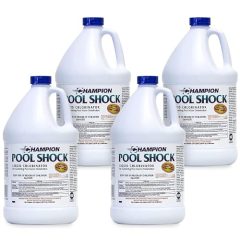 Liquid Chlorine / Sodium Hypochlorite (12.5%)
Everyday sanitizer — the B in BBB View on Amazon →
Liquid Chlorine / Sodium Hypochlorite (12.5%)
Everyday sanitizer — the B in BBB View on Amazon →
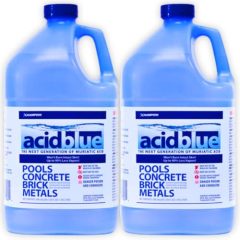 Acid Blue - Low Fume Muriatic Acid for Swimming Pools & Spas - Lower's pH, Reduces Alkalinity - 2 Gallon
View on Amazon →
Acid Blue - Low Fume Muriatic Acid for Swimming Pools & Spas - Lower's pH, Reduces Alkalinity - 2 Gallon
View on Amazon →
Still need help? Ask a Pool & Spa Expert AD
Get a personalized answer from PoolGuy810 — 30 years owning a pool and spa repair company. Describe your issue and get step-by-step help.
Related Pool Guides
Need More Help?
Try our free pool calculators and tools to help diagnose and fix your pool problems.
Browse Pool ToolsSLAM calculator, pH calculator, salt dosing & more