
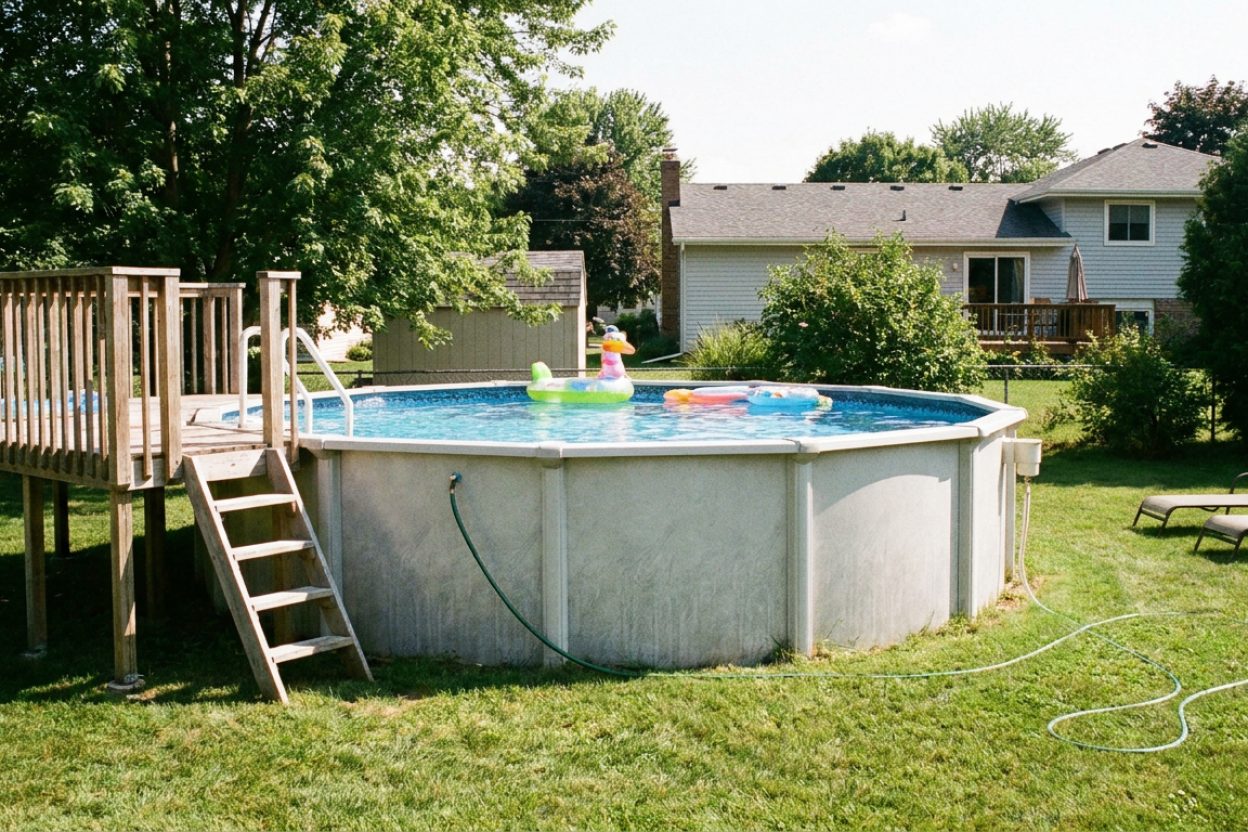
Can You Paint Pool Liner? Guide for Above-Ground Pools

Is it possible to paint my pool liner? New pool owner here
Read full question
Staring at my faded above-ground pool liner, I'm probably crazy for wondering this, but can you actually paint these things? The liner has some areas that don't look great and I was wondering if I could just paint over them to freshen things up.
Someone at the pool store mentioned that painting liners might not always work, but they weren't sure about the details. I have a vinyl liner - is that something I can paint? Or are there certain types of liners that work better for painting than others? I really don't want to mess anything up.
Quick Answer
Almost every above-ground pool has a vinyl liner, and painting a vinyl liner doesn't hold up - the slick, flexible surface gives a coating little to grab, so it tends to peel, flake, and cloud the water. Skip it and refresh the liner another way: replace it, clean off staining, or use a vinyl pool crayon for small marks. Only hard surfaces (concrete or a fiberglass shell, both uncommon above grade) can actually be painted.
You almost certainly have a vinyl liner
If your above-ground pool has a smooth, flexible liner that was installed in one piece over a metal or resin frame, that's vinyl — the standard for above-ground pools. It's deliberately non-porous and chemical-resistant, which is exactly why paint has little to grab onto.
Don't paint a vinyl liner — do this instead
Paint doesn't hold up on a vinyl liner: the slick, flexible, non-porous surface gives a coating little to grab, so it tends to peel and flake into the water and you'll usually have thrown away the time and money. You'll find things sold that sound like vinyl-liner paint, but read them closely — most are mislabeled, with the name describing the chemistry or the job rather than the surface they actually bond to. A "vinyl" pool paint is usually a vinyl-resin coating made for masonry; an "epoxy pond liner" is a coating that replaces a liner on a hard concrete or fiberglass shell, not something that sticks to a flexible vinyl membrane; and many "vinyl-liner pool" kits are meant for the rigid steps. The generic no-name "vinyl liner paint" listings are real in that someone's selling them, but those are the ones with the peel-and-cloud track record. (Liquid-rubber coatings are the one category where bonding to a flexible surface is at least plausible, but it's unproven on pool liners.) Skip it and pick a method that actually works:
- Replace the liner: if it's faded, brittle, or leaking, a new liner is the real fix and the only lasting one. For above-ground pools this is typically a few hundred dollars.
- Clean it first: what looks like fading is often staining. A vinyl-safe liner cleaner (for example Natural Chemistry Clean & Perfect or Stain Free) can bring back the original color without replacing anything.
- Pool crayons: for small scratches or marks, a vinyl pool crayon is a quick cosmetic touch-up.
- Stay on top of water chemistry: keep pH 7.4-7.6, total alkalinity 80-120 ppm, and free chlorine matched to your CYACyanuric Acid (stabilizer) — Sunscreen for your chlorine — it keeps sunlight from burning it off. The catch: the more you have, the more chlorine you need to keep. learn more → (commonly 4-8 ppm for a stabilized outdoor pool) so the liner doesn't degrade or stain in the first place. Estimate yours with our all-in-one calculator.
If you actually have a concrete or fiberglass pool (uncommon above grade)
It is possible to build a concrete pool or set a fiberglass shell above ground, but both are unusual and costly — most people reading this won't have one. If you genuinely do, those hard surfaces can be painted with the right prep and products.
Fiberglass shell
- Drain and let the surface dry completely (about 48 hours).
- Clean off all oils, algae, and residue with a degreaser such as TSP.
- Scuff the gel-coat with ~220-grit sandpaper so paint can adhere.
- Fill any cracks or chips with marine-grade fiberglass filler and sand smooth.
- Prime with a fiberglass-rated marine primer.
- Apply 2-3 thin coats of marine-grade epoxy pool paint, curing each per the label.
- Let it cure (often around 7 days) before refilling — follow the manufacturer's stated time.
Concrete or gunite
- Etch the surface with a diluted muriatic acid wash (about 1 part acid to 4 parts water), following the product's directions — wear gloves and eye protection, always add acid to water (never the reverse), and work in good ventilation.
- Pressure-wash off all loose material and let it dry thoroughly (a couple of days).
- Prime and paint with a pool paint made for concrete — chlorinated-rubber or epoxy.
Safety tip: an empty pool acts like a confined space — epoxy and solvent-based pool paints give off vapors that sink and collect at the bottom, so cross-ventilate with fans, take fresh-air breaks, don’t work alone, and wear a respirator with organic-vapor (OV) cartridges (a dust mask won’t stop solvent fumes). Let oily rags dry flat outdoors or seal them in water in a metal can, since they can self-ignite, and follow the manufacturer’s cure time before refilling.
Paint products
For a paintable hard surface, stick with pool-specific brands such as Ramuc, Kelley Technical Coatings, or Insl-X. Most above-grade pools need only a gallon or two depending on size and number of coats. Follow the product label for coverage, coats, and cure time.
After painting
A painted surface needs steady chemistry to last:
- Keep pH 7.4-7.6 so the coating doesn't break down.
- Hold CYA (stabilizer) around 30-50 ppm — enough to protect chlorine without over-stabilizing.
- Favor liquid chlorine over cal-hypo to avoid calcium buildup on the finish.
- Test 2-3 times a week in season and brush weekly with a soft brush.
Even done well, a painted surface usually needs redoing every few years — factor that into the decision.
When to call a pro
- The surface has extensive damage or previous paint that's failing.
- You're unsure about surface prep.
- It's a large or complex pool, or you want warranty coverage on the work.
For the full breakdown of safe chlorine levels by CYA level, see our pool water chemistry guide.
Still need help? Ask a Pool & Spa Expert AD
Get a personalized answer from PoolGuy810 — 30 years owning a pool and spa repair company. Describe your issue and get step-by-step help.
Related Pool Guides
Need More Help?
Try our free pool calculators and tools to help diagnose and fix your pool problems.
Browse Pool ToolsSLAM calculator, pH calculator, salt dosing & more