

How Long Pool Chemicals Take to Settle - Complete Guide

What's the proper wait time for pool chemicals to circulate?
Read full question
Halfway through adding my pool chemicals, they're just floating on the surface for hours instead of dissolving like they normally do. After adding chemicals like chlorine, pH adjusters, or alkalinity increasers, I want to ensure they're properly mixed before taking water samples for testing.
My pump runs approximately 6-8 hours daily, and I'm concerned about getting inaccurate readings if I test too early. What's the standard circulation time required for different types of pool chemicals to fully distribute throughout the water? I want to establish a proper testing protocol to avoid chemical imbalances.
Quick Answer
Most pool chemicals take 2-8 hours to fully circulate and settle, depending on the type of chemical and your pump runtime. Liquid chemicals like chlorine mix in fastest — you can usually retest in about 15-30 minutes of circulation — while denser granular chemicals like calcium hardness increaser take a few hours, and stabilizer can take 24 hours up to a week to fully dissolve and register. Pre-dissolve CYA in a bucket of hot water or use the sock method for faster dissolution.
Settlement Times by Chemical Type
Fast-Acting Liquid Chemicals (15-30 Minutes)
Liquid chlorine (sodium hypochlorite) and muriatic acid are the quickest to settle because they're already in solution. These chemicals mix rapidly with your pool water and typically reach full circulation within 2-4 hours of pump operation. You can safely test and swim after this period.
Granular Chlorine and pH Adjusters (About 20-30 Minutes)
Granular chlorine (calcium hypochlorite), sodium carbonate (pH increaser), and sodium bisulfate (pH decreaser) generally distribute within about 20-30 minutes of circulation before you retest, though cal-hypo shock raises chlorine you'll want to let fall back under 10 ppm before swimming. Always pre-dissolve granular chemicals in a bucket of pool water before adding to prevent bleaching of pool surfaces.
Alkalinity and Calcium Adjusters (20 Minutes to a Few Hours)
Baking soda (sodium bicarbonate, alkalinity increaser) distributes quickly — retest after about 20-30 minutes of circulation. Calcium chloride (hardness increaser) is denser and slower; allow roughly 2-4 hours before retesting. These chemicals can temporarily cloud your water during the settlement process.
Stabilizer/Cyanuric Acid (24 Hours to a Week)
Cyanuric acid (CYACyanuric Acid (stabilizer) — Sunscreen for your chlorine — it keeps sunlight from burning it off. The catch: the more you have, the more chlorine you need to keep. learn more →) is notoriously slow to dissolve, often taking 24 hours up to a week to fully dissolve and register even with continuous circulation. Pre-dissolve CYA in a bucket of hot water and pour it in slowly, or use the sock method by placing the CYA in a sock or nylon in the skimmer basket, or hang it in front of a return jet, squeezing occasionally for faster dissolution.
Factors That Affect Settlement Time
Circulation and Filtration
Your pool pump must run continuously during the settlement period for chemicals to distribute evenly. A properly sized pump should turn over your entire pool volume in 6-8 hours. If your pump is undersized or you're running it intermittently, expect longer settlement times.
Water Temperature
Warmer water dissolves chemicals faster than cold water. In summer months, chemicals may settle 25-30% faster than in cooler spring or fall conditions. This is especially noticeable with granular chemicals and stabilizer.
Pool Size and Shape
Larger pools naturally take longer for complete chemical distribution. Pools with complex shapes, multiple levels, or dead spots may need additional circulation time. Consider using a pool brush to help distribute chemicals manually in these areas.
Proper Testing Timeline
When to Test After Adding Chemicals
Never test immediately after adding chemicals – you'll get inaccurate readings. Follow these minimum wait times:
- Liquid chlorine: ~15-30 minutes (until free chlorine is back under 10 ppm); muriatic acid: ~30 minutes (up to an hour for large doses)
- Cal-hypo shock: 8-24 hours, until free chlorine drops below 10 ppm
- Baking soda / soda ash: 20-30 minutes; calcium chloride: 2-4 hours
- Stabilizer (CYA): no swim gate - keep swimming; the 24-48 hours is only for retesting CYA (it is slow to register)
Using a Quality Test Kit
Use a Taylor K-2006C test kit or comparable FAS-DPDFAS-DPD test — A drop-based test that reads chlorine accurately even at high "shock" levels, where test strips give up. see test kits → testing method for accurate results. Test strips can give false readings, especially immediately after chemical addition. The Trouble Free Pool (TFP) method emphasizes accurate testing for proper water balance.
Safety Considerations During Settlement
Swimming Restrictions
Avoid swimming right after adding chemicals. Wait for full circulation and for free chlorine to drop back under 10 ppm (per CDC). Some chemicals can cause skin and eye irritation if not properly distributed.
Chemical Addition Best Practices
Add chemicals during evening hours when the sun won't immediately break down chlorine. Always add chemicals separately – never mix different chemicals together. Add chemicals to the deep end near return jets for better circulation.
Troubleshooting Slow Settlement
Cloudy Water After Adding Chemicals
Temporary cloudiness is normal, especially with calcium or alkalinity adjusters. If cloudiness persists beyond 8 hours, check your filter system and consider backwashing or cleaning your filter media.
Uneven Chemical Distribution
If testing shows inconsistent readings across your pool, increase circulation time and manually brush pool surfaces. Consider running your pump 24 hours during initial chemical balancing or SLAMShock Level And Maintain — raise free chlorine to a target based on your CYA and hold it there until the algae is gone. It's a process, not a one-time dose. the SLAM walkthrough → (Shock Level And Maintain) processes.
Seasonal Considerations
Spring openings often require multiple chemical additions over several days. Allow full settlement between each addition to avoid over-correcting. During peak summer use, maintain consistent daily testing and chemical addition schedules rather than large weekly adjustments.
Remember that proper chemical settlement is crucial for accurate water testing and safe swimming conditions. Patience during the settlement period prevents chemical waste and ensures optimal water balance.
For the full breakdown of safe chlorine levels by CYA level, see our pool water chemistry guide or use the FC/CYAFC/CYA chart — The chart that sets your chlorine target from your stabilizer (CYA) level — the two go together. see the chart → relationship — our all-in-one pool calculator estimates the free chlorine target for your CYA.
 Taylor K-2006C Complete FAS-DPD Pool & Spa Test Kit
The FAS-DPD kit pool pros trust — reads chlorine accurately even at shock/SLAM levels, plus pH, alkalinity, calcium hardness and CYA. View on Amazon →
Taylor K-2006C Complete FAS-DPD Pool & Spa Test Kit
The FAS-DPD kit pool pros trust — reads chlorine accurately even at shock/SLAM levels, plus pH, alkalinity, calcium hardness and CYA. View on Amazon →
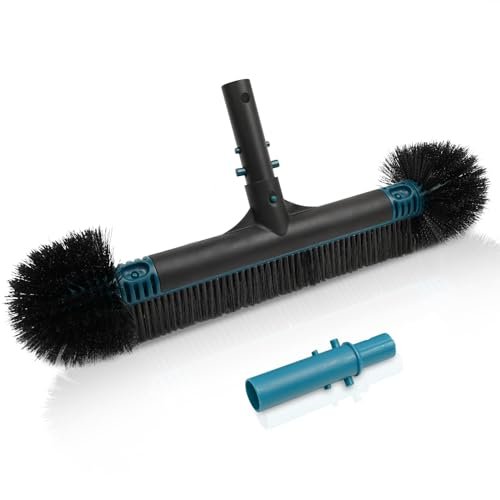 Poolvio 20" 2-in-1 Pool Brush Head (Walls & Floor)
Sturdy 20-inch brush head that clips onto any standard telescopic pole. View on Amazon →
Poolvio 20" 2-in-1 Pool Brush Head (Walls & Floor)
Sturdy 20-inch brush head that clips onto any standard telescopic pole. View on Amazon →
Still need help? Ask a Pool & Spa Expert AD
Get a personalized answer from PoolGuy810 — 30 years owning a pool and spa repair company. Describe your issue and get step-by-step help.
Related Pool Guides
Need More Help?
Try our free pool calculators and tools to help diagnose and fix your pool problems.
Browse Pool ToolsSLAM calculator, pH calculator, salt dosing & more