

Do Indoor Pools Need Cyanuric Acid? Pool Stabilizer Guide

Is cyanuric acid really necessary for my indoor pool?
Read full question
Standing in front of my indoor pool with a tight budget — is cyanuric acid actually necessary or can I skip this $30+ expense the pool store keeps pushing? Last time I was there, they insisted I needed cyanuric acid for my indoor pool and tried to upsell me on their "premium stabilizer package" for like $60.
My pool is completely indoors with no direct sunlight hitting it. I've been managing fine without CYA so far, but I'm wondering if there's actually a legitimate reason to use it? I'm all for DIY pool maintenance and cutting out unnecessary expenses, but I also don't want to mess up my water chemistry if stabilizer actually serves a purpose indoors.
Quick Answer
Indoor pools generally don't need cyanuric acid (stabilizer) because UV rays aren't breaking down the chlorine. However, if you experience rapid chlorine loss, maintaining 20-30 ppm CYA can help. High CYA levels over-stabilize the water, slowing chlorine and risking algae growth and wasted chemicals. Target levels for indoor pools are 0 ppm CYA for most, 20-30 ppm if needed, and 1.5-3 ppm free chlorine.
Why Indoor Pools Are Different
Cyanuric acid's primary job is protecting chlorine from UV degradation. In outdoor pools, sunlight breaks down free chlorine rapidly - sometimes within hours. This is why outdoor pools need 30-50 ppm of CYACyanuric Acid (stabilizer) — Sunscreen for your chlorine — it keeps sunlight from burning it off. The catch: the more you have, the more chlorine you need to keep. learn more → (or 70-80 ppm for salt water generators) to maintain proper sanitization.
Indoor pools don't face this UV challenge. Your chlorine naturally lasts much longer indoors, meaning you'll use less chemical and save money. This is one of the major advantages of indoor pool ownership from a maintenance perspective.
When Indoor Pools Might Benefit from Low CYA
There are specific situations where adding a small amount of cyanuric acid to an indoor pool makes sense:
- High bather loads: Commercial indoor pools or residential pools with frequent heavy use may benefit from 20-30 ppm CYA
- Incidental UV exposure: Skylights or large windows that let some sunlight reach the water
- Chlorine demand problems: If you're constantly fighting chlorine loss despite proper FCFree Chlorine — The chlorine actively sanitizing your water right now. This is the number you keep an eye on. how much you need → levels and no algae
The Problems with Too Much CYA Indoors
Many pool owners make the mistake of treating their indoor pool like an outdoor one, leading to CYA levels of 50+ ppm. This creates several problems:
Over-Stabilization Issues
High cyanuric acid heavily buffers your free chlorine, making it less effective. According to the FC/CYAFC/CYA chart — The chart that sets your chlorine target from your stabilizer (CYA) level — the two go together. see the chart → relationship chart, you need higher chlorine levels as CYA increases. At 50 ppm CYA, you need 4 ppm FC minimum, but at 20 ppm CYA, you only need 1.5 ppm FC.
Algae Growth Risk
Overstabilized pools are prone to algae blooms because the chlorine becomes sluggish. You might test 3 ppm free chlorine but have poor sanitization due to high CYA binding the chlorine.
Wasted Chemicals
You'll spend significantly more on chlorine trying to maintain higher FC levels that high CYA demands, even though you don't need the UV protection indoors.
Testing and Maintaining Proper Levels
Testing CYA Levels
Use a quality test kit like the Taylor K-2006C to accurately measure cyanuric acid. The turbidity test requires proper mixing and timing - add the reagent, cap and invert 10 times, then read when the black dot disappears.
Test CYA monthly for indoor pools, or immediately if you're experiencing chlorine loss issues. Many pool stores use test strips that are notoriously inaccurate for CYA readings.
Target Levels for Indoor Pools
- No CYA: 0 ppm is perfectly fine for most indoor pools
- Low CYA: 20-30 ppm maximum if you determine you need some stabilizer
- Free Chlorine: 1.5-3 ppm depending on your CYA level and bather load
Adding Stabilizer to Indoor Pools
If you determine your indoor pool needs cyanuric acid, add it carefully:
- Starting dose: about 1 pound of stabilizer per 10,000 gallons raises CYA by roughly 10-12 ppm (about 13 oz per 10 ppm) - size it for your pool with the calculator
- Add a bit less than you think you need at first, then retest before adding more — it’s easy to overshoot and hard to remove excess. For the amount that fits your pool, try our easy-to-use pool calculator or browse our pool guides.
- Pre-dissolve granular stabilizer in a bucket of hot water - it dissolves slowly
- Add the solution near return jets with circulation running
- Wait several days (up to a week) before testing, as granular CYA dissolves slowly and reads low until it has fully dissolved and registered
- Retest and adjust if needed
Safety note: Always add chemicals to water, never water to chemicals, and use proper ventilation even indoors.
Maintaining Indoor Pool Chemistry
With little or no CYA, your indoor pool chemistry becomes much simpler:
- pH: Maintain 7.4-7.6 for comfort and chlorine effectiveness
- Total Alkalinity: 80-120 ppm (60-80 for salt water systems)
- Free Chlorine: 1.5-3 ppm (lower end possible with minimal CYA)
- Calcium Hardness: 250-350 ppm for plaster pools, 175-225 ppm for vinyl/fiberglass
Removing Excess CYA
If your indoor pool has high cyanuric acid from previous outdoor use or over-treatment, you'll need to dilute it. CYA breaks down only very slowly, so in practice it's reduced by:
- Partial drain and refill (most effective method)
- Reverse osmosis treatment (expensive but preserves water)
- Commercial CYA reducer products like Bio-Active (limited effectiveness)
Calculate the dilution needed: if current CYA is 60 ppm and you want 20 ppm, you need to replace about 67% of your pool water [(60-20)/60 = 66.7%].
For the full breakdown of safe chlorine levels by CYA level, see our pool water chemistry guide.
 Taylor K-2006C Complete FAS-DPD Pool & Spa Test Kit
The FAS-DPD kit pool pros trust — reads chlorine accurately even at shock/SLAM levels, plus pH, alkalinity, calcium hardness and CYA. View on Amazon →
Taylor K-2006C Complete FAS-DPD Pool & Spa Test Kit
The FAS-DPD kit pool pros trust — reads chlorine accurately even at shock/SLAM levels, plus pH, alkalinity, calcium hardness and CYA. View on Amazon →
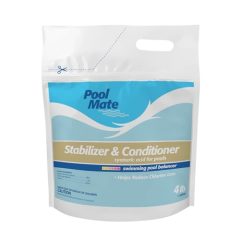 Pool Mate 4-Pounds Premium Pool Stabilizer and Conditioner, Concentrated Cyanuric Acid for Pools, Helps Chlorine Last Longer
View on Amazon →
Pool Mate 4-Pounds Premium Pool Stabilizer and Conditioner, Concentrated Cyanuric Acid for Pools, Helps Chlorine Last Longer
View on Amazon →
Still need help? Ask a Pool & Spa Expert AD
Get a personalized answer from PoolGuy810 — 30 years owning a pool and spa repair company. Describe your issue and get step-by-step help.
Related Pool Guides
Need More Help?
Try our free pool calculators and tools to help diagnose and fix your pool problems.
Browse Pool ToolsSLAM calculator, pH calculator, salt dosing & more