

Do I Need to Vacuum My Pool? Complete Guide & Schedule

Is pool vacuuming necessary or can I rely on filtration alone?
Read full question
Spent more money on pool filter cartridges in the past month than I did all last season, yet debris keeps settling on my pool floor.
From a technical standpoint, what are the limitations of relying solely on filtration versus implementing a systematic vacuuming schedule? I need to understand the optimal frequency and whether this is actually necessary for maintaining proper water quality and circulation efficiency.
Quick Answer
Yes, you absolutely need to vacuum your pool regularly to remove debris that your filter can't catch. Most pools need vacuuming roughly 1-3 times per week, depending on usage and environmental factors.
Step-by-Step Guide to Determining Your Vacuuming Needs
- Assess your pool's current condition
Look at your pool floor, walls, and steps. If you see visible debris, dirt patches, or any discoloration, vacuuming is immediately necessary. Even crystal-clear water can hide fine sediment on the pool floor. - Evaluate your environment factors
Pools surrounded by trees, experiencing heavy bather loads, or in windy areas need more frequent vacuuming. Desert pools may need daily vacuuming due to sand and dust, while covered pools in clean environments might only need weekly attention. - Check your filtration system efficiency
Run your filter system for 24 hours, then examine the pool floor. If debris remains after this full cycle, your filter alone cannot handle the cleaning load, making vacuuming essential. - Test your water chemistry
Use a Taylor K-2006 test kit to check free chlorine (FCFree Chlorine — The chlorine actively sanitizing your water right now. This is the number you keep an eye on. how much you need →), pH, total alkalinity (TATotal Alkalinity — The buffer that keeps your pH from bouncing around. Get this in range and pH gets a lot easier to manage. learn more →), and cyanuric acid (CYACyanuric Acid (stabilizer) — Sunscreen for your chlorine — it keeps sunlight from burning it off. The catch: the more you have, the more chlorine you need to keep. learn more →) levels. Poor water chemistry often correlates with increased debris and algae growth, requiring more frequent vacuuming. - Establish your baseline vacuuming frequency
Start with twice-weekly vacuuming for two weeks. Monitor water clarity and debris accumulation to adjust frequency up or down based on your pool's specific needs.
When Vacuuming Becomes Critical
Certain situations make vacuuming absolutely non-negotiable:
- After storms or high winds: Debris and organic matter can quickly overwhelm your sanitizer and create algae blooms
- Heavy bather loads: Oils, lotions, and organic waste settle to the bottom and feed algae growth
- Visible algae spots: Even small algae patches must be vacuumed to waste immediately to prevent spread (Vacuuming to waste needs a sand or DE filter with a multiport "waste" valve — cartridge filters have no waste setting, so with a cartridge you vacuum through the filter and then clean or replace it, or use a separate utility pump to send the water out of the pool.)
- After chemical treatments: Dead algae and precipitated metals need removal via vacuuming
- Spring opening: Winter debris and biofilm require thorough mechanical removal
Proper Vacuuming Technique
- Pre-vacuum preparation
Skim surface debris first, then brush walls and steps to dislodge attached contaminants. This prevents you from chasing floating debris while vacuuming. - Set up your vacuum system
Whether using a manual vacuum, automatic cleaner, or robotic unit, ensure all connections are secure and the system is properly primed to avoid air bubbles. - Choose your vacuum setting
For light debris, vacuum to your filter. For heavy debris, algae, or very fine particles, vacuum to waste to avoid re-circulating contaminants through your system. - Execute systematic cleaning pattern
Start from the shallow end and work toward the deep end, using slow, overlapping strokes. Quick movements stir up debris rather than capturing it. - Post-vacuum water chemistry adjustment
After vacuuming to waste, you'll need to refill and rebalance your pool. Test and adjust FC, pH, and TA levels according to TFP (Trouble Free Pool) guidelines.
Frequency Guidelines by Pool Type
High-use residential pools: Vacuum every 2-3 days during swimming season, weekly during off-season.
Low-use residential pools: Weekly vacuuming typically suffices, with spot-cleaning as needed.
Pools with automatic cleaners: Still need manual vacuuming weekly to reach areas automatic cleaners miss and to handle heavy debris loads.
Indoor pools: Usually need less frequent vacuuming (every 7-10 days) due to reduced environmental contamination.
Signs You're Not Vacuuming Enough
- Cloudy water despite proper chemical levels
- Algae growth in corners or low-circulation areas
- Increased chemical consumption to maintain proper FC levels
- Visible debris accumulation on pool surfaces
- Filter cleaning frequency increasing dramatically
- Staining on pool surfaces from settled organic matter
Safety Warning: When you vacuum visible algae, vacuum to waste so it leaves the system instead of recirculating through your filter. If your filter has no waste setting and you must vacuum back to the pool, shock first and run the filter afterward. Circulating algae through your filter can spread contamination and make treatment much more difficult and expensive.
Regular vacuuming is not optional—it's a fundamental part of proper pool maintenance that works hand-in-hand with your filtration system and chemical program to keep your pool safe, clean, and enjoyable.
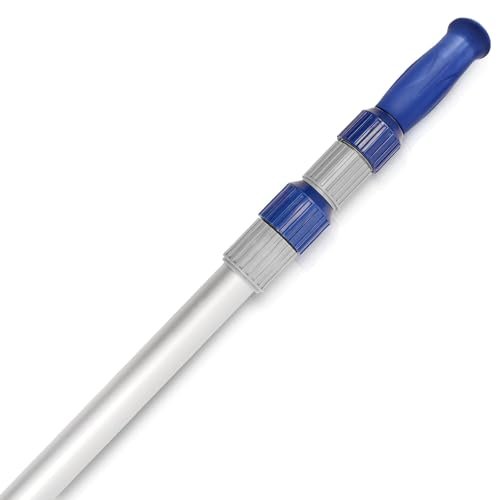 Poolvio 15 ft Telescopic Pool Pole (3-Piece Aluminum)
Telescoping pole that fits brushes, skimmer nets, and vacuum heads. View on Amazon →
Poolvio 15 ft Telescopic Pool Pole (3-Piece Aluminum)
Telescoping pole that fits brushes, skimmer nets, and vacuum heads. View on Amazon →
 Taylor K-2006C Complete FAS-DPD Pool & Spa Test Kit
The FAS-DPD kit pool pros trust — reads chlorine accurately even at shock/SLAM levels, plus pH, alkalinity, calcium hardness and CYA. View on Amazon →
Taylor K-2006C Complete FAS-DPD Pool & Spa Test Kit
The FAS-DPD kit pool pros trust — reads chlorine accurately even at shock/SLAM levels, plus pH, alkalinity, calcium hardness and CYA. View on Amazon →
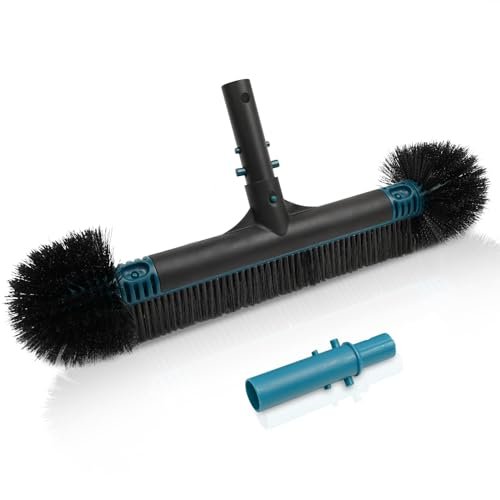 Poolvio 20" 2-in-1 Pool Brush Head (Walls & Floor)
Sturdy 20-inch brush head that clips onto any standard telescopic pole. View on Amazon →
Poolvio 20" 2-in-1 Pool Brush Head (Walls & Floor)
Sturdy 20-inch brush head that clips onto any standard telescopic pole. View on Amazon →
Still need help? Ask a Pool & Spa Expert AD
Get a personalized answer from PoolGuy810 — 30 years owning a pool and spa repair company. Describe your issue and get step-by-step help.
Need More Help?
Try our free pool calculators and tools to help diagnose and fix your pool problems.
Browse Pool ToolsSLAM calculator, pH calculator, salt dosing & more