

Can I Use Baking Soda for Pool Stabilizer? Chemistry Facts

Is baking soda the same thing as pool stabilizer?
Read full question
Planning to add some baking soda to my pool, but there's this sharp chemical tang in the air that makes my eyes water every time I get close. Someone at the pool store mentioned I might need stabilizer, but that stuff is expensive.
I've got a huge box of baking soda at home and I'm wondering - can I just use that instead of buying actual pool stabilizer? They're both white powders that go in the pool, so maybe they do the same thing? I'm really hoping there's a cheaper solution here because I've already spent a fortune this season and I'm getting desperate.
Quick Answer
No, baking soda cannot be used as pool stabilizer. Baking soda raises total alkalinity and pH, while pool stabilizer (cyanuric acid) protects chlorine from UV degradation. The correct method for adding cyanuric acid includes pre-dissolving it in a bucket of hot water or using the SOCK method, and adding 1 pound per 10,000 gallons to raise CYA by 13 ppm. Ideal CYA ranges are 30-50 ppm for regular pools and 70-80 ppm for salt water generator pools.
Understanding the Chemical Difference
This is a common misconception among pool owners, but baking soda and pool stabilizer work on entirely different aspects of water chemistry:
What Baking Soda Does
- Raises total alkalinity (TATotal Alkalinity — The buffer that keeps your pH from bouncing around. Get this in range and pH gets a lot easier to manage. learn more →)
- Increases pH
- Acts as a pH buffer to prevent rapid pH swings
- Chemical formula: NaHCO₃ (sodium bicarbonate)
What Pool Stabilizer Does
- Protects free chlorine from UV degradation
- Allows chlorine to last longer in sunlight
- Creates a chlorine reservoir in your pool
- Chemical formula: C₃H₃N₃O₃ (cyanuric acid)
Why You Need Actual Stabilizer
Without proper cyanuric acid levels, your pool will experience rapid chlorine loss. In direct sunlight, unstabilized chlorine can dissipate by 90% within two hours. This means you'll be constantly adding chlorine and fighting algae growth.
The ideal cyanuric acid range is:
- Regular chlorine pools: 30-50 ppm
- Salt water generator pools: 70-80 ppm
How to Properly Add Pool Stabilizer
Here's the correct method for adding cyanuric acid to your pool:
- Test current CYACyanuric Acid (stabilizer) — Sunscreen for your chlorine — it keeps sunlight from burning it off. The catch: the more you have, the more chlorine you need to keep. learn more → levels using a Taylor K-2006 test kit or reliable test strips
- Starting dose: About 1 pound of cyanuric acid per 10,000 gallons raises CYA by approximately 13 ppm - size it for your pool with the calculator
- Pre-dissolve the stabilizer in a bucket of hot water (it dissolves slowly and won't fully dissolve - pour it all in) or use the SOCK method (put the CYA in a sock/nylon in the skimmer basket, or hang it in front of a return, squeezing occasionally)
- Run circulation system for 24-48 hours to fully dissolve
- Retest after 48 hours to confirm proper levels
When to Use Baking Soda in Pool Maintenance
While baking soda can't replace stabilizer, it does have important uses in pool chemistry:
Raising Total Alkalinity
Use baking soda when your TA falls below the ideal range:
- Regular pools: 80-120 ppm
- Salt water pools: 60-80 ppm
Dosage: Add 1.4 pounds of baking soda per 10,000 gallons to raise TA by 10 ppm.
Emergency pH Adjustment
Baking soda can raise pH when it drops below 7.2, though soda ash (sodium carbonate) is more effective for pH-only adjustments.
Common Stabilizer Mistakes to Avoid
Over-stabilization can only be undone by dilution. Unlike other chemicals, you cannot easily remove cyanuric acid from pool water. If CYA exceeds 100 ppm, you'll need to partially drain and refill your pool.
- Don't use stabilized chlorine products (trichlor, dichlor) continuously - they add CYA with each dose
- Never add stabilizer during the SLAMShock Level And Maintain — raise free chlorine to a target based on your CYA and hold it there until the algae is gone. It's a process, not a one-time dose. the SLAM walkthrough → process - wait until your pool is clear
- Test CYA levels monthly during pool season
The Right Products for Each Job
Keep these distinct chemicals in your pool maintenance arsenal:
For Stabilization
- Cyanuric acid (granular)
- Liquid stabilizer (faster dissolving)
For Alkalinity/pH
- Baking soda (sodium bicarbonate) - raises TA primarily
- Soda ash (sodium carbonate) - raises pH primarily
Testing and Monitoring
Proper pool chemistry requires regular testing of all parameters. Use a reliable test kit like the Taylor K-2006 or K-2005 to monitor:
- Free chlorine (FCFree Chlorine — The chlorine actively sanitizing your water right now. This is the number you keep an eye on. how much you need →)
- Combined chlorine (CCCombined Chlorine — "Used-up" chlorine left over from doing its job. Above about 0.5 ppm is the classic sign water needs a shock. learn more →)
- pH levels
- Total alkalinity (TA)
- Cyanuric acid (CYA)
- Calcium hardness (CH)
Remember that CYA affects your required chlorine levels. Use the FC/CYAFC/CYA chart — The chart that sets your chlorine target from your stabilizer (CYA) level — the two go together. see the chart → relationship — our all-in-one pool calculator estimates the free chlorine target for your CYA.
Safety note: Always add chemicals to water, never water to chemicals, and store all pool chemicals in a cool, dry place away from children and pets.
For the full breakdown of safe chlorine levels by CYA level, see our pool water chemistry guide.
 Taylor K-2006C Complete FAS-DPD Pool & Spa Test Kit
The FAS-DPD kit pool pros trust — reads chlorine accurately even at shock/SLAM levels, plus pH, alkalinity, calcium hardness and CYA. View on Amazon →
Taylor K-2006C Complete FAS-DPD Pool & Spa Test Kit
The FAS-DPD kit pool pros trust — reads chlorine accurately even at shock/SLAM levels, plus pH, alkalinity, calcium hardness and CYA. View on Amazon →
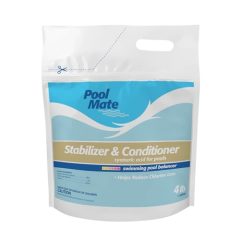 Pool Mate 4-Pounds Premium Pool Stabilizer and Conditioner, Concentrated Cyanuric Acid for Pools, Helps Chlorine Last Longer
View on Amazon →
Pool Mate 4-Pounds Premium Pool Stabilizer and Conditioner, Concentrated Cyanuric Acid for Pools, Helps Chlorine Last Longer
View on Amazon →
Still need help? Ask a Pool & Spa Expert AD
Get a personalized answer from PoolGuy810 — 30 years owning a pool and spa repair company. Describe your issue and get step-by-step help.
Related Pool Guides
Need More Help?
Try our free pool calculators and tools to help diagnose and fix your pool problems.
Browse Pool ToolsSLAM calculator, pH calculator, salt dosing & more