
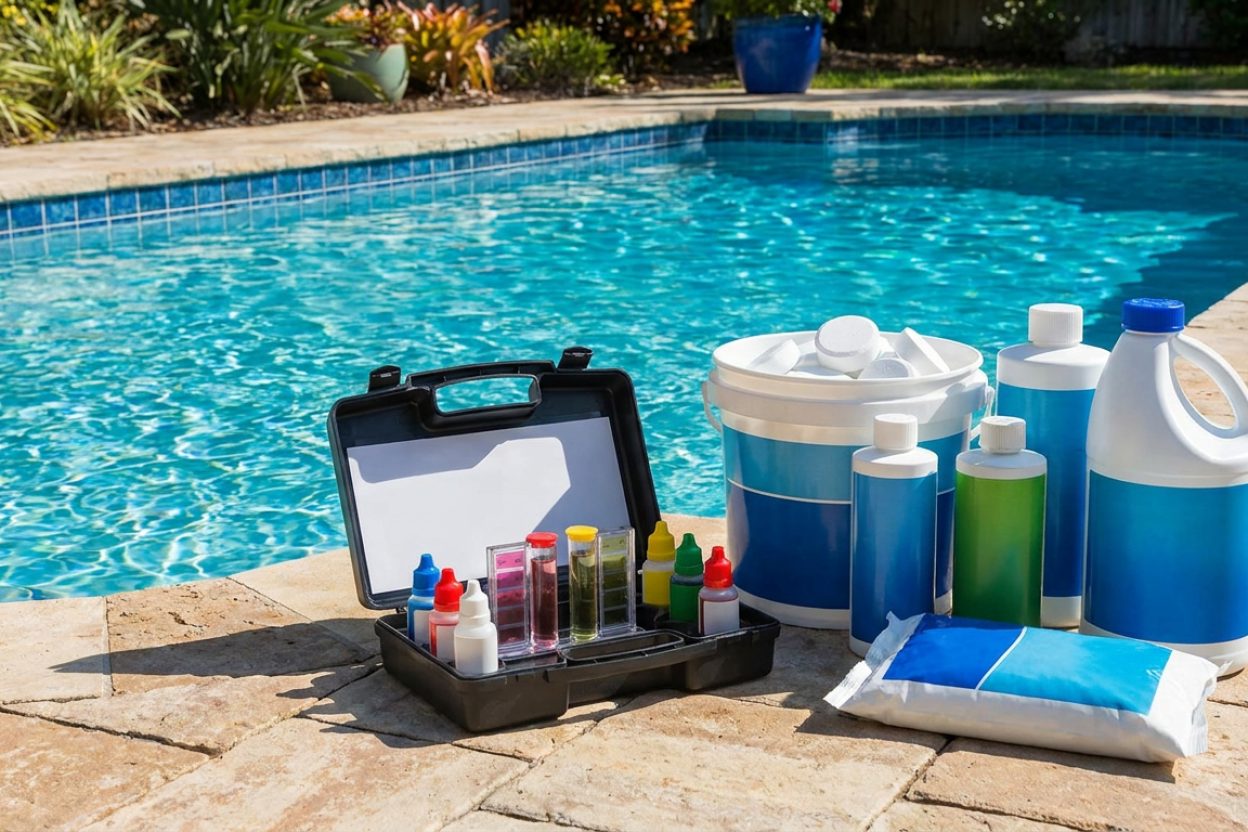
Can I Add Pool Chemicals at the Same Time? Safe Mixing Guide

New pool owner - can I add multiple chemicals at once?
Read full question
Spent all week prepping for Saturday's pool party and now I'm scrambling to balance the water but wondering if I can add multiple chemicals together to save time.
The pool store gave me a bunch of different chemicals but didn't really explain the timing. I want to make sure I'm not going to create some dangerous reaction or mess up my water chemistry. Should I be spacing these out somehow?
Quick Answer
The pool-chemical reactions that you should be worried about (chlorine gas, fire, nitrogen trichloride) only happen when chemicals meet concentrated — in a bucket, scoop or the same spot. A pool is thousands of gallons of dilution, so adding chemicals separately, in different areas with the pump running, is far more forgiving; you can even add acid and chlorine on the same visit. Though spacing additions out is good practice for distribution, safety and testing.
Quick Answer: It’s the Bucket, Not the Pool
Here’s the part most guides get wrong: the dangerous reactions you’ve heard about — chlorine gas, fire, nitrogen trichloride — happen when chemicals meet in concentrated form: in the same bucket, scoop or container, or poured directly onto each other. A pool is thousands of gallons of dilution, so adding chemicals separately to the water — in different areas, with the pump running — is far more forgiving. Plenty of experienced owners add, say, acid and liquid chlorine on the same visit (in different spots) with no trouble. The genuine rule is simple: never combine concentrated chemicals outside the pool. Spacing additions out is still good practice, but mostly for even distribution and accurate testing — not because the diluted pool will gas you.
Adding More Than One Thing on the Same Day
Because the pool dilutes everything so heavily, you have more latitude than the “one chemical at a time” rule suggests — as long as each goes in separately, in a different part of the pool, with the pump running:
- Liquid chlorine and salt — completely compatible in a saltwater pool
- Acid and chlorine on the same visit — fine if you add them in different areas, with the pump running, so they disperse before they ever meet — and if you'd rather wait, space them about 15-30 minutes apart; just never pour them into the same spot, bucket or skimmer
- Multiple liquid products of the same type — different brands of liquid chlorine are interchangeable
Even so, adding things one at a time gives you better distribution and lets you see each chemical’s effect on your test numbers.
Combinations to Never Mix in Concentrated Form
These reactions are real — but they happen when the chemicals meet concentrated: in a bucket, a shared scoop, a storage container, or poured straight onto one another. Keep them apart outside the pool and you avoid every one of them. Added separately to a large, circulating pool, the dilution prevents these reactions:
- Chlorine + Acid - Creates dangerous chlorine gas
- Different types of chlorine — don’t combine cal-hypo and liquid chlorine in the same container or scoop (added to the pool separately they’re fine — many owners pour one after the other)
- Chlorine + Algaecide - High chlorine degrades most algaecides (polyquat/quat), wasting them — add algaecide once chlorine has come back to normal levels
- Shock + Clarifier - High chlorine levels can break down clarifiers
- Different dry chemicals in one container or scoop — can react, smoke, or even catch fire
- Trichlor tablets + Cal-hypo shock - The genuinely dangerous one: mixing an oxidizer (cal-hypo) with organic chlorine (trichlor) can ignite or explode — never store or combine them
Proper Chemical Addition Sequence
Follow this order when adding multiple chemicals to your pool:
- Test your water first using a reliable test kit like the Taylor K-2006 to establish baseline readings
- Balance pH first - Add muriatic acid if pH is above 7.6, or soda ash (sodium carbonate) if pH is below 7.4. Don’t reach for baking soda (sodium bicarbonate) to raise a low pH — it raises total alkalinity, not pH
- Give it ~30 minutes to circulate with the pump running — for even mixing and a reliable retest, not a safety delay
- Adjust total alkalinity if needed using sodium bicarbonate or muriatic acid
- Let it circulate ~30 minutes before retesting and proceeding
- Add chlorine products - Whether liquid chlorine, cal-hypo, or dichlor
- Wait at least 4-8 hours before adding specialty chemicals like algaecide, clarifier, or metal sequestrants
- Add calcium hardness increaser if needed, as it can cloud water temporarily and may require pH rebalancing afterward
Timing Between Chemical Additions
Treat these as sane defaults for even distribution and reliable test readings — not safety countdowns. In a large, circulating pool the dilution already handles safety, so if you add each chemical in a different area with the pump running, the “wait” mostly happens on its own as you work your way around the pool:
- ~30 minutes - A good default between two different chemicals, for even mixing and accurate retesting (not a safety requirement in a diluted, circulating pool)
- 30 minutes - Between pH adjusters and chlorine (add them in different areas with the pump running; the pool’s dilution makes longer waits unnecessary, though spacing still helps even distribution and testing)
- 4-8 hours - Between sanitizers and specialty chemicals
- 24 hours - Between shock treatments and metal treatments
- No added wait for stabilizer (CYACyanuric Acid (stabilizer) — Sunscreen for your chlorine — it keeps sunlight from burning it off. The catch: the more you have, the more chlorine you need to keep. learn more →) - keep chlorinating and balancing as normal while it dissolves; the only caveats are to avoid backwashing for ~24 hours so undissolved stabilizer isn’t flushed out, and to wait 24–48 hours before retesting CYA for an accurate reading
Why This Spacing Helps
This isn’t about preventing a dangerous reaction in the pool — the dilution takes care of that. Spacing additions out simply avoids these practical headaches:
- Chemical reactions that can neutralize effectiveness
- Precipitation that clouds your water or clogs filters
- Localized high concentrations that can bleach pool surfaces
- Inaccurate test results from interfering compounds
Application Best Practices
When adding chemicals individually:
- Wear safety equipment (goggles and gloves) when handling chemicals
- Always add chemicals to water, never water to chemicals
- Pour slowly around the pool perimeter with the pump running
- Use a clean measuring cup for each different chemical
- Pre-dissolve granular chemicals in a bucket of pool water when possible
- Brush the pool after adding chemicals to prevent settling
- Keep detailed records of what you added and when
Emergency Situations
The only time you might consider faster chemical addition is during a SLAMShock Level And Maintain — raise free chlorine to a target based on your CYA and hold it there until the algae is gone. It's a process, not a one-time dose. the SLAM walkthrough → (Shock Level And Maintain) process for green pools. Even then, set pH to about 7.2 before you start, then leave it alone — at SLAM-level chlorine the pH test reads artificially high, so chasing a 7.8 reading just sends you after a false number. Never rush the process with algaecides or clarifiers during SLAM.
Testing After Chemical Addition
Wait appropriate times before retesting:
- 30 minutes - After pH or alkalinity adjustments
- 2 hours - After chlorine additions
- 4 hours - After calcium hardness additions
- 24 hours - After stabilizer additions for accurate readings
Following these guidelines keeps your pool water balanced safely and effectively while protecting both swimmers and equipment.
 Taylor K-2006C Complete FAS-DPD Pool & Spa Test Kit
The FAS-DPD kit pool pros trust — reads chlorine accurately even at shock/SLAM levels, plus pH, alkalinity, calcium hardness and CYA. View on Amazon →
Taylor K-2006C Complete FAS-DPD Pool & Spa Test Kit
The FAS-DPD kit pool pros trust — reads chlorine accurately even at shock/SLAM levels, plus pH, alkalinity, calcium hardness and CYA. View on Amazon →
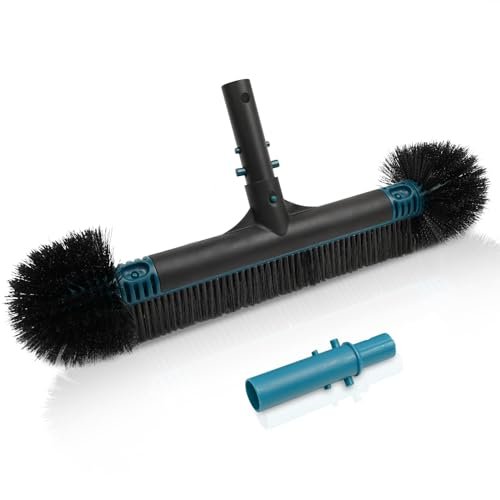 Poolvio 20" 2-in-1 Pool Brush Head (Walls & Floor)
Sturdy 20-inch brush head that clips onto any standard telescopic pole. View on Amazon →
Poolvio 20" 2-in-1 Pool Brush Head (Walls & Floor)
Sturdy 20-inch brush head that clips onto any standard telescopic pole. View on Amazon →
Still need help? Ask a Pool & Spa Expert AD
Get a personalized answer from PoolGuy810 — 30 years owning a pool and spa repair company. Describe your issue and get step-by-step help.
Related Pool Guides
Need More Help?
Try our free pool calculators and tools to help diagnose and fix your pool problems.
Browse Pool ToolsSLAM calculator, pH calculator, salt dosing & more