

Above Ground Pool Problems: Complete Troubleshooting Guide

What's wrong with my above ground pool? Need DIY troubleshooting
Read full question
Our above ground pool faces the exact same maddening issues every single spring, and we're tired of getting ripped off by overpriced pool store "solutions. Between overpriced chemicals and costly service calls, I'm looking to become more self-sufficient with pool maintenance.
My pool seems to have different issues throughout the season - sometimes the water looks off, other times the pump isn't working right, and occasionally I notice problems with the liner or walls. Rather than guessing or getting upsold every time, I'd love a systematic way to figure out what's actually wrong so I can tackle these problems myself and save some money.
Quick Answer
First, diagnose your above ground pool issue by checking water chemistry, equipment function, and structural integrity. Most problems fall into water quality, circulation system, or liner/wall issues. For water chemistry, test for FC, CC, pH, TA, CH, and CYA. Use the SLAM method to address green or cloudy water. For equipment, check the pump, skimmer basket, and filter media. For structural issues, inspect the liner and walls.
First, Let's Diagnose Your Above Ground Pool Issue
What if that frustrating above ground pool problem keeping you out of the water has a simple 5-minute fix you haven't tried yet? Since your question covers general above ground pool concerns, I'll walk you through a systematic approach to identify and resolve the most common issues pool owners face.
Start by categorizing your problem into one of three main areas: water chemistry and clarity issues, equipment and circulation problems, or structural and liner concerns. Each category requires different diagnostic steps and solutions.
Water Chemistry and Clarity Problems
Cloudy or Green Water Diagnosis
Begin with a comprehensive water test using a reliable test kit like the Taylor K-2006C. Test for Free Chlorine (FCFree Chlorine — The chlorine actively sanitizing your water right now. This is the number you keep an eye on. how much you need →), Combined Chlorine (CCCombined Chlorine — "Used-up" chlorine left over from doing its job. Above about 0.5 ppm is the classic sign water needs a shock. learn more →), pH, Total Alkalinity (TATotal Alkalinity — The buffer that keeps your pH from bouncing around. Get this in range and pH gets a lot easier to manage. learn more →), Calcium Hardness (CH), and Cyanuric Acid (CYACyanuric Acid (stabilizer) — Sunscreen for your chlorine — it keeps sunlight from burning it off. The catch: the more you have, the more chlorine you need to keep. learn more →). Record all readings before taking action.
If your pool is green or cloudy, you're likely dealing with algae or bacterial contamination. The solution is the SLAMShock Level And Maintain — raise free chlorine to a target based on your CYA and hold it there until the algae is gone. It's a process, not a one-time dose. the SLAM walkthrough → method (Shock Level And Maintain). Calculate your shock (SLAM) level from your CYA reading using the FC/CYAFC/CYA chart — The chart that sets your chlorine target from your stabilizer (CYA) level — the two go together. see the chart → chart - SLAM FC runs roughly 40% of your CYA: for CYA 30-40ppm, hold FC around 12-16ppm; for 50-60ppm CYA, around 20-24ppm FC. These are temporary SLAM levels, not your normal day-to-day target of about 4-7ppm.
Chemical Balance Solutions
- Address pH first: Adjust pH to 7.4-7.6 range before shocking. Use muriatic acid to lower pH (amount varies based on starting pH, alkalinity, and acid concentration - see manufacturer specs) or sodium carbonate to raise it.
- Execute SLAM process: Add liquid chlorine (sodium hypochlorite) to reach shock level.
To get an estimate of chlorine for your pool size and current levels, our all-in-one pool calculator estimates the amount, based on your pool size and current vs. target levels.
- Maintain shock level: Test FC every 2-4 hours, adding more liquid chlorine as needed. Continue until you pass the Overnight Chlorine Loss Test (OCLT) - FC at shock level drops less than 1ppm overnight, combined chlorine (CC) is 0.5 ppm or less, and the water is clear.
- Brush and vacuum: Brush pool walls and floor twice daily during SLAM. Vacuum debris to waste if possible, or use your regular filter system.
Equipment and Circulation Issues
Pump and Filter Diagnosis
Above ground pools typically use smaller pumps and cartridge or sand filters that require frequent maintenance. If water isn't circulating properly, check these components systematically.
Pump problems: Listen for unusual noises, check for leaks around the pump housing, and verify the pump is priming properly. Above ground pumps are often self-priming but may lose prime due to air leaks in suction lines.
Circulation System Solutions
- Prime the pump: Turn off power, remove pump lid, fill pump basket and housing with water, replace lid with new O-ring if needed, then restart pump.
- Check skimmer basket: Clean skimmer basket weekly or more frequently during heavy use. A clogged basket reduces water flow significantly.
- Service filter media: For cartridge filters, rinse weekly and deep clean monthly with filter cleaner. Replace cartridge elements every 2-5 years, or sooner if pleats show wear. For sand filters, backwash when pressure gauge reads 8-10 psi above clean pressure.
- Inspect hoses and connections: Above ground pools use flexible hoses that can develop cracks or loose clamps. Tighten all connections and replace damaged hoses immediately.
Structural and Liner Problems
Liner and Wall Diagnosis
Above ground pool liners are vulnerable to damage from chemical imbalance, sharp objects, and UV exposure. Inspect your liner regularly for signs of stretching, fading, or small tears that can quickly become major problems.
Warning signs include: Water level dropping faster than normal evaporation (varies by climate, typically 1/8 to 1/4 inch per day in hot, dry conditions), soft spots in liner, wrinkles that weren't present initially, or visible tears and punctures.
Structural Solutions
- Address minor liner issues: Small tears can be patched using underwater vinyl repair kits. Clean area thoroughly, apply patch according to manufacturer's instructions, and avoid swimming for 24 hours.
- Prevent liner damage: Maintain proper water chemistry - pH between 7.4-7.6, and if you use calcium hypochlorite shock, pre-dissolve it first - undissolved granules settling on a vinyl liner can bleach it. Keep CYA levels between 30-50ppm to protect chlorine without over-stabilizing.
- Check wall integrity: Inspect metal walls for rust or corrosion, especially at ground level. Address rust spots immediately with appropriate primers and paints designed for pool walls.
- Maintain proper water level: Keep water level at the middle of the skimmer opening. Too low causes pump problems; too high reduces skimming efficiency.
Prevention and Maintenance Schedule
Above ground pools require consistent maintenance to prevent major issues. Test water chemistry twice weekly during swimming season, clean skimmer basket weekly, and brush walls bi-weekly minimum. Replace cartridge elements every 2-5 years, and consider upgrading to a larger filter system if you experience frequent clogging.
Seasonal considerations: Above ground pools are more susceptible to temperature fluctuations and UV damage. Use a quality pool cover when not in use, and consider adding a stabilizer (cyanuric acid) if using liquid chlorine to reach the 30-50 ppm range. Pre-dissolve the CYA in a bucket of hot water and pour it in slowly, or use the SOCK method (place the CYA in a sock or nylon in the skimmer basket, or hang it in front of a return, squeezing occasionally). CYA dissolves slowly, so retest after a few days to a week and do not add more until you are sure the levels are correct.
Monitor your pool's unique characteristics and adjust maintenance accordingly. Above ground pools heat up faster but also lose heat quickly, affecting chemical consumption and algae growth patterns.
For the full breakdown of safe chlorine levels by CYA level, see our pool water chemistry guide.
 Taylor K-2006C Complete FAS-DPD Pool & Spa Test Kit
The FAS-DPD kit pool pros trust — reads chlorine accurately even at shock/SLAM levels, plus pH, alkalinity, calcium hardness and CYA. View on Amazon →
Taylor K-2006C Complete FAS-DPD Pool & Spa Test Kit
The FAS-DPD kit pool pros trust — reads chlorine accurately even at shock/SLAM levels, plus pH, alkalinity, calcium hardness and CYA. View on Amazon →
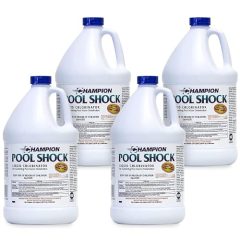 Liquid Chlorine / Sodium Hypochlorite (12.5%)
Everyday sanitizer — the B in BBB View on Amazon →
Liquid Chlorine / Sodium Hypochlorite (12.5%)
Everyday sanitizer — the B in BBB View on Amazon →
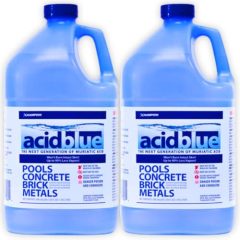 Acid Blue - Low Fume Muriatic Acid for Swimming Pools & Spas - Lower's pH, Reduces Alkalinity - 2 Gallon
View on Amazon →
Acid Blue - Low Fume Muriatic Acid for Swimming Pools & Spas - Lower's pH, Reduces Alkalinity - 2 Gallon
View on Amazon →
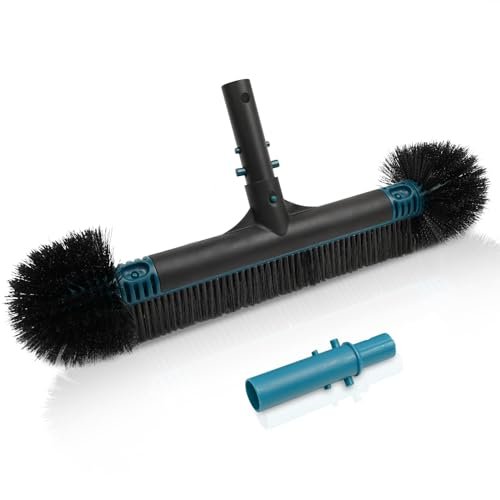 Poolvio 20" 2-in-1 Pool Brush Head (Walls & Floor)
Sturdy 20-inch brush head that clips onto any standard telescopic pole. View on Amazon →
Poolvio 20" 2-in-1 Pool Brush Head (Walls & Floor)
Sturdy 20-inch brush head that clips onto any standard telescopic pole. View on Amazon →
Still need help? Ask a Pool & Spa Expert AD
Get a personalized answer from PoolGuy810 — 30 years owning a pool and spa repair company. Describe your issue and get step-by-step help.
Related Pool Guides
Need More Help?
Try our free pool calculators and tools to help diagnose and fix your pool problems.
Browse Pool ToolsSLAM calculator, pH calculator, salt dosing & more