
Are Borates Actually Worth Adding to My Pool?

Are Borates Actually Worth Adding to My Pool?
Read full question
Nobody at the pool store seems to give me a straight answer about borates — they either push every product on the shelf or just shrug. My water has this slightly harsh, almost sharp smell to it after I shock, and I keep reading that borates can help with that kind of thing. But I honestly don't understand what they actually do chemically, or whether they're going to create more work for me than they're worth. Is this one of those optional 'nice to have' additions, or am I missing something that would genuinely make a difference in how the water feels and behaves?
Quick Answer
Borates (held around 30-50 ppm) act as a mild pH buffer, make water feel silkier, and lightly inhibit algae - they don't replace chlorine. They reduce how fast pH drifts up (handy for saltwater pools), so you adjust less often — though each acid dose is larger and total acid use stays about the same. Add via boric acid (cheapest, slightly lowers pH) or a pre-made pH-neutral product. They persist until diluted; keep pets from drinking borated water and keep it off garden beds.
What Borates Actually Do (The Short Version)
Borates — typically maintained at around 30–50 ppm in pool water — act as a mild pH buffer, a water-feel enhancer, and a low-level algae inhibitor. They won't replace your sanitizer or your regular chemistry work, but they do make that work a bit easier. That sharp, almost chemical smell after shocking is primarily caused by chloramines — combined chlorine compounds that form when free chlorine reacts with nitrogen-containing compounds like sweat and body care products. While pH doesn't directly cause chloramine formation, keeping pH stable helps your free chlorine stay more effective, which can reduce the conditions that allow chloramines to accumulate. Borates contribute indirectly by helping hold pH in the optimal range for chlorine efficiency.
Worth noting: borates are not a sanitizer. They don't replace chlorine. But because they help hold pH steadier, your chlorine stays more effective for longer — and that's a real, measurable benefit. For a full picture of how pH and chlorine interact, the pool water chemistry guide is worth reading before you add anything new to your water.
Your Three Main Approaches — Compared
Option 1: Skip Borates Entirely
What it looks like: You manage pH and chlorine through standard chemistry — no borates added. Perfectly valid, and millions of pools run this way without issue.
- Pros: Fewer chemicals to track, lower upfront cost, no initial dosing process required
- Cons: pH tends to drift upward more freely (especially with aeration, waterfalls, or SWGs), which means more frequent acid additions; slightly higher chlorine demand; water can feel harsher to sensitive skin and eyes
If your pool is already well-balanced and you're not fighting constant pH drift or irritated eyes, this option is perfectly fine. You're not missing anything critical — just a convenience layer.
Option 2: Add Borates with Boric Acid (The Precise Method)
What it looks like: You purchase pure boric acid powder (sold as a pool product or in bulk at some retailers) and dose your pool to reach a target of around 30–50 ppm. Because boric acid is mildly acidic, it can lower pH as you add it — the extent depends on your starting pH and dose size. You may need to raise pH afterward using soda ash (sodium carbonate) — note this is different from sodium bicarbonate (baking soda / alkalinity increaser), which is not the right tool here.
- Pros: Most cost-effective per pound, especially for larger pools; clean and predictable chemistry; widely used in the TFP (Trouble Free Pool) community
- Cons: Requires more careful dosing and pH management during the initial addition; boric acid can be harder to find locally (though readily available online); needs a good test kit to verify your boron level
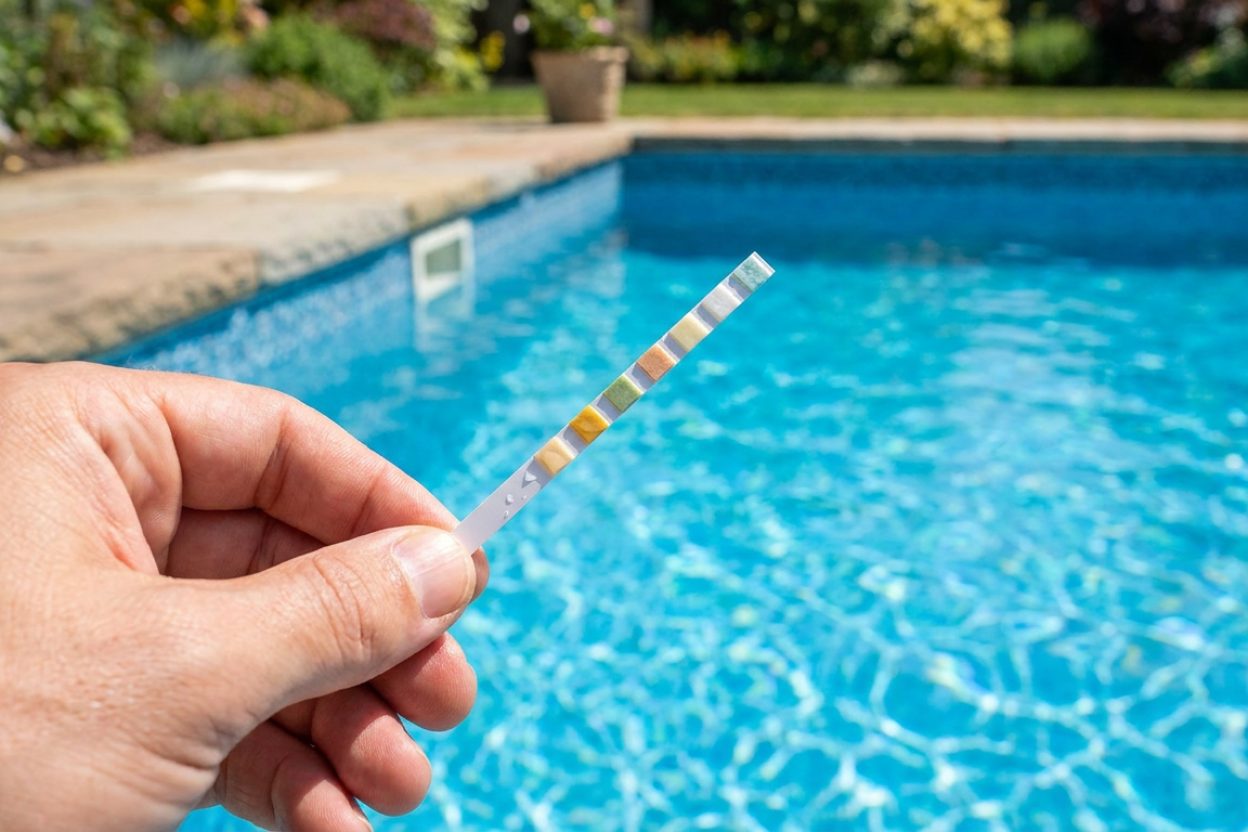
To verify your level, use a dedicated borate test strip — borates are the one parameter where strips are the standard tool. There isn't a common reagent (drop-based) borate test for home use; even popular reagent kits like the Taylor K-2006 don't measure boron. A borate strip such as the AquaChek Borate test strips reads 0–80 ppm, which comfortably covers the 30–50 ppm target — dip, wait about 15 seconds, and match the pad to the color chart.
Option 3: Use a Pre-Made Borate Product (The Simpler Path)
What it looks like: Products like ProTeam Supreme Plus, BioGuard Optimizer Plus, or similar borate-based pool treatments are premixed and often pH-neutral, making the addition process more forgiving. You follow the product's label directions for your pool volume.
- Pros: Easier to add without causing pH disruption; no chemistry calculations required; good for pool owners who want simplicity over precision
- Cons: Significantly more expensive per dose than raw boric acid; you're paying for convenience; you'll still want a test kit to verify final borate levels
If you're newer to pool chemistry or just want to try borates without a learning curve, this is a reasonable starting point.
The Real-World Difference You'll Notice
Many pool owners report that after adding borates, water takes on a noticeably silkier feel — softer on skin and eyes, less of that harsh edge. The pH also tends to stay put longer between adjustments, which is especially noticeable for saltwater pool owners (SWGs naturally drive pH upward). And while borates alone won't stop an algae bloom, they do create an environment where algae struggles to take hold, acting as a mild secondary line of defense alongside your chlorine.
That said, if your current chlorine levels are properly calibrated to your CYACyanuric Acid (stabilizer) — Sunscreen for your chlorine — it keeps sunlight from burning it off. The catch: the more you have, the more chlorine you need to keep. learn more → level and your pH is staying in range without much effort, you might not notice a dramatic transformation. Borates are a refinement, not a rescue.
One Caution: Pets and Plants
Borates come from boric acid, which is mildly toxic if swallowed in quantity. At 30–50 ppm the water is perfectly fine for swimming, but don’t let dogs or other pets habitually drink from a borated pool, and avoid using borated backwash or splash-out water on garden beds — boron is great for your pool but is harsh on many plants. It’s a small, manageable trade-off, just one worth knowing before you commit.
What You'll Need to Get Started
- A reliable pool volume estimate — use the pool volume calculator if you're not sure
- Boric acid powder (for the DIY method) or a commercial borate product
- Borate test strips — the standard way to check boron at home (there's no common reagent borate test; kits like the Taylor K-2006 don't measure it). The AquaChek Borate test strips are the usual choice.
- pH test and pH adjuster — boric acid additions may require pH correction afterward
- A pool brush to help the product dissolve and circulate
The Bottom Line: Is It Worth It?
For most pool owners, borates are a worthwhile addition that pays for itself in reduced pH adjustment frequency and a noticeably better swim experience. If the sharp post-shock smell is bothering you, the real fix is maintaining adequate free chlorine for your CYA (and shocking to break down chloramines); borates only help indirectly by keeping pH stable so your chlorine stays effective. The boric acid method offers the best value; the premixed product approach offers the most convenience. Borates persist well and don't get consumed the way chlorine does, but water lost to splash-out, backwashing, or rain dilution will gradually reduce borate levels. It's worth testing borate concentration once or twice a season — and after any significant water replacement — to confirm levels are still in range.
Still need help? Ask a Pool & Spa Expert AD
Get a personalized answer from PoolGuy810 — 30 years owning a pool and spa repair company. Describe your issue and get step-by-step help.
Related Pool Guides
Need More Help?
Try our free pool calculators and tools to help diagnose and fix your pool problems.
Browse Pool ToolsSLAM calculator, pH calculator, salt dosing & more